

1905 Ogden Ave rezoning application
This application was approved by Council on July 28, 2026, following the Public Hearing on July 21, 2026.
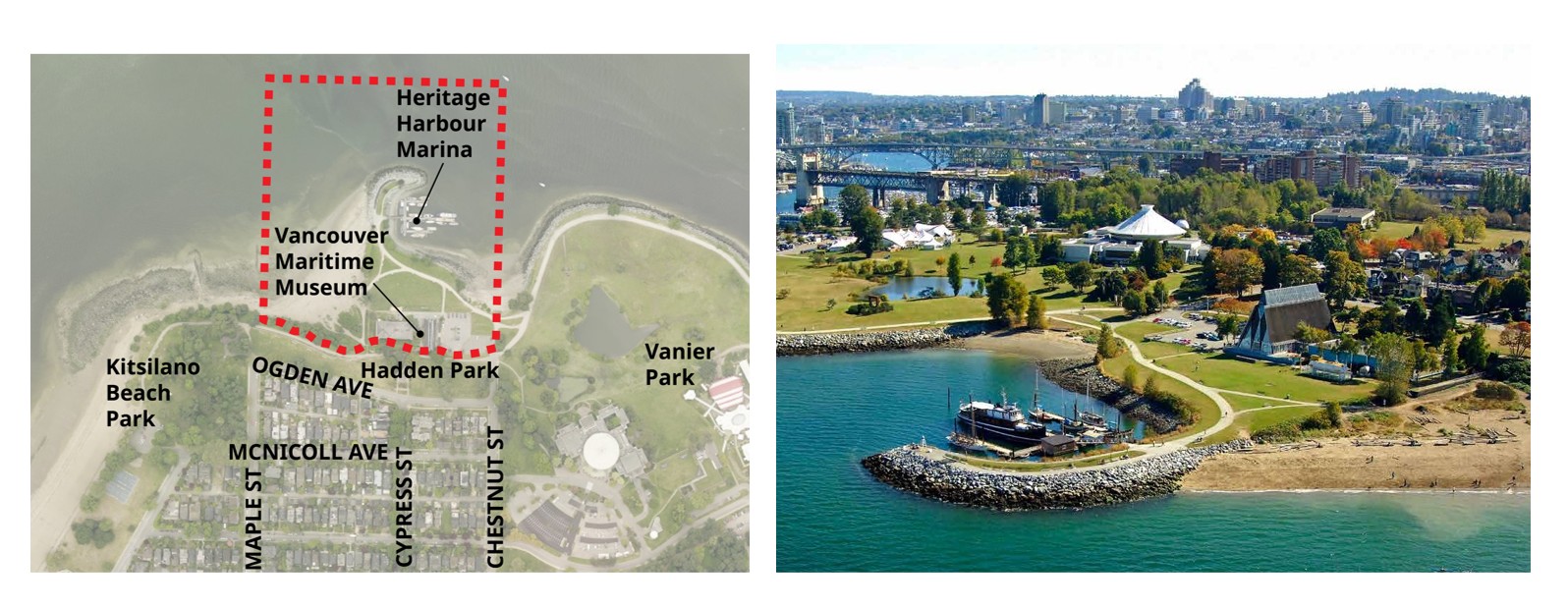
Revised Site Plan (April 2, 2026)
The proponent has provided an updated rezoning booklet. The updated booklet corrects the site plan on page 17 to reflect the proper size of the floating barge. The revised rezoning booklet can be viewed from the link on this webpage.
Original Application (January 16, 2026)
This is a City-initiated application to rezone the subject site from R1-1 (Residential) District to CD-1 (Comprehensive Development) District. This rezoning is to maintain museum and park use, and to add a beauty and wellness centre use.
This rezoning is initiated at the request of the Vancouver Maritime Museum to support its long-term viability.
The beauty and wellness centre use is proposed to take the form of a floating barge with hydrotherapy activities, located at the Heritage Harbour Marina, and includes:
• A floor area of 1,274.5 sq. m (13,719 sq. ft.) over three levels
• A structure height of 10.4 m (34 ft.) above the water line
Application drawings and materials are posted on this Shape Your City Page.
Revised Site Plan (April 2, 2026)
The proponent has provided an updated rezoning booklet. The updated booklet corrects the site plan on page 17 to reflect the proper size of the floating barge. The revised rezoning booklet can be viewed from the link on this webpage.
Original Application (January 16, 2026)
This is a City-initiated application to rezone the subject site from R1-1 (Residential) District to CD-1 (Comprehensive Development) District. This rezoning is to maintain museum and park use, and to add a beauty and wellness centre use.
This rezoning is initiated at the request of the Vancouver Maritime Museum to support its long-term viability.
The beauty and wellness centre use is proposed to take the form of a floating barge with hydrotherapy activities, located at the Heritage Harbour Marina, and includes:
• A floor area of 1,274.5 sq. m (13,719 sq. ft.) over three levels
• A structure height of 10.4 m (34 ft.) above the water line
Application drawings and materials are posted on this Shape Your City Page.
This application was approved by Council on July 28, 2026, following the Public Hearing on July 21, 2026.
The opportunity to ask questions through the Q&A is available from March 4 to March 24, 2026.
We post all questions as-is and aim to respond within two business days. Some questions may require coordination with internal departments and additional time may be needed to post a response.
Please note that the comment form will remain open after the Q&A period. The Rezoning Planner can also be contacted directly for any further feedback or questions.
-
Share This is a question about the Contradiction Between City Funding Cuts and "Maintained" Grants The Motion claims the city is still supporting arts grants, yet the 2026 budget cut them by 12%. Why use a private luxury spa to fix a problem the city itself created? Kirby-Yung’s Motion claims "Vancouver has committed to maintaining its grant funding support for the arts" amid "challenging economic times" (WHEREAS 2), while highlighting the Vancouver Maritime Museum's 2024 operating deficit and 2025 projections (WHEREAS 3) as justification for HAVN's revenue. Yet the City's 2026 budget—passed November 2025 under ABC leadership—cut arts, culture, and community services by 12% ($6 million savings) to achieve zero property-tax increase. This creates an inherent contradiction: the City reduces direct support, then directs staff to fast-track a private commercial barge as a workaround. Why did the Museum not advocate for restored municipal funding or explore non-privatizing solutions before partnering with HAVN? This offloading risks turning a public heritage asset into a revenue crutch, undermining the Museum's core mandate and setting precedent for defunding cultural institutions while outsourcing fixes. An illustrative precedent: Vancouver Art Gallery cuts (2025–2026). Amid similar budget squeezes, VAG faced deep staff/program reductions without private partnerships; critics argued it eroded accessibility. Like VAG, Maritime Museum's deficits stem partly from City policy—the Motion's "maintained grants" claim ignores this, letting the museum pursue HAVN without addressing root causes. Past councils learned from VAG backlash that funding hypocrisy fuels opposition and weakens legitimacy of the application. This also mirrors what senior staff did at the Vancouver Aquatic Centre, where they slashed the competition pool to avoid “even a dollar over budget” without telling the public or Park Board until it was too late (CBC, March 5, 2026). on Facebook Share This is a question about the Contradiction Between City Funding Cuts and "Maintained" Grants The Motion claims the city is still supporting arts grants, yet the 2026 budget cut them by 12%. Why use a private luxury spa to fix a problem the city itself created? Kirby-Yung’s Motion claims "Vancouver has committed to maintaining its grant funding support for the arts" amid "challenging economic times" (WHEREAS 2), while highlighting the Vancouver Maritime Museum's 2024 operating deficit and 2025 projections (WHEREAS 3) as justification for HAVN's revenue. Yet the City's 2026 budget—passed November 2025 under ABC leadership—cut arts, culture, and community services by 12% ($6 million savings) to achieve zero property-tax increase. This creates an inherent contradiction: the City reduces direct support, then directs staff to fast-track a private commercial barge as a workaround. Why did the Museum not advocate for restored municipal funding or explore non-privatizing solutions before partnering with HAVN? This offloading risks turning a public heritage asset into a revenue crutch, undermining the Museum's core mandate and setting precedent for defunding cultural institutions while outsourcing fixes. An illustrative precedent: Vancouver Art Gallery cuts (2025–2026). Amid similar budget squeezes, VAG faced deep staff/program reductions without private partnerships; critics argued it eroded accessibility. Like VAG, Maritime Museum's deficits stem partly from City policy—the Motion's "maintained grants" claim ignores this, letting the museum pursue HAVN without addressing root causes. Past councils learned from VAG backlash that funding hypocrisy fuels opposition and weakens legitimacy of the application. This also mirrors what senior staff did at the Vancouver Aquatic Centre, where they slashed the competition pool to avoid “even a dollar over budget” without telling the public or Park Board until it was too late (CBC, March 5, 2026). on X (formerly Twitter) Share This is a question about the Contradiction Between City Funding Cuts and "Maintained" Grants The Motion claims the city is still supporting arts grants, yet the 2026 budget cut them by 12%. Why use a private luxury spa to fix a problem the city itself created? Kirby-Yung’s Motion claims "Vancouver has committed to maintaining its grant funding support for the arts" amid "challenging economic times" (WHEREAS 2), while highlighting the Vancouver Maritime Museum's 2024 operating deficit and 2025 projections (WHEREAS 3) as justification for HAVN's revenue. Yet the City's 2026 budget—passed November 2025 under ABC leadership—cut arts, culture, and community services by 12% ($6 million savings) to achieve zero property-tax increase. This creates an inherent contradiction: the City reduces direct support, then directs staff to fast-track a private commercial barge as a workaround. Why did the Museum not advocate for restored municipal funding or explore non-privatizing solutions before partnering with HAVN? This offloading risks turning a public heritage asset into a revenue crutch, undermining the Museum's core mandate and setting precedent for defunding cultural institutions while outsourcing fixes. An illustrative precedent: Vancouver Art Gallery cuts (2025–2026). Amid similar budget squeezes, VAG faced deep staff/program reductions without private partnerships; critics argued it eroded accessibility. Like VAG, Maritime Museum's deficits stem partly from City policy—the Motion's "maintained grants" claim ignores this, letting the museum pursue HAVN without addressing root causes. Past councils learned from VAG backlash that funding hypocrisy fuels opposition and weakens legitimacy of the application. This also mirrors what senior staff did at the Vancouver Aquatic Centre, where they slashed the competition pool to avoid “even a dollar over budget” without telling the public or Park Board until it was too late (CBC, March 5, 2026). on Linkedin Email This is a question about the Contradiction Between City Funding Cuts and "Maintained" Grants The Motion claims the city is still supporting arts grants, yet the 2026 budget cut them by 12%. Why use a private luxury spa to fix a problem the city itself created? Kirby-Yung’s Motion claims "Vancouver has committed to maintaining its grant funding support for the arts" amid "challenging economic times" (WHEREAS 2), while highlighting the Vancouver Maritime Museum's 2024 operating deficit and 2025 projections (WHEREAS 3) as justification for HAVN's revenue. Yet the City's 2026 budget—passed November 2025 under ABC leadership—cut arts, culture, and community services by 12% ($6 million savings) to achieve zero property-tax increase. This creates an inherent contradiction: the City reduces direct support, then directs staff to fast-track a private commercial barge as a workaround. Why did the Museum not advocate for restored municipal funding or explore non-privatizing solutions before partnering with HAVN? This offloading risks turning a public heritage asset into a revenue crutch, undermining the Museum's core mandate and setting precedent for defunding cultural institutions while outsourcing fixes. An illustrative precedent: Vancouver Art Gallery cuts (2025–2026). Amid similar budget squeezes, VAG faced deep staff/program reductions without private partnerships; critics argued it eroded accessibility. Like VAG, Maritime Museum's deficits stem partly from City policy—the Motion's "maintained grants" claim ignores this, letting the museum pursue HAVN without addressing root causes. Past councils learned from VAG backlash that funding hypocrisy fuels opposition and weakens legitimacy of the application. This also mirrors what senior staff did at the Vancouver Aquatic Centre, where they slashed the competition pool to avoid “even a dollar over budget” without telling the public or Park Board until it was too late (CBC, March 5, 2026). link
This is a question about the Contradiction Between City Funding Cuts and "Maintained" Grants The Motion claims the city is still supporting arts grants, yet the 2026 budget cut them by 12%. Why use a private luxury spa to fix a problem the city itself created? Kirby-Yung’s Motion claims "Vancouver has committed to maintaining its grant funding support for the arts" amid "challenging economic times" (WHEREAS 2), while highlighting the Vancouver Maritime Museum's 2024 operating deficit and 2025 projections (WHEREAS 3) as justification for HAVN's revenue. Yet the City's 2026 budget—passed November 2025 under ABC leadership—cut arts, culture, and community services by 12% ($6 million savings) to achieve zero property-tax increase. This creates an inherent contradiction: the City reduces direct support, then directs staff to fast-track a private commercial barge as a workaround. Why did the Museum not advocate for restored municipal funding or explore non-privatizing solutions before partnering with HAVN? This offloading risks turning a public heritage asset into a revenue crutch, undermining the Museum's core mandate and setting precedent for defunding cultural institutions while outsourcing fixes. An illustrative precedent: Vancouver Art Gallery cuts (2025–2026). Amid similar budget squeezes, VAG faced deep staff/program reductions without private partnerships; critics argued it eroded accessibility. Like VAG, Maritime Museum's deficits stem partly from City policy—the Motion's "maintained grants" claim ignores this, letting the museum pursue HAVN without addressing root causes. Past councils learned from VAG backlash that funding hypocrisy fuels opposition and weakens legitimacy of the application. This also mirrors what senior staff did at the Vancouver Aquatic Centre, where they slashed the competition pool to avoid “even a dollar over budget” without telling the public or Park Board until it was too late (CBC, March 5, 2026).
CharlesA asked 7 months agoLike many cultural non-profits across Canada, the Vancouver Maritime Museum (VMM) face rising costs (inflation, insurance, wages, etc.) while audiences and corporate sponsorships recover unevenly post-pandemic, and federal arts funding has seen reductions in recent budgets, putting sustained pressure on core operating dollars across the sector. The Council motion to achieve a zero percent property tax increase is resulting in 12% cuts to Arts, Culture, and Community Services in 2026, however the motion also protected the budget for community grants. In terms of City funding, the VMM has received consistent operating support through the Cultural Operating Funding Institutions (COFI) program: $400K annually since 2010, rising to $405K in 2025. 2026 grants will be recommended to Council on April 13, 2026. They have also been awarded ad-hoc project grants to support planning and infrastructure needs. While the City remains a key funder of the VMM, within this broader funding context, the City encourages non-profit tenants to explore creative partnerships that support both their sustainability and public service provision.
-
Share This is a question about HAVN’s other False Creek Rejections and Location Alternatives. HAVN has already been rejected in other sites in False Creek. Why was no open search done for more appropriate or less sensitive sites before forcing it into this tiny harbour? HAVN's prior proposal for False Creek (Plaza of Nations dock) was cancelled after failed negotiations and permit issues, leading to this shift to Heritage Harbour. The Motion seeks the 'simplest process' (THEREFORE) for HAVN specifically, yet no evidence shows exploration of larger, less-sensitive industrial sites or local operators. Why was no comparative location assessment or open RFP required before pursuing rezoning here—especially when the barge's nearly 5,000 square foot footprint risks dominating a delicate heritage marina, contradicting Vancouver Plan waterfront-vitality protections (Policy 8.2)? An illustrative precedent: Plaza of Nations HAVN permit denial (2025). Failed talks and community pushback killed the bid—site moved without alternatives: No comparative sites or RFP have been undertaken. on Facebook Share This is a question about HAVN’s other False Creek Rejections and Location Alternatives. HAVN has already been rejected in other sites in False Creek. Why was no open search done for more appropriate or less sensitive sites before forcing it into this tiny harbour? HAVN's prior proposal for False Creek (Plaza of Nations dock) was cancelled after failed negotiations and permit issues, leading to this shift to Heritage Harbour. The Motion seeks the 'simplest process' (THEREFORE) for HAVN specifically, yet no evidence shows exploration of larger, less-sensitive industrial sites or local operators. Why was no comparative location assessment or open RFP required before pursuing rezoning here—especially when the barge's nearly 5,000 square foot footprint risks dominating a delicate heritage marina, contradicting Vancouver Plan waterfront-vitality protections (Policy 8.2)? An illustrative precedent: Plaza of Nations HAVN permit denial (2025). Failed talks and community pushback killed the bid—site moved without alternatives: No comparative sites or RFP have been undertaken. on X (formerly Twitter) Share This is a question about HAVN’s other False Creek Rejections and Location Alternatives. HAVN has already been rejected in other sites in False Creek. Why was no open search done for more appropriate or less sensitive sites before forcing it into this tiny harbour? HAVN's prior proposal for False Creek (Plaza of Nations dock) was cancelled after failed negotiations and permit issues, leading to this shift to Heritage Harbour. The Motion seeks the 'simplest process' (THEREFORE) for HAVN specifically, yet no evidence shows exploration of larger, less-sensitive industrial sites or local operators. Why was no comparative location assessment or open RFP required before pursuing rezoning here—especially when the barge's nearly 5,000 square foot footprint risks dominating a delicate heritage marina, contradicting Vancouver Plan waterfront-vitality protections (Policy 8.2)? An illustrative precedent: Plaza of Nations HAVN permit denial (2025). Failed talks and community pushback killed the bid—site moved without alternatives: No comparative sites or RFP have been undertaken. on Linkedin Email This is a question about HAVN’s other False Creek Rejections and Location Alternatives. HAVN has already been rejected in other sites in False Creek. Why was no open search done for more appropriate or less sensitive sites before forcing it into this tiny harbour? HAVN's prior proposal for False Creek (Plaza of Nations dock) was cancelled after failed negotiations and permit issues, leading to this shift to Heritage Harbour. The Motion seeks the 'simplest process' (THEREFORE) for HAVN specifically, yet no evidence shows exploration of larger, less-sensitive industrial sites or local operators. Why was no comparative location assessment or open RFP required before pursuing rezoning here—especially when the barge's nearly 5,000 square foot footprint risks dominating a delicate heritage marina, contradicting Vancouver Plan waterfront-vitality protections (Policy 8.2)? An illustrative precedent: Plaza of Nations HAVN permit denial (2025). Failed talks and community pushback killed the bid—site moved without alternatives: No comparative sites or RFP have been undertaken. link
This is a question about HAVN’s other False Creek Rejections and Location Alternatives. HAVN has already been rejected in other sites in False Creek. Why was no open search done for more appropriate or less sensitive sites before forcing it into this tiny harbour? HAVN's prior proposal for False Creek (Plaza of Nations dock) was cancelled after failed negotiations and permit issues, leading to this shift to Heritage Harbour. The Motion seeks the 'simplest process' (THEREFORE) for HAVN specifically, yet no evidence shows exploration of larger, less-sensitive industrial sites or local operators. Why was no comparative location assessment or open RFP required before pursuing rezoning here—especially when the barge's nearly 5,000 square foot footprint risks dominating a delicate heritage marina, contradicting Vancouver Plan waterfront-vitality protections (Policy 8.2)? An illustrative precedent: Plaza of Nations HAVN permit denial (2025). Failed talks and community pushback killed the bid—site moved without alternatives: No comparative sites or RFP have been undertaken.
CharlesA asked 7 months agoThere is no requirement for the proponent to conduct a comparative site search or public RFP process. The Vancouver Maritime Museum has acted within its mandate to explore a partnership that supports its long-term sustainability and has determined that the proposal is compatible with the Harbour’s use. Previous discussions in other locations involved separate site-specific considerations and are not directly applicable to this proposal.
Vancouver’s public spaces, parks and beaches make the city a vibrant place to live. The park and museum uses will be maintained in the rezoning. The rezoning does not limit access to Hadden Park, the marina dock or adjacent beach areas.
The staff team is unclear what policies you are referring to, as Policy 8.2 within Vancouver Plan, now the Vancouver Official Development Plan (ODP) refers to Arts and Cultural Spaces. The Vancouver ODP contains policies to support the health of Vancouver’s ecosystems, including guidance on the protection, restoration and enhancement of the city’s natural areas. The Vancouver ODP policy FG1.4.6 Waterfront, specifically calls to “Enhance the use, enjoyment, and resilience of Vancouver’s public waterfront by ensuring that public spaces are resilient to coastal flooding and sea level rise.”
-
Share This is a question about Inappropriate Scale and Visual Impact. The harbour is a Vancouver treasure and hidden gem - it is tiny and intimate. This application proposes a 5000 sq ft steel wall that will dominate views from the beach, the museum, the sea wall, the parks and the ferries. Why are there no real photomontages or scale studies from public viewpoints? The Application Booklet’s site images and renderings (pp. 6, 18, 24) depict Heritage Harbour as an intimate, small-scale working marina with wooden heritage vessels and open water views—yet the proposal introduces a 150-foot steel barge measuring nearly 5,000 square feet in footprint. The R1-1 District Schedule imposes strict width limits of 17.4 metres for multiple dwellings (Section 3.1.2.10) and emphasizes retention of single-lot character. Why is no comparable scale restriction, bulk calculation, or independent visual-impact photomontage—from the public beach, False Creek Ferries, and Hadden Park—required to demonstrate that this massive floating structure won’t industrialize and dominate the 'hidden gem' waterfront character protected under Vancouver Plan waterfront policies? An illustrative precedent: 555 West Cordova rezoning opposition (2018–2020). The City approved a 28-storey tower at 555 West Cordova in Gastown—a heritage-sensitive waterfront edge—despite no independent photomontages or bulk calculations from key views like the Seawall. Residents sued under the Vancouver Charter, arguing it industrialized the "intimate" scale; council paused, scaled back, and added view-corridor studies after public outcry (Vancouver Sun, 2019). This also echoes the March 2026 Barclay Street hotel deferral: council sent back a 29-storey tower near Stanley Park because it was 'never envisioned' for that mid-block site—despite potential policy alignment. (Vancouver Sun, March 15). Where are the photomontages and scale studies that give the public the true rendering of the scale and visual impact? on Facebook Share This is a question about Inappropriate Scale and Visual Impact. The harbour is a Vancouver treasure and hidden gem - it is tiny and intimate. This application proposes a 5000 sq ft steel wall that will dominate views from the beach, the museum, the sea wall, the parks and the ferries. Why are there no real photomontages or scale studies from public viewpoints? The Application Booklet’s site images and renderings (pp. 6, 18, 24) depict Heritage Harbour as an intimate, small-scale working marina with wooden heritage vessels and open water views—yet the proposal introduces a 150-foot steel barge measuring nearly 5,000 square feet in footprint. The R1-1 District Schedule imposes strict width limits of 17.4 metres for multiple dwellings (Section 3.1.2.10) and emphasizes retention of single-lot character. Why is no comparable scale restriction, bulk calculation, or independent visual-impact photomontage—from the public beach, False Creek Ferries, and Hadden Park—required to demonstrate that this massive floating structure won’t industrialize and dominate the 'hidden gem' waterfront character protected under Vancouver Plan waterfront policies? An illustrative precedent: 555 West Cordova rezoning opposition (2018–2020). The City approved a 28-storey tower at 555 West Cordova in Gastown—a heritage-sensitive waterfront edge—despite no independent photomontages or bulk calculations from key views like the Seawall. Residents sued under the Vancouver Charter, arguing it industrialized the "intimate" scale; council paused, scaled back, and added view-corridor studies after public outcry (Vancouver Sun, 2019). This also echoes the March 2026 Barclay Street hotel deferral: council sent back a 29-storey tower near Stanley Park because it was 'never envisioned' for that mid-block site—despite potential policy alignment. (Vancouver Sun, March 15). Where are the photomontages and scale studies that give the public the true rendering of the scale and visual impact? on X (formerly Twitter) Share This is a question about Inappropriate Scale and Visual Impact. The harbour is a Vancouver treasure and hidden gem - it is tiny and intimate. This application proposes a 5000 sq ft steel wall that will dominate views from the beach, the museum, the sea wall, the parks and the ferries. Why are there no real photomontages or scale studies from public viewpoints? The Application Booklet’s site images and renderings (pp. 6, 18, 24) depict Heritage Harbour as an intimate, small-scale working marina with wooden heritage vessels and open water views—yet the proposal introduces a 150-foot steel barge measuring nearly 5,000 square feet in footprint. The R1-1 District Schedule imposes strict width limits of 17.4 metres for multiple dwellings (Section 3.1.2.10) and emphasizes retention of single-lot character. Why is no comparable scale restriction, bulk calculation, or independent visual-impact photomontage—from the public beach, False Creek Ferries, and Hadden Park—required to demonstrate that this massive floating structure won’t industrialize and dominate the 'hidden gem' waterfront character protected under Vancouver Plan waterfront policies? An illustrative precedent: 555 West Cordova rezoning opposition (2018–2020). The City approved a 28-storey tower at 555 West Cordova in Gastown—a heritage-sensitive waterfront edge—despite no independent photomontages or bulk calculations from key views like the Seawall. Residents sued under the Vancouver Charter, arguing it industrialized the "intimate" scale; council paused, scaled back, and added view-corridor studies after public outcry (Vancouver Sun, 2019). This also echoes the March 2026 Barclay Street hotel deferral: council sent back a 29-storey tower near Stanley Park because it was 'never envisioned' for that mid-block site—despite potential policy alignment. (Vancouver Sun, March 15). Where are the photomontages and scale studies that give the public the true rendering of the scale and visual impact? on Linkedin Email This is a question about Inappropriate Scale and Visual Impact. The harbour is a Vancouver treasure and hidden gem - it is tiny and intimate. This application proposes a 5000 sq ft steel wall that will dominate views from the beach, the museum, the sea wall, the parks and the ferries. Why are there no real photomontages or scale studies from public viewpoints? The Application Booklet’s site images and renderings (pp. 6, 18, 24) depict Heritage Harbour as an intimate, small-scale working marina with wooden heritage vessels and open water views—yet the proposal introduces a 150-foot steel barge measuring nearly 5,000 square feet in footprint. The R1-1 District Schedule imposes strict width limits of 17.4 metres for multiple dwellings (Section 3.1.2.10) and emphasizes retention of single-lot character. Why is no comparable scale restriction, bulk calculation, or independent visual-impact photomontage—from the public beach, False Creek Ferries, and Hadden Park—required to demonstrate that this massive floating structure won’t industrialize and dominate the 'hidden gem' waterfront character protected under Vancouver Plan waterfront policies? An illustrative precedent: 555 West Cordova rezoning opposition (2018–2020). The City approved a 28-storey tower at 555 West Cordova in Gastown—a heritage-sensitive waterfront edge—despite no independent photomontages or bulk calculations from key views like the Seawall. Residents sued under the Vancouver Charter, arguing it industrialized the "intimate" scale; council paused, scaled back, and added view-corridor studies after public outcry (Vancouver Sun, 2019). This also echoes the March 2026 Barclay Street hotel deferral: council sent back a 29-storey tower near Stanley Park because it was 'never envisioned' for that mid-block site—despite potential policy alignment. (Vancouver Sun, March 15). Where are the photomontages and scale studies that give the public the true rendering of the scale and visual impact? link
This is a question about Inappropriate Scale and Visual Impact. The harbour is a Vancouver treasure and hidden gem - it is tiny and intimate. This application proposes a 5000 sq ft steel wall that will dominate views from the beach, the museum, the sea wall, the parks and the ferries. Why are there no real photomontages or scale studies from public viewpoints? The Application Booklet’s site images and renderings (pp. 6, 18, 24) depict Heritage Harbour as an intimate, small-scale working marina with wooden heritage vessels and open water views—yet the proposal introduces a 150-foot steel barge measuring nearly 5,000 square feet in footprint. The R1-1 District Schedule imposes strict width limits of 17.4 metres for multiple dwellings (Section 3.1.2.10) and emphasizes retention of single-lot character. Why is no comparable scale restriction, bulk calculation, or independent visual-impact photomontage—from the public beach, False Creek Ferries, and Hadden Park—required to demonstrate that this massive floating structure won’t industrialize and dominate the 'hidden gem' waterfront character protected under Vancouver Plan waterfront policies? An illustrative precedent: 555 West Cordova rezoning opposition (2018–2020). The City approved a 28-storey tower at 555 West Cordova in Gastown—a heritage-sensitive waterfront edge—despite no independent photomontages or bulk calculations from key views like the Seawall. Residents sued under the Vancouver Charter, arguing it industrialized the "intimate" scale; council paused, scaled back, and added view-corridor studies after public outcry (Vancouver Sun, 2019). This also echoes the March 2026 Barclay Street hotel deferral: council sent back a 29-storey tower near Stanley Park because it was 'never envisioned' for that mid-block site—despite potential policy alignment. (Vancouver Sun, March 15). Where are the photomontages and scale studies that give the public the true rendering of the scale and visual impact?
CharlesA asked 7 months agoThere are no Council-adopted protected public views applicable to this location. Additional view renderings have been requested from the proponent from Teatotaler Beach and Vanier Park. They will be posted on this website when ready.
The review of proposed use and form are taking place as part of this rezoning application review. Comments received through this engagement process are being considered by staff.
-
Share Are there existing line-of-sight photos with the barge shown to scale? From all angles and vantage points? The impact of views were not shown in the one rather cartoonish drawing I have seen released. on Facebook Share Are there existing line-of-sight photos with the barge shown to scale? From all angles and vantage points? The impact of views were not shown in the one rather cartoonish drawing I have seen released. on X (formerly Twitter) Share Are there existing line-of-sight photos with the barge shown to scale? From all angles and vantage points? The impact of views were not shown in the one rather cartoonish drawing I have seen released. on Linkedin Email Are there existing line-of-sight photos with the barge shown to scale? From all angles and vantage points? The impact of views were not shown in the one rather cartoonish drawing I have seen released. link
Are there existing line-of-sight photos with the barge shown to scale? From all angles and vantage points? The impact of views were not shown in the one rather cartoonish drawing I have seen released.
LG1 asked 7 months agoThere are no Council-adopted protected public views applicable to this location. Nonetheless, additional view renderings have been requested from the proponent from Teatotaler Beach and Vanier Park. They will be posted on this website in the coming weeks.
-
Share This is a question about a Policy Contradiction with Vancouver Plan Vancouver Plan Policy 8.2 promises to protect waterfront “hidden gems” and public access. The HAVN barge privatizes an amenity in a valued public marina, contradicting Plan's inclusive-access mandate. Why is there no assessment showing how a private luxury spa dock fits that promise? Vancouver Plan Policy 8.2 (and equivalents) mandates protection of public waterfront vitality, cultural 'hidden gems,' and inclusive access—echoed in the Motion's emphasis on arts/cultural support (WHEREAS 2) and museum-district enhancement (WHEREAS 12). Introducing a nearly 5,000 square foot commercial barge risks turning Heritage Harbour from a living maritime exhibit into a private spa dock. Why has no cultural-heritage impact assessment, public-trust evaluation, or compatibility review with these policies been provided before advancing rezoning? An illustrative precedent: Port Metro Vancouver expansion lawsuits (2023). Expansion violated Policy 8.2 by undermining waterfront vitality and "hidden gems". on Facebook Share This is a question about a Policy Contradiction with Vancouver Plan Vancouver Plan Policy 8.2 promises to protect waterfront “hidden gems” and public access. The HAVN barge privatizes an amenity in a valued public marina, contradicting Plan's inclusive-access mandate. Why is there no assessment showing how a private luxury spa dock fits that promise? Vancouver Plan Policy 8.2 (and equivalents) mandates protection of public waterfront vitality, cultural 'hidden gems,' and inclusive access—echoed in the Motion's emphasis on arts/cultural support (WHEREAS 2) and museum-district enhancement (WHEREAS 12). Introducing a nearly 5,000 square foot commercial barge risks turning Heritage Harbour from a living maritime exhibit into a private spa dock. Why has no cultural-heritage impact assessment, public-trust evaluation, or compatibility review with these policies been provided before advancing rezoning? An illustrative precedent: Port Metro Vancouver expansion lawsuits (2023). Expansion violated Policy 8.2 by undermining waterfront vitality and "hidden gems". on X (formerly Twitter) Share This is a question about a Policy Contradiction with Vancouver Plan Vancouver Plan Policy 8.2 promises to protect waterfront “hidden gems” and public access. The HAVN barge privatizes an amenity in a valued public marina, contradicting Plan's inclusive-access mandate. Why is there no assessment showing how a private luxury spa dock fits that promise? Vancouver Plan Policy 8.2 (and equivalents) mandates protection of public waterfront vitality, cultural 'hidden gems,' and inclusive access—echoed in the Motion's emphasis on arts/cultural support (WHEREAS 2) and museum-district enhancement (WHEREAS 12). Introducing a nearly 5,000 square foot commercial barge risks turning Heritage Harbour from a living maritime exhibit into a private spa dock. Why has no cultural-heritage impact assessment, public-trust evaluation, or compatibility review with these policies been provided before advancing rezoning? An illustrative precedent: Port Metro Vancouver expansion lawsuits (2023). Expansion violated Policy 8.2 by undermining waterfront vitality and "hidden gems". on Linkedin Email This is a question about a Policy Contradiction with Vancouver Plan Vancouver Plan Policy 8.2 promises to protect waterfront “hidden gems” and public access. The HAVN barge privatizes an amenity in a valued public marina, contradicting Plan's inclusive-access mandate. Why is there no assessment showing how a private luxury spa dock fits that promise? Vancouver Plan Policy 8.2 (and equivalents) mandates protection of public waterfront vitality, cultural 'hidden gems,' and inclusive access—echoed in the Motion's emphasis on arts/cultural support (WHEREAS 2) and museum-district enhancement (WHEREAS 12). Introducing a nearly 5,000 square foot commercial barge risks turning Heritage Harbour from a living maritime exhibit into a private spa dock. Why has no cultural-heritage impact assessment, public-trust evaluation, or compatibility review with these policies been provided before advancing rezoning? An illustrative precedent: Port Metro Vancouver expansion lawsuits (2023). Expansion violated Policy 8.2 by undermining waterfront vitality and "hidden gems". link
This is a question about a Policy Contradiction with Vancouver Plan Vancouver Plan Policy 8.2 promises to protect waterfront “hidden gems” and public access. The HAVN barge privatizes an amenity in a valued public marina, contradicting Plan's inclusive-access mandate. Why is there no assessment showing how a private luxury spa dock fits that promise? Vancouver Plan Policy 8.2 (and equivalents) mandates protection of public waterfront vitality, cultural 'hidden gems,' and inclusive access—echoed in the Motion's emphasis on arts/cultural support (WHEREAS 2) and museum-district enhancement (WHEREAS 12). Introducing a nearly 5,000 square foot commercial barge risks turning Heritage Harbour from a living maritime exhibit into a private spa dock. Why has no cultural-heritage impact assessment, public-trust evaluation, or compatibility review with these policies been provided before advancing rezoning? An illustrative precedent: Port Metro Vancouver expansion lawsuits (2023). Expansion violated Policy 8.2 by undermining waterfront vitality and "hidden gems".
CharlesA asked 7 months agoThe staff team is unclear what policies you are referring to, as Policy 8.2 within Vancouver Plan, now the Vancouver Official Development Plan (ODP) refers to Arts and Cultural Spaces. The Vancouver ODP contains policies to support the health of Vancouver’s ecosystems, including guidance on the protection, restoration and enhancement of the city’s natural areas. The Vancouver ODP policy FG1.4.6 Waterfront, specifically calls to “Enhance the use, enjoyment, and resilience of Vancouver’s public waterfront by ensuring that public spaces are resilient to coastal flooding and sea level rise.”
The proposed rezoning does not limit access to the Hadden Park, the marina dock or adjacent beach areas for passive and active recreation, including entry for paddling and small craft in the surrounding waters. Boat owners moored at the heritage harbour will continue to have access to the marina, and passengers of the False Creek ferries will continue to be able to disembark at the marina. Please note that formal small craft launching is not currently permitted within Heritage Harbour itself.
-
Share This is a question about the Loss of a Small Community Beach. The beach right beside the harbour is one of a few quiet spots left for swimmers, families and paddlers. Why is there no study showing the impact of the barge on use, water quality, views, or access? The adjacent public beach—visible in Application Booklet site images (p. 6)—serves as a rare, low-key access point for swimmers, paddlers, kayakers, and canoeists, directly abutting Heritage Harbour. Placing a nearly 5,000 square foot steel barge immediately beside it blocks sightlines, casts shadows, and alters the calm recreational feel. Why has no public-access impact assessment, view-corridor study, or recreational-amenity review—required under the Healthy City Strategy and Vancouver Plan waterfront-protection clauses—been conducted to prove this won’t erode one of Kitsilano’s few remaining quiet water-entry spots? An illustrative precedent: Sunset Beach barge blocking (2021). The English Bay barge beached right beside Sunset Beach, blocking access for months—paddlers/swimmers diverted, views ruined (Vancouver Sun). No recreational review; city added barriers post-facto. The barge abuts the beach (p. 6), casting morning shadows in the park and compromising the calm entry. Healthy City Strategy requires amenity studies. on Facebook Share This is a question about the Loss of a Small Community Beach. The beach right beside the harbour is one of a few quiet spots left for swimmers, families and paddlers. Why is there no study showing the impact of the barge on use, water quality, views, or access? The adjacent public beach—visible in Application Booklet site images (p. 6)—serves as a rare, low-key access point for swimmers, paddlers, kayakers, and canoeists, directly abutting Heritage Harbour. Placing a nearly 5,000 square foot steel barge immediately beside it blocks sightlines, casts shadows, and alters the calm recreational feel. Why has no public-access impact assessment, view-corridor study, or recreational-amenity review—required under the Healthy City Strategy and Vancouver Plan waterfront-protection clauses—been conducted to prove this won’t erode one of Kitsilano’s few remaining quiet water-entry spots? An illustrative precedent: Sunset Beach barge blocking (2021). The English Bay barge beached right beside Sunset Beach, blocking access for months—paddlers/swimmers diverted, views ruined (Vancouver Sun). No recreational review; city added barriers post-facto. The barge abuts the beach (p. 6), casting morning shadows in the park and compromising the calm entry. Healthy City Strategy requires amenity studies. on X (formerly Twitter) Share This is a question about the Loss of a Small Community Beach. The beach right beside the harbour is one of a few quiet spots left for swimmers, families and paddlers. Why is there no study showing the impact of the barge on use, water quality, views, or access? The adjacent public beach—visible in Application Booklet site images (p. 6)—serves as a rare, low-key access point for swimmers, paddlers, kayakers, and canoeists, directly abutting Heritage Harbour. Placing a nearly 5,000 square foot steel barge immediately beside it blocks sightlines, casts shadows, and alters the calm recreational feel. Why has no public-access impact assessment, view-corridor study, or recreational-amenity review—required under the Healthy City Strategy and Vancouver Plan waterfront-protection clauses—been conducted to prove this won’t erode one of Kitsilano’s few remaining quiet water-entry spots? An illustrative precedent: Sunset Beach barge blocking (2021). The English Bay barge beached right beside Sunset Beach, blocking access for months—paddlers/swimmers diverted, views ruined (Vancouver Sun). No recreational review; city added barriers post-facto. The barge abuts the beach (p. 6), casting morning shadows in the park and compromising the calm entry. Healthy City Strategy requires amenity studies. on Linkedin Email This is a question about the Loss of a Small Community Beach. The beach right beside the harbour is one of a few quiet spots left for swimmers, families and paddlers. Why is there no study showing the impact of the barge on use, water quality, views, or access? The adjacent public beach—visible in Application Booklet site images (p. 6)—serves as a rare, low-key access point for swimmers, paddlers, kayakers, and canoeists, directly abutting Heritage Harbour. Placing a nearly 5,000 square foot steel barge immediately beside it blocks sightlines, casts shadows, and alters the calm recreational feel. Why has no public-access impact assessment, view-corridor study, or recreational-amenity review—required under the Healthy City Strategy and Vancouver Plan waterfront-protection clauses—been conducted to prove this won’t erode one of Kitsilano’s few remaining quiet water-entry spots? An illustrative precedent: Sunset Beach barge blocking (2021). The English Bay barge beached right beside Sunset Beach, blocking access for months—paddlers/swimmers diverted, views ruined (Vancouver Sun). No recreational review; city added barriers post-facto. The barge abuts the beach (p. 6), casting morning shadows in the park and compromising the calm entry. Healthy City Strategy requires amenity studies. link
This is a question about the Loss of a Small Community Beach. The beach right beside the harbour is one of a few quiet spots left for swimmers, families and paddlers. Why is there no study showing the impact of the barge on use, water quality, views, or access? The adjacent public beach—visible in Application Booklet site images (p. 6)—serves as a rare, low-key access point for swimmers, paddlers, kayakers, and canoeists, directly abutting Heritage Harbour. Placing a nearly 5,000 square foot steel barge immediately beside it blocks sightlines, casts shadows, and alters the calm recreational feel. Why has no public-access impact assessment, view-corridor study, or recreational-amenity review—required under the Healthy City Strategy and Vancouver Plan waterfront-protection clauses—been conducted to prove this won’t erode one of Kitsilano’s few remaining quiet water-entry spots? An illustrative precedent: Sunset Beach barge blocking (2021). The English Bay barge beached right beside Sunset Beach, blocking access for months—paddlers/swimmers diverted, views ruined (Vancouver Sun). No recreational review; city added barriers post-facto. The barge abuts the beach (p. 6), casting morning shadows in the park and compromising the calm entry. Healthy City Strategy requires amenity studies.
CharlesA asked 7 months agoThe proposed rezoning does not limit access to the Hadden Park, the marina dock or adjacent beach areas for passive and active recreation, including entry for paddling and small craft in the surrounding waters. Boat owners moored at the heritage harbour will continue to have access to the marina, and passengers of the False Creek ferries will continue to be able to disembark at the marina. Please note that formal small craft launching is not currently permitted within Heritage Harbour itself.
There are no Council-adopted protected public view policies applicable at this location.
-
Share This is a question about the Park Board Privatization Precedent Mayor Sim’s attempt to abolish the Park Board was called “a backdoor to privatization”. Has this been studied and have risks been assessed of this approach? What specific protections are in place resulting from an assessment of this change for Vancouver? Mayor Sim's bid to dissolve the elected Park Board (2023–2025) has been cited as a way to privatize parks via asset sales or commercial leases—ex-commissioners called it a "real estate coup" amid austerity. Why risk the same here: rezoning a public water lot for HAVN's spa without ironclad protections, when charter loopholes already let non-permanent lands shift uses easier? on Facebook Share This is a question about the Park Board Privatization Precedent Mayor Sim’s attempt to abolish the Park Board was called “a backdoor to privatization”. Has this been studied and have risks been assessed of this approach? What specific protections are in place resulting from an assessment of this change for Vancouver? Mayor Sim's bid to dissolve the elected Park Board (2023–2025) has been cited as a way to privatize parks via asset sales or commercial leases—ex-commissioners called it a "real estate coup" amid austerity. Why risk the same here: rezoning a public water lot for HAVN's spa without ironclad protections, when charter loopholes already let non-permanent lands shift uses easier? on X (formerly Twitter) Share This is a question about the Park Board Privatization Precedent Mayor Sim’s attempt to abolish the Park Board was called “a backdoor to privatization”. Has this been studied and have risks been assessed of this approach? What specific protections are in place resulting from an assessment of this change for Vancouver? Mayor Sim's bid to dissolve the elected Park Board (2023–2025) has been cited as a way to privatize parks via asset sales or commercial leases—ex-commissioners called it a "real estate coup" amid austerity. Why risk the same here: rezoning a public water lot for HAVN's spa without ironclad protections, when charter loopholes already let non-permanent lands shift uses easier? on Linkedin Email This is a question about the Park Board Privatization Precedent Mayor Sim’s attempt to abolish the Park Board was called “a backdoor to privatization”. Has this been studied and have risks been assessed of this approach? What specific protections are in place resulting from an assessment of this change for Vancouver? Mayor Sim's bid to dissolve the elected Park Board (2023–2025) has been cited as a way to privatize parks via asset sales or commercial leases—ex-commissioners called it a "real estate coup" amid austerity. Why risk the same here: rezoning a public water lot for HAVN's spa without ironclad protections, when charter loopholes already let non-permanent lands shift uses easier? link
This is a question about the Park Board Privatization Precedent Mayor Sim’s attempt to abolish the Park Board was called “a backdoor to privatization”. Has this been studied and have risks been assessed of this approach? What specific protections are in place resulting from an assessment of this change for Vancouver? Mayor Sim's bid to dissolve the elected Park Board (2023–2025) has been cited as a way to privatize parks via asset sales or commercial leases—ex-commissioners called it a "real estate coup" amid austerity. Why risk the same here: rezoning a public water lot for HAVN's spa without ironclad protections, when charter loopholes already let non-permanent lands shift uses easier?
CharlesA asked 7 months agoThis is a rezoning proposal to change the site’s zoning from R1-1 to CD-1. The CD-1 zone will maintain the museum and park use, and add a beauty and wellness centre use. The height and density of future uses are shown in the application booklet and on this application’s webpage, and will be constrained by the future CD-1 zoning. Questions about privatization can be directed to Mayor and Council or the Park Board.
-
Share In one of the COV’s responses, you stated that the facility will not contain a bar, will not host late-night amplified events and will not serve alcohol. The sub-leasee has stated that their mandate is to provide a reflective and calm environment. Consistent with these undertakings, would you consider placing a covenant in this rezoning to restrict any amplified events and the serving of alcohol? Also, the nightly pick-up of garbage from VMM is very noisy (although following a prior request, at least the back-up warning beepers are suppressed) and would be increased by the proposed spa facility. Would you consider a further covenant to prohibit service vehicles between 10 pm and 6 am? on Facebook Share In one of the COV’s responses, you stated that the facility will not contain a bar, will not host late-night amplified events and will not serve alcohol. The sub-leasee has stated that their mandate is to provide a reflective and calm environment. Consistent with these undertakings, would you consider placing a covenant in this rezoning to restrict any amplified events and the serving of alcohol? Also, the nightly pick-up of garbage from VMM is very noisy (although following a prior request, at least the back-up warning beepers are suppressed) and would be increased by the proposed spa facility. Would you consider a further covenant to prohibit service vehicles between 10 pm and 6 am? on X (formerly Twitter) Share In one of the COV’s responses, you stated that the facility will not contain a bar, will not host late-night amplified events and will not serve alcohol. The sub-leasee has stated that their mandate is to provide a reflective and calm environment. Consistent with these undertakings, would you consider placing a covenant in this rezoning to restrict any amplified events and the serving of alcohol? Also, the nightly pick-up of garbage from VMM is very noisy (although following a prior request, at least the back-up warning beepers are suppressed) and would be increased by the proposed spa facility. Would you consider a further covenant to prohibit service vehicles between 10 pm and 6 am? on Linkedin Email In one of the COV’s responses, you stated that the facility will not contain a bar, will not host late-night amplified events and will not serve alcohol. The sub-leasee has stated that their mandate is to provide a reflective and calm environment. Consistent with these undertakings, would you consider placing a covenant in this rezoning to restrict any amplified events and the serving of alcohol? Also, the nightly pick-up of garbage from VMM is very noisy (although following a prior request, at least the back-up warning beepers are suppressed) and would be increased by the proposed spa facility. Would you consider a further covenant to prohibit service vehicles between 10 pm and 6 am? link
In one of the COV’s responses, you stated that the facility will not contain a bar, will not host late-night amplified events and will not serve alcohol. The sub-leasee has stated that their mandate is to provide a reflective and calm environment. Consistent with these undertakings, would you consider placing a covenant in this rezoning to restrict any amplified events and the serving of alcohol? Also, the nightly pick-up of garbage from VMM is very noisy (although following a prior request, at least the back-up warning beepers are suppressed) and would be increased by the proposed spa facility. Would you consider a further covenant to prohibit service vehicles between 10 pm and 6 am?
UoS asked 7 months agoAll land uses and noise generated by activities are regulated under the City’s Noise Control By-law. Noise complaints can be made through the City’s 3-1-1 line, and will be regulated based on the Noise Control By-law. Operational impacts are being reviewed as part of this rezoning and subsequent permitting processes.
-
Share This is a question about Wave Attenuation and Marine Engineering Validation. The application assumes the barge could shelter boats, but no engineering proves it. Why no independent wave or hydrodynamic study when even big commercial barges have failed in this area before? The Application Booklet implies the barge could shelter heritage boats (p. 5). Claims of “shelter’ lack evidence and the complexity of this exposed harbour is well known. Wave attenuation requires specific engineering—not barge placement alone—as the Lafarge barge's repeated wash-ashores in English Bay storms demonstrate. No coastal or hydrodynamic report appears in the materials. Why is an independent marine-engineering assessment—not just a shadow study (p. 23)—not mandatory before CD-1 referral, given Transport Canada/Coast Guard rules for navigable waters and the risk of worsening exposure in this storm-prone bay? An illustrative precedent: Lafarge barge wash-ashores (English Bay, 2020–2022): A barge similar to the one touted as an attenuator in the application, has washed ashore twice. on Facebook Share This is a question about Wave Attenuation and Marine Engineering Validation. The application assumes the barge could shelter boats, but no engineering proves it. Why no independent wave or hydrodynamic study when even big commercial barges have failed in this area before? The Application Booklet implies the barge could shelter heritage boats (p. 5). Claims of “shelter’ lack evidence and the complexity of this exposed harbour is well known. Wave attenuation requires specific engineering—not barge placement alone—as the Lafarge barge's repeated wash-ashores in English Bay storms demonstrate. No coastal or hydrodynamic report appears in the materials. Why is an independent marine-engineering assessment—not just a shadow study (p. 23)—not mandatory before CD-1 referral, given Transport Canada/Coast Guard rules for navigable waters and the risk of worsening exposure in this storm-prone bay? An illustrative precedent: Lafarge barge wash-ashores (English Bay, 2020–2022): A barge similar to the one touted as an attenuator in the application, has washed ashore twice. on X (formerly Twitter) Share This is a question about Wave Attenuation and Marine Engineering Validation. The application assumes the barge could shelter boats, but no engineering proves it. Why no independent wave or hydrodynamic study when even big commercial barges have failed in this area before? The Application Booklet implies the barge could shelter heritage boats (p. 5). Claims of “shelter’ lack evidence and the complexity of this exposed harbour is well known. Wave attenuation requires specific engineering—not barge placement alone—as the Lafarge barge's repeated wash-ashores in English Bay storms demonstrate. No coastal or hydrodynamic report appears in the materials. Why is an independent marine-engineering assessment—not just a shadow study (p. 23)—not mandatory before CD-1 referral, given Transport Canada/Coast Guard rules for navigable waters and the risk of worsening exposure in this storm-prone bay? An illustrative precedent: Lafarge barge wash-ashores (English Bay, 2020–2022): A barge similar to the one touted as an attenuator in the application, has washed ashore twice. on Linkedin Email This is a question about Wave Attenuation and Marine Engineering Validation. The application assumes the barge could shelter boats, but no engineering proves it. Why no independent wave or hydrodynamic study when even big commercial barges have failed in this area before? The Application Booklet implies the barge could shelter heritage boats (p. 5). Claims of “shelter’ lack evidence and the complexity of this exposed harbour is well known. Wave attenuation requires specific engineering—not barge placement alone—as the Lafarge barge's repeated wash-ashores in English Bay storms demonstrate. No coastal or hydrodynamic report appears in the materials. Why is an independent marine-engineering assessment—not just a shadow study (p. 23)—not mandatory before CD-1 referral, given Transport Canada/Coast Guard rules for navigable waters and the risk of worsening exposure in this storm-prone bay? An illustrative precedent: Lafarge barge wash-ashores (English Bay, 2020–2022): A barge similar to the one touted as an attenuator in the application, has washed ashore twice. link
This is a question about Wave Attenuation and Marine Engineering Validation. The application assumes the barge could shelter boats, but no engineering proves it. Why no independent wave or hydrodynamic study when even big commercial barges have failed in this area before? The Application Booklet implies the barge could shelter heritage boats (p. 5). Claims of “shelter’ lack evidence and the complexity of this exposed harbour is well known. Wave attenuation requires specific engineering—not barge placement alone—as the Lafarge barge's repeated wash-ashores in English Bay storms demonstrate. No coastal or hydrodynamic report appears in the materials. Why is an independent marine-engineering assessment—not just a shadow study (p. 23)—not mandatory before CD-1 referral, given Transport Canada/Coast Guard rules for navigable waters and the risk of worsening exposure in this storm-prone bay? An illustrative precedent: Lafarge barge wash-ashores (English Bay, 2020–2022): A barge similar to the one touted as an attenuator in the application, has washed ashore twice.
CharlesA asked 7 months agoThe rezoning booklet is not intended to include detailed marine engineering analysis. It outlines the proposed use for land-use consideration.
Technical matters such as wave attenuation, mooring design, and hydrodynamic performance are addressed through separate regulatory and engineering review processes. These include assessment by qualified marine professionals and review by relevant authorities such as Transport Canada, where applicable.
Those processes require detailed analysis to ensure safety and performance under local conditions before any approvals are granted.
-
Share This is a question about the Impact of a 18-Hour Commercial Operation. HAVN Victoria already runs 12–14 hours a day with noise complaints. Why is there no acoustic or vibration study for 18-hour operations next to a park, beaches and small harbour? The Motion references HAVN's Victoria model (WHEREAS 6), implying similar extended hours, yet the Application Booklet states no operational schedule. The 8am-10pm daily use—saunas, plunges, HVAC, fans and pumps, public access—would disrupt the beach, parks and harbour community. Why has no acoustic, lighting, or vibration study modelled this intensity on adjacent vessels, and how a 18 hr commercial business squares with the 'calm, wellness-focused' third-space claim (WHEREAS 7)? Calm for who? An illustrative precedent: HAVN Victoria ongoing complaints (2023–2026). Extended hours (8 AM–9:45 PM) sparked noise/crowd issues—local reviews cite harbour disruption from HVAC and pumps. Unmodelled commercial intensity will increase complaints and enforcement calls. Victoria has shown us that Vancouver will import known as well as new problems. on Facebook Share This is a question about the Impact of a 18-Hour Commercial Operation. HAVN Victoria already runs 12–14 hours a day with noise complaints. Why is there no acoustic or vibration study for 18-hour operations next to a park, beaches and small harbour? The Motion references HAVN's Victoria model (WHEREAS 6), implying similar extended hours, yet the Application Booklet states no operational schedule. The 8am-10pm daily use—saunas, plunges, HVAC, fans and pumps, public access—would disrupt the beach, parks and harbour community. Why has no acoustic, lighting, or vibration study modelled this intensity on adjacent vessels, and how a 18 hr commercial business squares with the 'calm, wellness-focused' third-space claim (WHEREAS 7)? Calm for who? An illustrative precedent: HAVN Victoria ongoing complaints (2023–2026). Extended hours (8 AM–9:45 PM) sparked noise/crowd issues—local reviews cite harbour disruption from HVAC and pumps. Unmodelled commercial intensity will increase complaints and enforcement calls. Victoria has shown us that Vancouver will import known as well as new problems. on X (formerly Twitter) Share This is a question about the Impact of a 18-Hour Commercial Operation. HAVN Victoria already runs 12–14 hours a day with noise complaints. Why is there no acoustic or vibration study for 18-hour operations next to a park, beaches and small harbour? The Motion references HAVN's Victoria model (WHEREAS 6), implying similar extended hours, yet the Application Booklet states no operational schedule. The 8am-10pm daily use—saunas, plunges, HVAC, fans and pumps, public access—would disrupt the beach, parks and harbour community. Why has no acoustic, lighting, or vibration study modelled this intensity on adjacent vessels, and how a 18 hr commercial business squares with the 'calm, wellness-focused' third-space claim (WHEREAS 7)? Calm for who? An illustrative precedent: HAVN Victoria ongoing complaints (2023–2026). Extended hours (8 AM–9:45 PM) sparked noise/crowd issues—local reviews cite harbour disruption from HVAC and pumps. Unmodelled commercial intensity will increase complaints and enforcement calls. Victoria has shown us that Vancouver will import known as well as new problems. on Linkedin Email This is a question about the Impact of a 18-Hour Commercial Operation. HAVN Victoria already runs 12–14 hours a day with noise complaints. Why is there no acoustic or vibration study for 18-hour operations next to a park, beaches and small harbour? The Motion references HAVN's Victoria model (WHEREAS 6), implying similar extended hours, yet the Application Booklet states no operational schedule. The 8am-10pm daily use—saunas, plunges, HVAC, fans and pumps, public access—would disrupt the beach, parks and harbour community. Why has no acoustic, lighting, or vibration study modelled this intensity on adjacent vessels, and how a 18 hr commercial business squares with the 'calm, wellness-focused' third-space claim (WHEREAS 7)? Calm for who? An illustrative precedent: HAVN Victoria ongoing complaints (2023–2026). Extended hours (8 AM–9:45 PM) sparked noise/crowd issues—local reviews cite harbour disruption from HVAC and pumps. Unmodelled commercial intensity will increase complaints and enforcement calls. Victoria has shown us that Vancouver will import known as well as new problems. link
This is a question about the Impact of a 18-Hour Commercial Operation. HAVN Victoria already runs 12–14 hours a day with noise complaints. Why is there no acoustic or vibration study for 18-hour operations next to a park, beaches and small harbour? The Motion references HAVN's Victoria model (WHEREAS 6), implying similar extended hours, yet the Application Booklet states no operational schedule. The 8am-10pm daily use—saunas, plunges, HVAC, fans and pumps, public access—would disrupt the beach, parks and harbour community. Why has no acoustic, lighting, or vibration study modelled this intensity on adjacent vessels, and how a 18 hr commercial business squares with the 'calm, wellness-focused' third-space claim (WHEREAS 7)? Calm for who? An illustrative precedent: HAVN Victoria ongoing complaints (2023–2026). Extended hours (8 AM–9:45 PM) sparked noise/crowd issues—local reviews cite harbour disruption from HVAC and pumps. Unmodelled commercial intensity will increase complaints and enforcement calls. Victoria has shown us that Vancouver will import known as well as new problems.
CharlesA asked 7 months agoAccording to HAVN, their proposed floating facility is a non-propelled, non-powered former naval barge. It has no propulsion engines and no generators. The mechanical systems consist primarily of:
- A single electric air-source heat pump
- Electrically powered circulation pumps for hot tubs
- Ventilation systems serving sauna and interior spaces
Except for the single heat pump mounted on the side of the barge, all primary mechanical equipment is located under decks on the top floor. The Victoria facility has operated for three years. During this period, no complaints regarding mechanical noise have been reported to the City of Victoria or to the HAVN operation according to HAVN. HAVN’s core operating model is centred on quiet, reflective hydrotherapy in a phone-free and alcohol-free environment.
All land uses are regulated by the City’s Noise Control By-law.
-
January 16 2026
-
March 04 → March 24 2026
-
June 02 2026
-
July 21 2026
-
Phone 604-829-9576 Email Chee.Chan@vancouver.ca
-
Phone 604-257-8301 Email david@vanmaritime.com