

1926-1978 E Broadway rezoning application
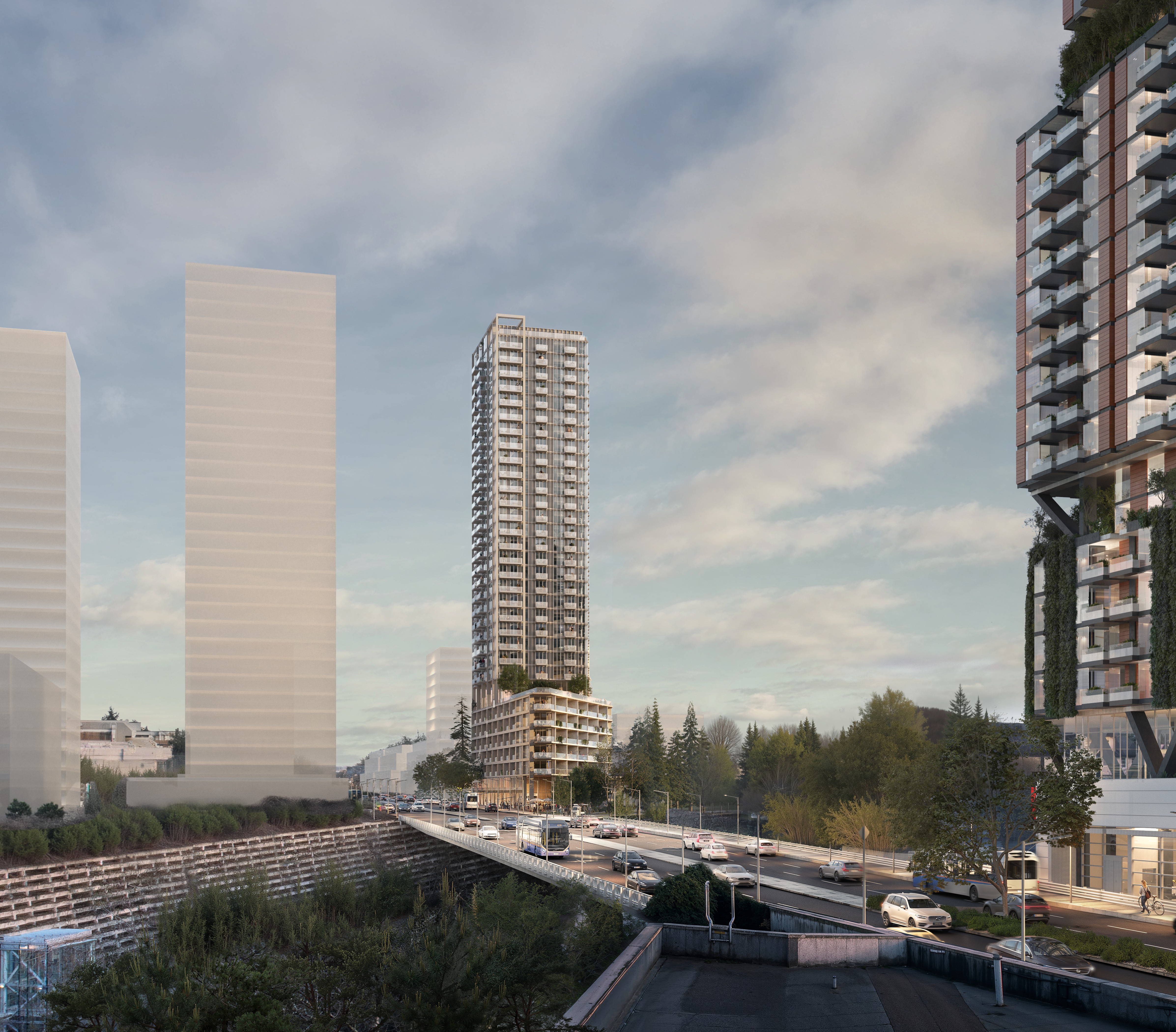
The City of Vancouver has received an application to rezone the subject site from C-1 (Commercial Inclusive) District and RT-5 (Residential) District to CD-1 (Comprehensive Development) District. The proposal is to allow for the development of a 33-storey mixed-use building with a 6-storey podium, and includes:
- 352 rental units with 20% of the floor area for below-market units;
- Commercial space on the ground floor;
- A floor space ratio (FSR) of 13.3; and
- A building height of 106 m (349 ft.) with additional height for rooftop amenity space.
This application is being considered under the Transit-Oriented Areas Rezoning Policy in the Grandview-Woodland Community Plan area. It requests consideration of density and height in excess of the existing policy.
The City’s Tenant Relocation and Protection Policy applies to this site. This policy provides assistance and protections to eligible renters impacted by redevelopment activity. To learn more visit: vancouver.ca/protecting-tenants.
Application drawings and statistics are posted as-submitted to the City. Following staff review, the final project statistics are documented within the referral report.
Update:
October 29th, 2025
Some drawings and renderings in the rezoning booklet and architectural drawings have been updated to better reflect the surrounding urban context.
Update:
December 19, 2025
Updated rezoning booklet added. Minor corrections in the drawing on p. 36/37 and unit breakdown added on p. 9.
The City of Vancouver has received an application to rezone the subject site from C-1 (Commercial Inclusive) District and RT-5 (Residential) District to CD-1 (Comprehensive Development) District. The proposal is to allow for the development of a 33-storey mixed-use building with a 6-storey podium, and includes:
- 352 rental units with 20% of the floor area for below-market units;
- Commercial space on the ground floor;
- A floor space ratio (FSR) of 13.3; and
- A building height of 106 m (349 ft.) with additional height for rooftop amenity space.
This application is being considered under the Transit-Oriented Areas Rezoning Policy in the Grandview-Woodland Community Plan area. It requests consideration of density and height in excess of the existing policy.
The City’s Tenant Relocation and Protection Policy applies to this site. This policy provides assistance and protections to eligible renters impacted by redevelopment activity. To learn more visit: vancouver.ca/protecting-tenants.
Application drawings and statistics are posted as-submitted to the City. Following staff review, the final project statistics are documented within the referral report.
Update:
October 29th, 2025
Some drawings and renderings in the rezoning booklet and architectural drawings have been updated to better reflect the surrounding urban context.
Update:
December 19, 2025
Updated rezoning booklet added. Minor corrections in the drawing on p. 36/37 and unit breakdown added on p. 9.
The opportunity to ask questions through the Q&A is available from October 8 to October 28, 2025.
We post all questions as-is and aim to respond within two business days. Some questions may require coordination with internal departments and additional time may be needed to post a response.
Please note that the comment form will remain open after the Q&A period. The Rezoning Planner can also be contacted directly for any further feedback or questions.
-
Share Why did the City of Vancouver squander copious amounts of money and time on a Citizens’ Assembly to develop and agree to the Grandview Woodland Plan (which called for 6-8 storeys on this site I believe) to then simply ignore the document and instead accept a developer proposal which calls for MORE THAN 4X THAT HEIGHT. It makes it difficult to view these “public engagement” exercises as anything more than posturing. The idiom “you can’t fight city hall” has literally never rung more true. on Facebook Share Why did the City of Vancouver squander copious amounts of money and time on a Citizens’ Assembly to develop and agree to the Grandview Woodland Plan (which called for 6-8 storeys on this site I believe) to then simply ignore the document and instead accept a developer proposal which calls for MORE THAN 4X THAT HEIGHT. It makes it difficult to view these “public engagement” exercises as anything more than posturing. The idiom “you can’t fight city hall” has literally never rung more true. on X (formerly Twitter) Share Why did the City of Vancouver squander copious amounts of money and time on a Citizens’ Assembly to develop and agree to the Grandview Woodland Plan (which called for 6-8 storeys on this site I believe) to then simply ignore the document and instead accept a developer proposal which calls for MORE THAN 4X THAT HEIGHT. It makes it difficult to view these “public engagement” exercises as anything more than posturing. The idiom “you can’t fight city hall” has literally never rung more true. on Linkedin Email Why did the City of Vancouver squander copious amounts of money and time on a Citizens’ Assembly to develop and agree to the Grandview Woodland Plan (which called for 6-8 storeys on this site I believe) to then simply ignore the document and instead accept a developer proposal which calls for MORE THAN 4X THAT HEIGHT. It makes it difficult to view these “public engagement” exercises as anything more than posturing. The idiom “you can’t fight city hall” has literally never rung more true. link
Why did the City of Vancouver squander copious amounts of money and time on a Citizens’ Assembly to develop and agree to the Grandview Woodland Plan (which called for 6-8 storeys on this site I believe) to then simply ignore the document and instead accept a developer proposal which calls for MORE THAN 4X THAT HEIGHT. It makes it difficult to view these “public engagement” exercises as anything more than posturing. The idiom “you can’t fight city hall” has literally never rung more true.
David Carman asked about 1 year agoThanks for reaching out and sharing your concerns with us. Your opposition to this project is noted. However, the City strives to create a welcoming and safe environment for everyone. So for any future communication with City staff, please review the below moderation rules and terms of use.
https://www.shapeyourcity.ca/moderation
https://www.shapeyourcity.ca/terms
Please also note that the City as per Council direction processes all rezoning applications submitted to the City and posts them “as is” on Shape your City. That does not imply staff support. Staff review of this project is currently underway. Staff are reviewing the project against approved City Plans and Policies, including the Grandview-Woodland Community Plan. Please note that the City is also bound by Provincial legislation (Bill 47) and that the site therefore also falls under the Transit-Oriented Development Rezoning Policy (TOA). That said, the proposal exceeds the height and density anticipated in this policy. The staff report to Council on this proposal will include analysis of where the proposal does or does not align with policy.
-
Share This proposed redevelopment has over three times the FSR, and almost three times as many storeys as allowed under Transit-Oriented Areas Rezoning Policy. What does the general manager of planning take into consideration when making a recommendation to the city council when reviewing such significant deviations from the adopted neighbourhood plans and rezoning policies? on Facebook Share This proposed redevelopment has over three times the FSR, and almost three times as many storeys as allowed under Transit-Oriented Areas Rezoning Policy. What does the general manager of planning take into consideration when making a recommendation to the city council when reviewing such significant deviations from the adopted neighbourhood plans and rezoning policies? on X (formerly Twitter) Share This proposed redevelopment has over three times the FSR, and almost three times as many storeys as allowed under Transit-Oriented Areas Rezoning Policy. What does the general manager of planning take into consideration when making a recommendation to the city council when reviewing such significant deviations from the adopted neighbourhood plans and rezoning policies? on Linkedin Email This proposed redevelopment has over three times the FSR, and almost three times as many storeys as allowed under Transit-Oriented Areas Rezoning Policy. What does the general manager of planning take into consideration when making a recommendation to the city council when reviewing such significant deviations from the adopted neighbourhood plans and rezoning policies? link
This proposed redevelopment has over three times the FSR, and almost three times as many storeys as allowed under Transit-Oriented Areas Rezoning Policy. What does the general manager of planning take into consideration when making a recommendation to the city council when reviewing such significant deviations from the adopted neighbourhood plans and rezoning policies?
GZ asked 12 months agoThank you for your question. At this time, staff are reviewing the application, and we have not arrived at any recommendations. As part of the process, the City seeks the input of the public on applications to contribute to the staff review process. Staff are compelled to process all rezoning applications, regardless of the initial compliance with City policy. As part of our review process, we work with applicants to refine their application with the objective of aligning with applicable plans and the intent of Council adopted policy. Despite that, the staff and Council must keep an open mind when considering an application.
In this regard, we consider a number of factors based on current and emerging policy directions, including Vancouver Plan, and other provincial policies, such as Transit Orientated Area development objectives. As part of this review, we also consider matters such as contextual fit, appropriate mix of land uses, appropriate heights and densities, public realm implications, availability of transportation and infrastructure capacity, land speculation, tenant displacement as well as school site capacity and access to community centres and public amenities, among other things. These factors are weighed against good planning principles, and trade-offs are inevitable required to be considered against Council priorities. We consider these range of factors, including the public’s input, before coming to final recommendations for Council’s consideration. We welcome your input in this regard, and participation in a future public hearing when this project is presented to Council for decision.
-
Share In this proposal, there is a small, constrained parcel that risks being surrounded by much larger buildings. The Broadway Plan explicitly cautions against this outcome. How do you protect small homeowners and property owners against this outcome. What compensation is available to them? How can they have discussions with you? on Facebook Share In this proposal, there is a small, constrained parcel that risks being surrounded by much larger buildings. The Broadway Plan explicitly cautions against this outcome. How do you protect small homeowners and property owners against this outcome. What compensation is available to them? How can they have discussions with you? on X (formerly Twitter) Share In this proposal, there is a small, constrained parcel that risks being surrounded by much larger buildings. The Broadway Plan explicitly cautions against this outcome. How do you protect small homeowners and property owners against this outcome. What compensation is available to them? How can they have discussions with you? on Linkedin Email In this proposal, there is a small, constrained parcel that risks being surrounded by much larger buildings. The Broadway Plan explicitly cautions against this outcome. How do you protect small homeowners and property owners against this outcome. What compensation is available to them? How can they have discussions with you? link
In this proposal, there is a small, constrained parcel that risks being surrounded by much larger buildings. The Broadway Plan explicitly cautions against this outcome. How do you protect small homeowners and property owners against this outcome. What compensation is available to them? How can they have discussions with you?
Lumela asked about 1 year agoThank you for your question. Please note that this proposal is not subject to Broadway Plan policies as it is outside the Broadway Plan area. The proposal is being considered under the Transit-Oriented Areas Rezoning Policy in the Grandview-Woodland Community Plan area. It requests consideration of density and height in excess of the existing policy. Staff review of the project is currently underway.
The project is located in Tier 2 of the TOA, which allows up to 12 storeys or 4 FSR.
Below is some general information pertaining to your question, but without a specific address staff is unable to provide parcel specific information. Generally, there are policies that reduce the risk of properties from being ‘locked in’ and/or from being precluded from development in the future (see more details below); however, the City cannot stop the site from being surrounded by larger buildings, as TOA legislation permits up to 12 storeys in this area.
In the TOA RZ Policy, there are policies outlining requirements to avoid precluding future opportunities (see 5.10.1 and 5.10.2). Noting that Council recently approved the following amendments to 5.10.2 (see Appendix D in linked Council report here):
- (5.10.2) Applicant proposals within 400 m from the SkyTrain Station or 200 m from a Bus Exchange (i.e. in Tiers 1, 2 and 4) will be expected to provide a block study that demonstrates that the proposed development does not prevent adjacent sites from being reasonably developed, specifically:
- For adjacent sites that have or could be assembled to have the minimum frontage requirements for a tower under this policy, to heights and densities specified in this policy.
- For adjacent site that do no have or could not be assembled to have the minimum frontage requirements for a tower under this policy, to achieve the heights and densities enabled under TOA.
- For adjacent sites where an area plan or other policies enable heights and density above six storeys or 23.0 m (70 ft) in height, to the heights and densities specified in the area plan.
- The study should also consider site-specific conditions (including tree retention, sidewalk/boulevard dedications, building setbacks) and project economics.
The Grandview-Woodland Community Plan permits courtyard rowhouses/traditional rowhouse (3.5 storeys) or apartments (6 storeys), depending on the specific site.
-
Share With all of the development along Broadway from Commercial past Nanaimo, and 12th Ave... My question is where is all the infrastructure to accommodate all of this density? This city is at a loss for schooling, traffic, dr's, fire and policing by adding so much density, but nothing to accommodate it. The Broadway subway expansion is only going to exasterbate the problem here. I work in Europe most of the time, and there seems to be a lot more vision and guidance, than just densifying without infrastructure at the same time.... Not an afterthought. on Facebook Share With all of the development along Broadway from Commercial past Nanaimo, and 12th Ave... My question is where is all the infrastructure to accommodate all of this density? This city is at a loss for schooling, traffic, dr's, fire and policing by adding so much density, but nothing to accommodate it. The Broadway subway expansion is only going to exasterbate the problem here. I work in Europe most of the time, and there seems to be a lot more vision and guidance, than just densifying without infrastructure at the same time.... Not an afterthought. on X (formerly Twitter) Share With all of the development along Broadway from Commercial past Nanaimo, and 12th Ave... My question is where is all the infrastructure to accommodate all of this density? This city is at a loss for schooling, traffic, dr's, fire and policing by adding so much density, but nothing to accommodate it. The Broadway subway expansion is only going to exasterbate the problem here. I work in Europe most of the time, and there seems to be a lot more vision and guidance, than just densifying without infrastructure at the same time.... Not an afterthought. on Linkedin Email With all of the development along Broadway from Commercial past Nanaimo, and 12th Ave... My question is where is all the infrastructure to accommodate all of this density? This city is at a loss for schooling, traffic, dr's, fire and policing by adding so much density, but nothing to accommodate it. The Broadway subway expansion is only going to exasterbate the problem here. I work in Europe most of the time, and there seems to be a lot more vision and guidance, than just densifying without infrastructure at the same time.... Not an afterthought. link
With all of the development along Broadway from Commercial past Nanaimo, and 12th Ave... My question is where is all the infrastructure to accommodate all of this density? This city is at a loss for schooling, traffic, dr's, fire and policing by adding so much density, but nothing to accommodate it. The Broadway subway expansion is only going to exasterbate the problem here. I work in Europe most of the time, and there seems to be a lot more vision and guidance, than just densifying without infrastructure at the same time.... Not an afterthought.
Dave N asked 12 months agoThank you for your question and sharing your concerns.
Generally, a Public Benefits Strategy (PBS) provides strategic direction for future capital investments in a community over the long-term. It covers key areas that support livable, healthy, and sustainable communities: affordable housing, childcare, parks and open spaces, community facilities, civic facilities, transportation, utilities, and heritage. The PBS takes into account the existing network of amenities and infrastructure within the community, as well as city-serving amenities located beyond the community’s boundary. The PBS is an aspirational plan that reflects the needs and desires of the community, and is intended to provide strategic direction to guide the in making investment decisions on public amenities and infrastructure in Grandview-Woodland over the next 25 years. The City’s fiscal capacity, emerging opportunities and evolving needs in this community and across the city will determine the actual amenity package that will be delivered incrementally over the long-term horizon. As such, a PBS will be reviewed and refined periodically and integrated into the City’s 10-year Capital Strategic Outlook, 4-year Capital Plan, and annual Capital Budget for prioritization and funding consideration on a city-wide level.
School capacity
Staff are in regular contact with the Vancouver School Board (VSB) to align City planning directions with VSB school capacity and long-range facilities planning. The preparation of our policies includes engagement with the VSB to understand future school aged population and school capacity requirements over the time horizon of policy/plan. However, it is the provincial government that is responsible for delivering schools, so school funding is not included in the list of public Benefits private development has to contribute to. However, the City plays an important role in liaising with the VSB on the provision of schools, ensuring that they are aware of, and planning for, the additional needs that will be generated as a result of population and job growth. The City will continue to work with VSB to investigate and action opportunities for new school sites, but it will be funded through provincial funding mechanisms. The prioritization and timing of funding approval for school expansion and upgrades is at the discretion of the Ministry of Education. Through policy implementation the City continues to work with the Vancouver School Board to help inform capital requests to the Ministry of Education.
VSB has forecasts on school capacity utilization in their Long Range Facilities Plan. The VSB report notes that overall enrolment trends for the wider area are changing. The VSB continues to explore options to reduce pressure on schools in this area, monitor development, and work with City staff to help plan for future growth.
Please feel free to also share your general concerns about school capacity with Council and the Vancouver School Board:https://vancouver.ca/your-government/contact-council.aspx
https://www.vsb.bc.ca/page/26683/departments
Community Amenities
Generally, amenities and infrastructure, such as childcare facilities, parks, community centres, libraries, cultural facilities, utility upgrades (water and sewer), and street improvements, are funded from a variety of sources. Development Cost Levies (DCLs) which are used to help pay for facilities made necessary by growth, including parks, childcare, social housing and engineering infrastructure (see also short video on the website for explanation), which the developer has to pay based on square footage. Another type of feels collected from private development Community Amenity Contributions (CACs) are in-kind or cash contributions by the developer. They are generated with the intention that they will serve the investments needed from development-related population growth.
Staff will also be reviewing rezoning application details including Engineering Services such as sewers, utilities infrastructure, sidewalk width, building setbacks, and overall public realm design. Following review, development conditions for off-site infrastructure may be required for this project, such as improved public realm, sidewalks, and intersection upgrades, to improve transportation operations and safety for pedestrians, cyclists, and motorists alike near the site that the developer has to pay for in addition to the above mentioned fees.
-
Share As currently shown in the application documents, residents' bikes, cars and all commercial deliveries to the 6 commercial tenants have to come from Semlin Dr via a narrow laneway. The city's right of way in this laneway is around 5m, which, for two-lane access, is below the absolute minimum width of 5.6m as calculated from City's 2019 Engineering Design Manual Table 8-11. In a previous response to another question it was mentioned that the Engineering staff review the application with respect to the transportation impacts, and that they may include conditions for off-site requirements to improve transportation operations. However, there is a reasonably foreseeable limit to how much can be done to an existing bottleneck to ensure that it is safe for cyclists, drivers, commercial traffic, emergency vehicles and the existing homeowners whose properties border this laneway. Does the city validate the feasibility of being able to provide safe access to a redeveloped site prior a redevelopment application going to vote by the city council? If amendments to the redevelopment are required to ensure safe access, how do those changes get incorporated into application? on Facebook Share As currently shown in the application documents, residents' bikes, cars and all commercial deliveries to the 6 commercial tenants have to come from Semlin Dr via a narrow laneway. The city's right of way in this laneway is around 5m, which, for two-lane access, is below the absolute minimum width of 5.6m as calculated from City's 2019 Engineering Design Manual Table 8-11. In a previous response to another question it was mentioned that the Engineering staff review the application with respect to the transportation impacts, and that they may include conditions for off-site requirements to improve transportation operations. However, there is a reasonably foreseeable limit to how much can be done to an existing bottleneck to ensure that it is safe for cyclists, drivers, commercial traffic, emergency vehicles and the existing homeowners whose properties border this laneway. Does the city validate the feasibility of being able to provide safe access to a redeveloped site prior a redevelopment application going to vote by the city council? If amendments to the redevelopment are required to ensure safe access, how do those changes get incorporated into application? on X (formerly Twitter) Share As currently shown in the application documents, residents' bikes, cars and all commercial deliveries to the 6 commercial tenants have to come from Semlin Dr via a narrow laneway. The city's right of way in this laneway is around 5m, which, for two-lane access, is below the absolute minimum width of 5.6m as calculated from City's 2019 Engineering Design Manual Table 8-11. In a previous response to another question it was mentioned that the Engineering staff review the application with respect to the transportation impacts, and that they may include conditions for off-site requirements to improve transportation operations. However, there is a reasonably foreseeable limit to how much can be done to an existing bottleneck to ensure that it is safe for cyclists, drivers, commercial traffic, emergency vehicles and the existing homeowners whose properties border this laneway. Does the city validate the feasibility of being able to provide safe access to a redeveloped site prior a redevelopment application going to vote by the city council? If amendments to the redevelopment are required to ensure safe access, how do those changes get incorporated into application? on Linkedin Email As currently shown in the application documents, residents' bikes, cars and all commercial deliveries to the 6 commercial tenants have to come from Semlin Dr via a narrow laneway. The city's right of way in this laneway is around 5m, which, for two-lane access, is below the absolute minimum width of 5.6m as calculated from City's 2019 Engineering Design Manual Table 8-11. In a previous response to another question it was mentioned that the Engineering staff review the application with respect to the transportation impacts, and that they may include conditions for off-site requirements to improve transportation operations. However, there is a reasonably foreseeable limit to how much can be done to an existing bottleneck to ensure that it is safe for cyclists, drivers, commercial traffic, emergency vehicles and the existing homeowners whose properties border this laneway. Does the city validate the feasibility of being able to provide safe access to a redeveloped site prior a redevelopment application going to vote by the city council? If amendments to the redevelopment are required to ensure safe access, how do those changes get incorporated into application? link
As currently shown in the application documents, residents' bikes, cars and all commercial deliveries to the 6 commercial tenants have to come from Semlin Dr via a narrow laneway. The city's right of way in this laneway is around 5m, which, for two-lane access, is below the absolute minimum width of 5.6m as calculated from City's 2019 Engineering Design Manual Table 8-11. In a previous response to another question it was mentioned that the Engineering staff review the application with respect to the transportation impacts, and that they may include conditions for off-site requirements to improve transportation operations. However, there is a reasonably foreseeable limit to how much can be done to an existing bottleneck to ensure that it is safe for cyclists, drivers, commercial traffic, emergency vehicles and the existing homeowners whose properties border this laneway. Does the city validate the feasibility of being able to provide safe access to a redeveloped site prior a redevelopment application going to vote by the city council? If amendments to the redevelopment are required to ensure safe access, how do those changes get incorporated into application?
Victor M asked 12 months agoThank you for your question. The proposed development is required to comply with the Parking By-law with respect to off-street vehicle parking spaces and well-sited to encourage reduced vehicle trip and parking demand. A Transportation Demand Management Plan will also be required which helps to further reduce development demand for vehicle trips and parking. As part of the rezoning process, Engineering staff include a review of the application with respect to transportation impacts and, if identified, may include development conditions for off-site requirements to improve transportation operations and safety for pedestrians, cyclists, and motorists adjacent to the site.
The City requires a standard 20-ft. wide lane, which can be achieved through the redevelopment. Parking and loading access would be provided from the rear lane with upgraded lighting and repaving. Fire trucks would access building(s) of this site from East Broadway. As the dead-end lane is less than 90 metres in length, fire trucks could safely reverse in and out during emergencies, and no turnaround is required. An on-site Class B Loading space in the lane would function as a turnaround for larger trucks, including waste collection.
-
Share What level of height and density is required by the provincial legislation for this location? Please compare this with what the City of Vancouver is proposing. on Facebook Share What level of height and density is required by the provincial legislation for this location? Please compare this with what the City of Vancouver is proposing. on X (formerly Twitter) Share What level of height and density is required by the provincial legislation for this location? Please compare this with what the City of Vancouver is proposing. on Linkedin Email What level of height and density is required by the provincial legislation for this location? Please compare this with what the City of Vancouver is proposing. link
What level of height and density is required by the provincial legislation for this location? Please compare this with what the City of Vancouver is proposing.
L Thompson asked 12 months agoThank you for your question. This application is being considered under the Transit-Oriented Areas Rezoning Policy in the Grandview-Woodland Community Plan area. As the TOA is providing more height and density, it is considered under that policy but the Grandview Woodland build form guidelines still apply, as per TOA rezoning policy. The project requests consideration of density and height in excess of the existing policy. However, if an applicant wishes to apply to rezone a property, staff do not have the ability to restrict an application from being submitted. Application materials are posted on Shape your City as-submitted by the applicant to the City.
The project is located in Tier 2 of the TOA, which allows up to 12 storeys or 4 FSR. Depending on the site, the Grandview-Woodland community plan either allows for courtyard rowhouses/traditional rowhouse (3.5 storeys) or apartments (6 storeys/3FSR), depending on the specific site. For this site, the Grandview-Woodland community plan also envisions commercial uses on the ground floor and office on the 2nd floor is encouraged. Staff review of the project is currently underway. Following review, Staff makes a recommendation to Council to approve or refuse the proposal, while considering the conditions as laid out in the referral report. Ultimately it is up to Council to make the final decision.
-
Share For transparency, did the developers submit a letter of enquiry prior to making this revised application? For a rezoning of this size, what fees would be associated with submitting the new application? It's a little difficult to parse the Zoning and Development Fee By-law Schedule https://vancouver.ca/files/cov/vancouver-development-building-permit-fees.pdf#page=8 Thank you. This information could help provide more background, as there are a number of other fees and expenses with a revised application like this one (such as abandoning the earlier 6-storey rezoning proposal, land holding costs, design plus engineering costs, other risks and so forth). on Facebook Share For transparency, did the developers submit a letter of enquiry prior to making this revised application? For a rezoning of this size, what fees would be associated with submitting the new application? It's a little difficult to parse the Zoning and Development Fee By-law Schedule https://vancouver.ca/files/cov/vancouver-development-building-permit-fees.pdf#page=8 Thank you. This information could help provide more background, as there are a number of other fees and expenses with a revised application like this one (such as abandoning the earlier 6-storey rezoning proposal, land holding costs, design plus engineering costs, other risks and so forth). on X (formerly Twitter) Share For transparency, did the developers submit a letter of enquiry prior to making this revised application? For a rezoning of this size, what fees would be associated with submitting the new application? It's a little difficult to parse the Zoning and Development Fee By-law Schedule https://vancouver.ca/files/cov/vancouver-development-building-permit-fees.pdf#page=8 Thank you. This information could help provide more background, as there are a number of other fees and expenses with a revised application like this one (such as abandoning the earlier 6-storey rezoning proposal, land holding costs, design plus engineering costs, other risks and so forth). on Linkedin Email For transparency, did the developers submit a letter of enquiry prior to making this revised application? For a rezoning of this size, what fees would be associated with submitting the new application? It's a little difficult to parse the Zoning and Development Fee By-law Schedule https://vancouver.ca/files/cov/vancouver-development-building-permit-fees.pdf#page=8 Thank you. This information could help provide more background, as there are a number of other fees and expenses with a revised application like this one (such as abandoning the earlier 6-storey rezoning proposal, land holding costs, design plus engineering costs, other risks and so forth). link
For transparency, did the developers submit a letter of enquiry prior to making this revised application? For a rezoning of this size, what fees would be associated with submitting the new application? It's a little difficult to parse the Zoning and Development Fee By-law Schedule https://vancouver.ca/files/cov/vancouver-development-building-permit-fees.pdf#page=8 Thank you. This information could help provide more background, as there are a number of other fees and expenses with a revised application like this one (such as abandoning the earlier 6-storey rezoning proposal, land holding costs, design plus engineering costs, other risks and so forth).
waterlily asked about 1 year agoThank you for your question which we shared with the applicant. Here is their response:
"Third Space did not submit a rezoning enquiry prior to submitting our revised rezoning application. The rezoning fee is based on site area and for this application/site the rezoning fee was $90,400. This is in addition to the fee for the previous rezoning application."
-
Share Could you please answer with a simple yes or no, that the following information is correct: The proposal breaks the Tier2 TOA policy as it: a) greatly exceeds the height of 12-storeys at 33-storeys b) greatly exceeds the Floor Space Ratio of 4.0, at 13.3 It breaks view protection policy as it would intrude into the current protected view from Trout Lake, as well as into the proposed narrowed view cone. The proposal breaks the Grandview-Woodland Community Plan (30-year plan adopted in 2016), as it: a) has floorplates at 7,967 sq. ft. (above 60 ft in height) that exceed the maximum of 6,500 sq. ft. in the plan b) it is in the apartment zone (height up to 6-storeys), in contrast with the requested 33-storeys c) the density measure of 13.3 FSR exceeds the plan's maximum 3.0 FSR for mixed-use apartment d) front yard setback of ~3m is insufficient (~3.2m to sidewalk on western edge of the property) as plan requires 5.5m (18 ft.) to sidewalk; 9.1m rear yard setback is also insufficient as building is too close (4.8m or less as building varies). The plan's upper floor setback rules (section 6.7.1) are not followed either. on Facebook Share Could you please answer with a simple yes or no, that the following information is correct: The proposal breaks the Tier2 TOA policy as it: a) greatly exceeds the height of 12-storeys at 33-storeys b) greatly exceeds the Floor Space Ratio of 4.0, at 13.3 It breaks view protection policy as it would intrude into the current protected view from Trout Lake, as well as into the proposed narrowed view cone. The proposal breaks the Grandview-Woodland Community Plan (30-year plan adopted in 2016), as it: a) has floorplates at 7,967 sq. ft. (above 60 ft in height) that exceed the maximum of 6,500 sq. ft. in the plan b) it is in the apartment zone (height up to 6-storeys), in contrast with the requested 33-storeys c) the density measure of 13.3 FSR exceeds the plan's maximum 3.0 FSR for mixed-use apartment d) front yard setback of ~3m is insufficient (~3.2m to sidewalk on western edge of the property) as plan requires 5.5m (18 ft.) to sidewalk; 9.1m rear yard setback is also insufficient as building is too close (4.8m or less as building varies). The plan's upper floor setback rules (section 6.7.1) are not followed either. on X (formerly Twitter) Share Could you please answer with a simple yes or no, that the following information is correct: The proposal breaks the Tier2 TOA policy as it: a) greatly exceeds the height of 12-storeys at 33-storeys b) greatly exceeds the Floor Space Ratio of 4.0, at 13.3 It breaks view protection policy as it would intrude into the current protected view from Trout Lake, as well as into the proposed narrowed view cone. The proposal breaks the Grandview-Woodland Community Plan (30-year plan adopted in 2016), as it: a) has floorplates at 7,967 sq. ft. (above 60 ft in height) that exceed the maximum of 6,500 sq. ft. in the plan b) it is in the apartment zone (height up to 6-storeys), in contrast with the requested 33-storeys c) the density measure of 13.3 FSR exceeds the plan's maximum 3.0 FSR for mixed-use apartment d) front yard setback of ~3m is insufficient (~3.2m to sidewalk on western edge of the property) as plan requires 5.5m (18 ft.) to sidewalk; 9.1m rear yard setback is also insufficient as building is too close (4.8m or less as building varies). The plan's upper floor setback rules (section 6.7.1) are not followed either. on Linkedin Email Could you please answer with a simple yes or no, that the following information is correct: The proposal breaks the Tier2 TOA policy as it: a) greatly exceeds the height of 12-storeys at 33-storeys b) greatly exceeds the Floor Space Ratio of 4.0, at 13.3 It breaks view protection policy as it would intrude into the current protected view from Trout Lake, as well as into the proposed narrowed view cone. The proposal breaks the Grandview-Woodland Community Plan (30-year plan adopted in 2016), as it: a) has floorplates at 7,967 sq. ft. (above 60 ft in height) that exceed the maximum of 6,500 sq. ft. in the plan b) it is in the apartment zone (height up to 6-storeys), in contrast with the requested 33-storeys c) the density measure of 13.3 FSR exceeds the plan's maximum 3.0 FSR for mixed-use apartment d) front yard setback of ~3m is insufficient (~3.2m to sidewalk on western edge of the property) as plan requires 5.5m (18 ft.) to sidewalk; 9.1m rear yard setback is also insufficient as building is too close (4.8m or less as building varies). The plan's upper floor setback rules (section 6.7.1) are not followed either. link
Could you please answer with a simple yes or no, that the following information is correct: The proposal breaks the Tier2 TOA policy as it: a) greatly exceeds the height of 12-storeys at 33-storeys b) greatly exceeds the Floor Space Ratio of 4.0, at 13.3 It breaks view protection policy as it would intrude into the current protected view from Trout Lake, as well as into the proposed narrowed view cone. The proposal breaks the Grandview-Woodland Community Plan (30-year plan adopted in 2016), as it: a) has floorplates at 7,967 sq. ft. (above 60 ft in height) that exceed the maximum of 6,500 sq. ft. in the plan b) it is in the apartment zone (height up to 6-storeys), in contrast with the requested 33-storeys c) the density measure of 13.3 FSR exceeds the plan's maximum 3.0 FSR for mixed-use apartment d) front yard setback of ~3m is insufficient (~3.2m to sidewalk on western edge of the property) as plan requires 5.5m (18 ft.) to sidewalk; 9.1m rear yard setback is also insufficient as building is too close (4.8m or less as building varies). The plan's upper floor setback rules (section 6.7.1) are not followed either.
waterlily asked about 1 year agoThank you for your question. The proposal exceeds policy in height, density and floor plate size, it also encroaches into the view cone. As the TOA rezoning policy offers more height and density, the project is considered under this policy, not the Grandview Woodland Community Plan, as mandated by the BC government. However, it’s build form guidelines still apply. Staff review for this project is currently ongoing. Following review, Staff makes a recommendation to Council to approve or refuse the proposal, while considering the conditions as laid out in the referral report. Ultimately it is up to Council to make the final decision.
-
Share You mentioned in a response that the project is located in Tier 2 of the TOA, which allows up to 12 storeys or 4 FSR. Depending on the site, the Grandview-Woodland community plan either allows for courtyard rowhouses/traditional rowhouse (3.5 storeys) or apartments (6 storeys/3FSR), depending on the specific site. For this site, the Grandview-Woodland community plan also envisions commercial uses on the ground floor and office on the 2nd floor is encouraged. This is upsetting to small property owners in adjacent properties who have made life decisions based on what they thought was CoV policy. The developer has also included "shadows" of several other building in their rendering that are clearly taller than 12 storeys. This gives the impression that developers can just do whatever they want and create their own reality. As small property owners adjacent to this site, we made life decisions based on the original thinking that the area would be a courtyard rowhouses/traditional rowhouse (3.5 storeys) which seems the most appropriate development for that site given its constraints and now we are facing down an application for 33 storeys. These decisions and processes impact people's lives, homes and mental/emotional health. It seems irresponsible to allow this application to even go to the review stage in the first place. Can you explain why developers are allowed to submit proposals that so obviously and extremely contravene the policy? Would CoV consider changing this process so that only applications that follow the policy guidelines are accepted for CoV review and published for public comments? Would CoV consider including in their policies a more personalized approach to consulting adjacent small property owners? on Facebook Share You mentioned in a response that the project is located in Tier 2 of the TOA, which allows up to 12 storeys or 4 FSR. Depending on the site, the Grandview-Woodland community plan either allows for courtyard rowhouses/traditional rowhouse (3.5 storeys) or apartments (6 storeys/3FSR), depending on the specific site. For this site, the Grandview-Woodland community plan also envisions commercial uses on the ground floor and office on the 2nd floor is encouraged. This is upsetting to small property owners in adjacent properties who have made life decisions based on what they thought was CoV policy. The developer has also included "shadows" of several other building in their rendering that are clearly taller than 12 storeys. This gives the impression that developers can just do whatever they want and create their own reality. As small property owners adjacent to this site, we made life decisions based on the original thinking that the area would be a courtyard rowhouses/traditional rowhouse (3.5 storeys) which seems the most appropriate development for that site given its constraints and now we are facing down an application for 33 storeys. These decisions and processes impact people's lives, homes and mental/emotional health. It seems irresponsible to allow this application to even go to the review stage in the first place. Can you explain why developers are allowed to submit proposals that so obviously and extremely contravene the policy? Would CoV consider changing this process so that only applications that follow the policy guidelines are accepted for CoV review and published for public comments? Would CoV consider including in their policies a more personalized approach to consulting adjacent small property owners? on X (formerly Twitter) Share You mentioned in a response that the project is located in Tier 2 of the TOA, which allows up to 12 storeys or 4 FSR. Depending on the site, the Grandview-Woodland community plan either allows for courtyard rowhouses/traditional rowhouse (3.5 storeys) or apartments (6 storeys/3FSR), depending on the specific site. For this site, the Grandview-Woodland community plan also envisions commercial uses on the ground floor and office on the 2nd floor is encouraged. This is upsetting to small property owners in adjacent properties who have made life decisions based on what they thought was CoV policy. The developer has also included "shadows" of several other building in their rendering that are clearly taller than 12 storeys. This gives the impression that developers can just do whatever they want and create their own reality. As small property owners adjacent to this site, we made life decisions based on the original thinking that the area would be a courtyard rowhouses/traditional rowhouse (3.5 storeys) which seems the most appropriate development for that site given its constraints and now we are facing down an application for 33 storeys. These decisions and processes impact people's lives, homes and mental/emotional health. It seems irresponsible to allow this application to even go to the review stage in the first place. Can you explain why developers are allowed to submit proposals that so obviously and extremely contravene the policy? Would CoV consider changing this process so that only applications that follow the policy guidelines are accepted for CoV review and published for public comments? Would CoV consider including in their policies a more personalized approach to consulting adjacent small property owners? on Linkedin Email You mentioned in a response that the project is located in Tier 2 of the TOA, which allows up to 12 storeys or 4 FSR. Depending on the site, the Grandview-Woodland community plan either allows for courtyard rowhouses/traditional rowhouse (3.5 storeys) or apartments (6 storeys/3FSR), depending on the specific site. For this site, the Grandview-Woodland community plan also envisions commercial uses on the ground floor and office on the 2nd floor is encouraged. This is upsetting to small property owners in adjacent properties who have made life decisions based on what they thought was CoV policy. The developer has also included "shadows" of several other building in their rendering that are clearly taller than 12 storeys. This gives the impression that developers can just do whatever they want and create their own reality. As small property owners adjacent to this site, we made life decisions based on the original thinking that the area would be a courtyard rowhouses/traditional rowhouse (3.5 storeys) which seems the most appropriate development for that site given its constraints and now we are facing down an application for 33 storeys. These decisions and processes impact people's lives, homes and mental/emotional health. It seems irresponsible to allow this application to even go to the review stage in the first place. Can you explain why developers are allowed to submit proposals that so obviously and extremely contravene the policy? Would CoV consider changing this process so that only applications that follow the policy guidelines are accepted for CoV review and published for public comments? Would CoV consider including in their policies a more personalized approach to consulting adjacent small property owners? link
You mentioned in a response that the project is located in Tier 2 of the TOA, which allows up to 12 storeys or 4 FSR. Depending on the site, the Grandview-Woodland community plan either allows for courtyard rowhouses/traditional rowhouse (3.5 storeys) or apartments (6 storeys/3FSR), depending on the specific site. For this site, the Grandview-Woodland community plan also envisions commercial uses on the ground floor and office on the 2nd floor is encouraged. This is upsetting to small property owners in adjacent properties who have made life decisions based on what they thought was CoV policy. The developer has also included "shadows" of several other building in their rendering that are clearly taller than 12 storeys. This gives the impression that developers can just do whatever they want and create their own reality. As small property owners adjacent to this site, we made life decisions based on the original thinking that the area would be a courtyard rowhouses/traditional rowhouse (3.5 storeys) which seems the most appropriate development for that site given its constraints and now we are facing down an application for 33 storeys. These decisions and processes impact people's lives, homes and mental/emotional health. It seems irresponsible to allow this application to even go to the review stage in the first place. Can you explain why developers are allowed to submit proposals that so obviously and extremely contravene the policy? Would CoV consider changing this process so that only applications that follow the policy guidelines are accepted for CoV review and published for public comments? Would CoV consider including in their policies a more personalized approach to consulting adjacent small property owners?
Lumela asked about 1 year agoThe proposed height in this rezoning application exceeds what policy anticipated for this location, however if an applicant wishes to apply to rezone a property, staff do not have the ability to restrict an application from being submitted. Following review, Staff can make a recommendation to Council to approve or refuse the proposal, and ultimately it is up to Council to make the final decision.
-
Share While there are a host of issues with this rezoning application and the 'consultation', perhaps the most concerning one is that this is an example of a developer attempting to set City policy. Contained within the rezoning application is a proposal to further weaken the Trout Lake view cone protections over what was already proposed by staff back in April of this year. With that backdrop, there's only this two week online Q&A period, without any mailing notification. Surely a much longer Q&A period would be warranted, given the proponent's attempt to shape the City's view protection policy. For other similar applications, the City has hosted in-person Open House events; why is this not the case here? It's also concerning that staff have not summarized how this proposal doesn't follow either the Grandview-Woodland Community Plan or the Tier 2 TOA. Surely it's possible to state the current height, FSR, tower floorplate maximum (6,500sq.ft), policy setbacks and so forth in a clear manner. The applicant's materials contain errors (for example, heights of view cones in their drawings), the City's photo of the Trout Lake view cone is not from the exact location of the view cone, and there's a lot of context missing about the 30-year Community Plan's directions and the intentions regarding the Grandview cut). Will any attempt be taken to provide missing details so that the public can make a fulsome review of this rezoning application? Will you extend the Q&A period and hold a public in-person Open House? on Facebook Share While there are a host of issues with this rezoning application and the 'consultation', perhaps the most concerning one is that this is an example of a developer attempting to set City policy. Contained within the rezoning application is a proposal to further weaken the Trout Lake view cone protections over what was already proposed by staff back in April of this year. With that backdrop, there's only this two week online Q&A period, without any mailing notification. Surely a much longer Q&A period would be warranted, given the proponent's attempt to shape the City's view protection policy. For other similar applications, the City has hosted in-person Open House events; why is this not the case here? It's also concerning that staff have not summarized how this proposal doesn't follow either the Grandview-Woodland Community Plan or the Tier 2 TOA. Surely it's possible to state the current height, FSR, tower floorplate maximum (6,500sq.ft), policy setbacks and so forth in a clear manner. The applicant's materials contain errors (for example, heights of view cones in their drawings), the City's photo of the Trout Lake view cone is not from the exact location of the view cone, and there's a lot of context missing about the 30-year Community Plan's directions and the intentions regarding the Grandview cut). Will any attempt be taken to provide missing details so that the public can make a fulsome review of this rezoning application? Will you extend the Q&A period and hold a public in-person Open House? on X (formerly Twitter) Share While there are a host of issues with this rezoning application and the 'consultation', perhaps the most concerning one is that this is an example of a developer attempting to set City policy. Contained within the rezoning application is a proposal to further weaken the Trout Lake view cone protections over what was already proposed by staff back in April of this year. With that backdrop, there's only this two week online Q&A period, without any mailing notification. Surely a much longer Q&A period would be warranted, given the proponent's attempt to shape the City's view protection policy. For other similar applications, the City has hosted in-person Open House events; why is this not the case here? It's also concerning that staff have not summarized how this proposal doesn't follow either the Grandview-Woodland Community Plan or the Tier 2 TOA. Surely it's possible to state the current height, FSR, tower floorplate maximum (6,500sq.ft), policy setbacks and so forth in a clear manner. The applicant's materials contain errors (for example, heights of view cones in their drawings), the City's photo of the Trout Lake view cone is not from the exact location of the view cone, and there's a lot of context missing about the 30-year Community Plan's directions and the intentions regarding the Grandview cut). Will any attempt be taken to provide missing details so that the public can make a fulsome review of this rezoning application? Will you extend the Q&A period and hold a public in-person Open House? on Linkedin Email While there are a host of issues with this rezoning application and the 'consultation', perhaps the most concerning one is that this is an example of a developer attempting to set City policy. Contained within the rezoning application is a proposal to further weaken the Trout Lake view cone protections over what was already proposed by staff back in April of this year. With that backdrop, there's only this two week online Q&A period, without any mailing notification. Surely a much longer Q&A period would be warranted, given the proponent's attempt to shape the City's view protection policy. For other similar applications, the City has hosted in-person Open House events; why is this not the case here? It's also concerning that staff have not summarized how this proposal doesn't follow either the Grandview-Woodland Community Plan or the Tier 2 TOA. Surely it's possible to state the current height, FSR, tower floorplate maximum (6,500sq.ft), policy setbacks and so forth in a clear manner. The applicant's materials contain errors (for example, heights of view cones in their drawings), the City's photo of the Trout Lake view cone is not from the exact location of the view cone, and there's a lot of context missing about the 30-year Community Plan's directions and the intentions regarding the Grandview cut). Will any attempt be taken to provide missing details so that the public can make a fulsome review of this rezoning application? Will you extend the Q&A period and hold a public in-person Open House? link
While there are a host of issues with this rezoning application and the 'consultation', perhaps the most concerning one is that this is an example of a developer attempting to set City policy. Contained within the rezoning application is a proposal to further weaken the Trout Lake view cone protections over what was already proposed by staff back in April of this year. With that backdrop, there's only this two week online Q&A period, without any mailing notification. Surely a much longer Q&A period would be warranted, given the proponent's attempt to shape the City's view protection policy. For other similar applications, the City has hosted in-person Open House events; why is this not the case here? It's also concerning that staff have not summarized how this proposal doesn't follow either the Grandview-Woodland Community Plan or the Tier 2 TOA. Surely it's possible to state the current height, FSR, tower floorplate maximum (6,500sq.ft), policy setbacks and so forth in a clear manner. The applicant's materials contain errors (for example, heights of view cones in their drawings), the City's photo of the Trout Lake view cone is not from the exact location of the view cone, and there's a lot of context missing about the 30-year Community Plan's directions and the intentions regarding the Grandview cut). Will any attempt be taken to provide missing details so that the public can make a fulsome review of this rezoning application? Will you extend the Q&A period and hold a public in-person Open House?
waterlily asked about 1 year agoThanks for your question and for sharing your concerns.
When a rezoning application is submitted, we notify the community in several ways: we post a sign at the site, create an online page where people can learn about the proposal and share feedback, and usually send postcards through Canada Post. Unfortunately, due to the current postal strike, we weren’t able to send postcards in time for this Q&A period.
Since the pandemic, we've been using a virtual format to keep people informed and involved. On the City’s Shape Your City website, you’ll find all the materials submitted by the applicant, including a video walkthrough and links to relevant policies, so you can review everything at your own pace.
The online Q&A runs for two weeks, giving the public a chance to ask questions and see responses posted publicly. During this time, staff share information, clarify details, and gather feedback. We know online engagement doesn’t work for everyone, so you’re always welcome to email the rezoning planner directly with questions or comments. The comment section on the website also stays open after the Q&A ends.
All feedback, whether submitted online, by email, or by phone, is collected and summarized in a report that goes to City Council. Before and during the Public Hearing, people can also provide input in writing or in person. If you leave a comment on the website, you can choose to be notified when the Public Hearing is scheduled.
-
July 14 2025
-
October 08 → October 28 2025
-
February 2026

-
Phone 604-495-0472 Email nshuttleworth@third.space
-
Phone 604-326-4844 Email susanne.ruhle@vancouver.ca