

2538 Birch Street (formerly 1296 West Broadway)
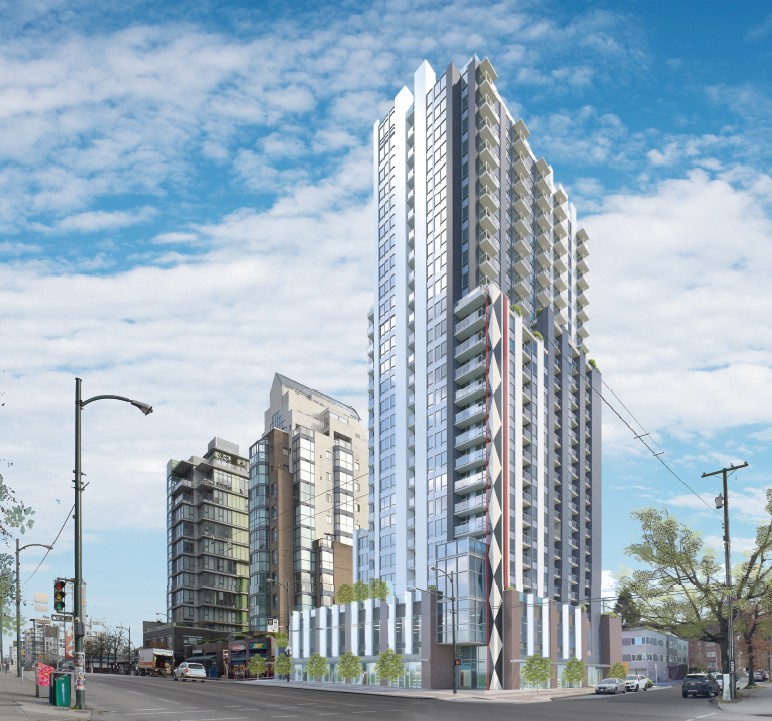
Revised Application (April 27, 2026)
The City of Vancouver has received a revised rezoning application to amend the CD-1 (708) (Comprehensive Development) District By-law, which allows for the development of a 28-storey mixed-use building. The revised amendment includes:
- Adding 202 hotel units;
- Removing 200 market rental housing units;
- Providing 56 Moderate Income Rental Housing Units;
- Adding a childcare facility; and
- A decrease in retail area.
Key changes in the revised application include:
- Changing the land use for the originally proposed 200 Temporary Accommodation for Medical Care units to 202 Hotel units; and
- Proposing 56 Moderate Income Rental Housing Units (two less from original application), while maintaining the same total floor area for the Moderate Income Rental Housing Units.
The building is currently under construction. No changes to the form of development are proposed.
This application is considered under the Broadway Plan.
The previously approved application is linked here: Rezoning Application, 2538 Birch Street
Application drawings and statistics are posted as-submitted to the City. Following staff review, the final project statistics are documented within the referral report.
Original Application (November 20, 2025)
The City of Vancouver has received an application to amend the CD-1 (708) (Comprehensive Development) District By-law, which allows for the development of a 28-storey mixed-use building. The amendment includes:
- Adding 200 Temporary Accommodation for Medical Care units;
- Removing 200 market rental housing units;
- Adding a childcare facility;
- An increase in amenity area; and
- A decrease of approximately 27.9 sq. m (300 sq. ft.) in retail area.
Temporary Accommodation for Medical Care units provide temporary accommodation for out-of-town individuals seeking medical care at local health facilities. The building will continue to provide 58 Moderate Income Rental Housing Units. No changes to the form of development, including height and density, are proposed.
The application is being considered under the Broadway Plan.
The previously approved application is linked here: Rezoning Application, 2538 Birch Street
Application drawings and statistics are posted as-submitted to the City. Following staff review, the final project statistics are documented within the referral report.
Public Hearing: Thursday, July 23, 2026 at 6:00 pm
Update: Due to time constraints, this item will be considered when the Public Hearing reconvenes on July 27, 2026, at 9:30 am.
These Public Hearings are to be convened by electronic means, with in-person attendance also available. You may participate in the Public Hearing either by speaking by phone or in person, or by submitting written comments that will be distributed to the Mayor and Councillors.
Or give feedback via mail to:
City of Vancouver, City Clerk’s Office
453 West 12th Avenue, Third Floor
Vancouver, BC, V5Y 1V4
Requests to speak open at 8:30 am on Wednesday, July 15, 2026. You may also register in person at City Hall between 5:30 and 6:00 pm on the day of the Public Hearing. All spoken and written comments will be publicly accessible on the City of Vancouver’s website with your full name attached.
Copies of the draft by-laws will be made available for in-person viewing from 8:30 am to 5:00 pm on weekdays at the City Clerk’s Office on the 3rd Floor of City Hall from Wednesday, July 15, 2026, and for viewing on the meeting agenda page on the same Friday starting at 1:00 pm. Minutes of the Public Hearing will also be available at this location approximately two business days after the meeting.
Revised Application (April 27, 2026)
The City of Vancouver has received a revised rezoning application to amend the CD-1 (708) (Comprehensive Development) District By-law, which allows for the development of a 28-storey mixed-use building. The revised amendment includes:
- Adding 202 hotel units;
- Removing 200 market rental housing units;
- Providing 56 Moderate Income Rental Housing Units;
- Adding a childcare facility; and
- A decrease in retail area.
Key changes in the revised application include:
- Changing the land use for the originally proposed 200 Temporary Accommodation for Medical Care units to 202 Hotel units; and
- Proposing 56 Moderate Income Rental Housing Units (two less from original application), while maintaining the same total floor area for the Moderate Income Rental Housing Units.
The building is currently under construction. No changes to the form of development are proposed.
This application is considered under the Broadway Plan.
The previously approved application is linked here: Rezoning Application, 2538 Birch Street
Application drawings and statistics are posted as-submitted to the City. Following staff review, the final project statistics are documented within the referral report.
Original Application (November 20, 2025)
The City of Vancouver has received an application to amend the CD-1 (708) (Comprehensive Development) District By-law, which allows for the development of a 28-storey mixed-use building. The amendment includes:
- Adding 200 Temporary Accommodation for Medical Care units;
- Removing 200 market rental housing units;
- Adding a childcare facility;
- An increase in amenity area; and
- A decrease of approximately 27.9 sq. m (300 sq. ft.) in retail area.
Temporary Accommodation for Medical Care units provide temporary accommodation for out-of-town individuals seeking medical care at local health facilities. The building will continue to provide 58 Moderate Income Rental Housing Units. No changes to the form of development, including height and density, are proposed.
The application is being considered under the Broadway Plan.
The previously approved application is linked here: Rezoning Application, 2538 Birch Street
Application drawings and statistics are posted as-submitted to the City. Following staff review, the final project statistics are documented within the referral report.
Public Hearing: Thursday, July 23, 2026 at 6:00 pm
Update: Due to time constraints, this item will be considered when the Public Hearing reconvenes on July 27, 2026, at 9:30 am.
These Public Hearings are to be convened by electronic means, with in-person attendance also available. You may participate in the Public Hearing either by speaking by phone or in person, or by submitting written comments that will be distributed to the Mayor and Councillors.
Or give feedback via mail to:
City of Vancouver, City Clerk’s Office
453 West 12th Avenue, Third Floor
Vancouver, BC, V5Y 1V4
Requests to speak open at 8:30 am on Wednesday, July 15, 2026. You may also register in person at City Hall between 5:30 and 6:00 pm on the day of the Public Hearing. All spoken and written comments will be publicly accessible on the City of Vancouver’s website with your full name attached.
Copies of the draft by-laws will be made available for in-person viewing from 8:30 am to 5:00 pm on weekdays at the City Clerk’s Office on the 3rd Floor of City Hall from Wednesday, July 15, 2026, and for viewing on the meeting agenda page on the same Friday starting at 1:00 pm. Minutes of the Public Hearing will also be available at this location approximately two business days after the meeting.
The opportunity to ask questions through the Q&A is available from May 6 to May 19, 2026.
We post all questions as-is and aim to respond within two business days. Some questions may require coordination with internal departments and additional time may be needed to post a response.
Please note that the comment form will remain open after the Q&A period. The Rezoning Planner can also be contacted directly for any further feedback or questions.
-
Share On Sheet A1.01 of the “2538 Birch St Rezoning” booklet, the truck turning diagram for the loading dock shows the turning radius exceeding the available space within the lane and encroaching onto the adjacent property. The swept path appears to pass directly through what are currently private parking stalls on the neighbouring lot. Can you confirm whether the loading dock can in fact be accessed without the truck turning movement entering neighbouring private parking spaces or blocking the lane, and how truck access and loading/unloading will be managed so that those private stalls and normal lane circulation for neighbouring properties are not compromised? on Facebook Share On Sheet A1.01 of the “2538 Birch St Rezoning” booklet, the truck turning diagram for the loading dock shows the turning radius exceeding the available space within the lane and encroaching onto the adjacent property. The swept path appears to pass directly through what are currently private parking stalls on the neighbouring lot. Can you confirm whether the loading dock can in fact be accessed without the truck turning movement entering neighbouring private parking spaces or blocking the lane, and how truck access and loading/unloading will be managed so that those private stalls and normal lane circulation for neighbouring properties are not compromised? on X (formerly Twitter) Share On Sheet A1.01 of the “2538 Birch St Rezoning” booklet, the truck turning diagram for the loading dock shows the turning radius exceeding the available space within the lane and encroaching onto the adjacent property. The swept path appears to pass directly through what are currently private parking stalls on the neighbouring lot. Can you confirm whether the loading dock can in fact be accessed without the truck turning movement entering neighbouring private parking spaces or blocking the lane, and how truck access and loading/unloading will be managed so that those private stalls and normal lane circulation for neighbouring properties are not compromised? on Linkedin Email On Sheet A1.01 of the “2538 Birch St Rezoning” booklet, the truck turning diagram for the loading dock shows the turning radius exceeding the available space within the lane and encroaching onto the adjacent property. The swept path appears to pass directly through what are currently private parking stalls on the neighbouring lot. Can you confirm whether the loading dock can in fact be accessed without the truck turning movement entering neighbouring private parking spaces or blocking the lane, and how truck access and loading/unloading will be managed so that those private stalls and normal lane circulation for neighbouring properties are not compromised? link
On Sheet A1.01 of the “2538 Birch St Rezoning” booklet, the truck turning diagram for the loading dock shows the turning radius exceeding the available space within the lane and encroaching onto the adjacent property. The swept path appears to pass directly through what are currently private parking stalls on the neighbouring lot. Can you confirm whether the loading dock can in fact be accessed without the truck turning movement entering neighbouring private parking spaces or blocking the lane, and how truck access and loading/unloading will be managed so that those private stalls and normal lane circulation for neighbouring properties are not compromised?
Susan Y asked 8 months agoThe applicant has advised the following: “The truck turning diagram has been revised to ensure all truck movements are contained entirely within the back lane and do not encroach upon adjacent private parking stalls on neighboring properties. This update addresses previous concerns regarding potential impacts to neighboring lots and lane circulation. For further details and confirmation, please refer to the updated architectural design drawings submitted with this response.”
-
Share Can you clarify who the proposed Group Child Care and Occasional Child Care is intended to serve? Specifically, will the childcare operation be restricted to families staying in the Temporary Accommodation for Medical Care units / building residents and staff, or will it be open to non-resident families from the broader community? If the facility is, or later becomes, licensed to include non-residents, childcare for non-residents will require a well-planned pick-up and drop-off strategy to avoid congestion and lane blockages. Has the City considered how a potential future pivot to serving non-residents would impact traffic and loading design, and would such a change trigger a requirement for substantial rework of the current transportation and site-access plans? on Facebook Share Can you clarify who the proposed Group Child Care and Occasional Child Care is intended to serve? Specifically, will the childcare operation be restricted to families staying in the Temporary Accommodation for Medical Care units / building residents and staff, or will it be open to non-resident families from the broader community? If the facility is, or later becomes, licensed to include non-residents, childcare for non-residents will require a well-planned pick-up and drop-off strategy to avoid congestion and lane blockages. Has the City considered how a potential future pivot to serving non-residents would impact traffic and loading design, and would such a change trigger a requirement for substantial rework of the current transportation and site-access plans? on X (formerly Twitter) Share Can you clarify who the proposed Group Child Care and Occasional Child Care is intended to serve? Specifically, will the childcare operation be restricted to families staying in the Temporary Accommodation for Medical Care units / building residents and staff, or will it be open to non-resident families from the broader community? If the facility is, or later becomes, licensed to include non-residents, childcare for non-residents will require a well-planned pick-up and drop-off strategy to avoid congestion and lane blockages. Has the City considered how a potential future pivot to serving non-residents would impact traffic and loading design, and would such a change trigger a requirement for substantial rework of the current transportation and site-access plans? on Linkedin Email Can you clarify who the proposed Group Child Care and Occasional Child Care is intended to serve? Specifically, will the childcare operation be restricted to families staying in the Temporary Accommodation for Medical Care units / building residents and staff, or will it be open to non-resident families from the broader community? If the facility is, or later becomes, licensed to include non-residents, childcare for non-residents will require a well-planned pick-up and drop-off strategy to avoid congestion and lane blockages. Has the City considered how a potential future pivot to serving non-residents would impact traffic and loading design, and would such a change trigger a requirement for substantial rework of the current transportation and site-access plans? link
Can you clarify who the proposed Group Child Care and Occasional Child Care is intended to serve? Specifically, will the childcare operation be restricted to families staying in the Temporary Accommodation for Medical Care units / building residents and staff, or will it be open to non-resident families from the broader community? If the facility is, or later becomes, licensed to include non-residents, childcare for non-residents will require a well-planned pick-up and drop-off strategy to avoid congestion and lane blockages. Has the City considered how a potential future pivot to serving non-residents would impact traffic and loading design, and would such a change trigger a requirement for substantial rework of the current transportation and site-access plans?
Susan Y asked 8 months agoThank you for your patience as we collected information for this response. Please not the file is still under review by staff. The applicant had advised the following:
“Intended Service Population
At this stage, the proposed Group Child Care and Occasional Child Care facility is intended to serve both families staying in the Temporary Accommodation for Medical Care units (building residents) and non-resident families from the surrounding community.
The proposed childcare facility is designed to accommodate a total of 75 children (comprising 68 group childcare spaces for ages 30 months to school age, and 7 occasional childcare spaces), supported by 11 staff within a 4,624 ft² indoor area.
For the purposes of traffic and loading analysis, we have assumed:
- 10% (8 children) are anticipated to be residents of the Temporary Accommodation for Medical Care units within the building (200 dwelling units).
- 90% (67 children) are anticipated to come from the surrounding neighbourhood.
Note: This allocation is based on analysis assumptions only. Final service population breakdown and operational details are subject to ongoing coordination with the childcare operator and may be revised.
Restriction to Residents vs. Community Access
The facility is not intended to be restricted solely to building residents, staff, or Temporary Accommodation families. It is planned to operate as a community-serving childcare center, open to both residents of the building and non-resident families from the broader neighborhood.
Pick-Up and Drop-Off Strategy for Non-Residents
To support efficient and safe site access, the following measures are proposed
- 10 Class A passenger loading stalls dedicated for childcare use, located underground.
These provisions:- Ensure convenient and direct access for families and guests.
- Provide high turnover rates to accommodate a significant number of drop-off and pick-up events without creating long-term parking demand.
- Are designed to meet peak demand (see Appendix B)
- No permanent staff parking is provided on site; staff will be dropped off/picked up or arrive by transit/walking.
- Children from the Temporary Accommodation units are assumed to walk and do not contribute to vehicle loading demand.
- Signage, wayfinding, and enforcement measures to ensure efficient use of loading areas.
Future Licensing or Change in Service Population
Should the facility’s license or operational scope change in the future (e.g., a higher proportion of non-resident
enrolment):
- The current “transportation and loading design” is flexible and scalable to accommodate increased demand.
- Traffic management and site access plans will be reviewed and updated in consultation with the city as needed.
- Additional operational measures (e.g., scheduled pick-up/drop-off windows, enhanced curbside management) can be implemented to further mitigate congestion or operational impacts.
- Substantial redesign of current plans is not anticipated due to the robust capacity and flexibility already incorporated.”
-
Share In the Transportation Study Applicability section, the memo states that “ancillary traffic such as drop-offs and pick-ups is anticipated to be similar to or less than what was previously analyzed.” This seems inconsistent with the change in land use. For a typical market-rental building, many residents would be expected to walk, bike, or take transit, with a relatively small proportion relying on regular vehicle pick-ups and drop-offs. By contrast, the proposed Temporary Accommodation for Medical Care will serve a much higher proportion of medically fragile patients who are statistically more likely to require door-to-door vehicle transport for appointments (HandyDART, taxis, shuttles, family/caregiver vehicles), as well as visitors coming to see them. On what basis did the transportation consultant conclude that ancillary traffic will be “similar to or less than” the original market-rental scenario? Has any updated analysis explicitly modelled pick-up/drop-off frequency for patients, caregivers, and visitors, including accessible vehicles and ambulances? If not, will the City require a revised transportation/parking analysis that reflects these different trip patterns and demonstrates how the site (not the rear lane) will safely accommodate the increased demand for loading/unloading and accessible drop-off? on Facebook Share In the Transportation Study Applicability section, the memo states that “ancillary traffic such as drop-offs and pick-ups is anticipated to be similar to or less than what was previously analyzed.” This seems inconsistent with the change in land use. For a typical market-rental building, many residents would be expected to walk, bike, or take transit, with a relatively small proportion relying on regular vehicle pick-ups and drop-offs. By contrast, the proposed Temporary Accommodation for Medical Care will serve a much higher proportion of medically fragile patients who are statistically more likely to require door-to-door vehicle transport for appointments (HandyDART, taxis, shuttles, family/caregiver vehicles), as well as visitors coming to see them. On what basis did the transportation consultant conclude that ancillary traffic will be “similar to or less than” the original market-rental scenario? Has any updated analysis explicitly modelled pick-up/drop-off frequency for patients, caregivers, and visitors, including accessible vehicles and ambulances? If not, will the City require a revised transportation/parking analysis that reflects these different trip patterns and demonstrates how the site (not the rear lane) will safely accommodate the increased demand for loading/unloading and accessible drop-off? on X (formerly Twitter) Share In the Transportation Study Applicability section, the memo states that “ancillary traffic such as drop-offs and pick-ups is anticipated to be similar to or less than what was previously analyzed.” This seems inconsistent with the change in land use. For a typical market-rental building, many residents would be expected to walk, bike, or take transit, with a relatively small proportion relying on regular vehicle pick-ups and drop-offs. By contrast, the proposed Temporary Accommodation for Medical Care will serve a much higher proportion of medically fragile patients who are statistically more likely to require door-to-door vehicle transport for appointments (HandyDART, taxis, shuttles, family/caregiver vehicles), as well as visitors coming to see them. On what basis did the transportation consultant conclude that ancillary traffic will be “similar to or less than” the original market-rental scenario? Has any updated analysis explicitly modelled pick-up/drop-off frequency for patients, caregivers, and visitors, including accessible vehicles and ambulances? If not, will the City require a revised transportation/parking analysis that reflects these different trip patterns and demonstrates how the site (not the rear lane) will safely accommodate the increased demand for loading/unloading and accessible drop-off? on Linkedin Email In the Transportation Study Applicability section, the memo states that “ancillary traffic such as drop-offs and pick-ups is anticipated to be similar to or less than what was previously analyzed.” This seems inconsistent with the change in land use. For a typical market-rental building, many residents would be expected to walk, bike, or take transit, with a relatively small proportion relying on regular vehicle pick-ups and drop-offs. By contrast, the proposed Temporary Accommodation for Medical Care will serve a much higher proportion of medically fragile patients who are statistically more likely to require door-to-door vehicle transport for appointments (HandyDART, taxis, shuttles, family/caregiver vehicles), as well as visitors coming to see them. On what basis did the transportation consultant conclude that ancillary traffic will be “similar to or less than” the original market-rental scenario? Has any updated analysis explicitly modelled pick-up/drop-off frequency for patients, caregivers, and visitors, including accessible vehicles and ambulances? If not, will the City require a revised transportation/parking analysis that reflects these different trip patterns and demonstrates how the site (not the rear lane) will safely accommodate the increased demand for loading/unloading and accessible drop-off? link
In the Transportation Study Applicability section, the memo states that “ancillary traffic such as drop-offs and pick-ups is anticipated to be similar to or less than what was previously analyzed.” This seems inconsistent with the change in land use. For a typical market-rental building, many residents would be expected to walk, bike, or take transit, with a relatively small proportion relying on regular vehicle pick-ups and drop-offs. By contrast, the proposed Temporary Accommodation for Medical Care will serve a much higher proportion of medically fragile patients who are statistically more likely to require door-to-door vehicle transport for appointments (HandyDART, taxis, shuttles, family/caregiver vehicles), as well as visitors coming to see them. On what basis did the transportation consultant conclude that ancillary traffic will be “similar to or less than” the original market-rental scenario? Has any updated analysis explicitly modelled pick-up/drop-off frequency for patients, caregivers, and visitors, including accessible vehicles and ambulances? If not, will the City require a revised transportation/parking analysis that reflects these different trip patterns and demonstrates how the site (not the rear lane) will safely accommodate the increased demand for loading/unloading and accessible drop-off?
Susan Y asked 8 months agoThank you for your patience as we collected information for this question. Please note City transportation staff are still reviewing the proposal and request additional information/study if their review determines it is necessary. The applicant has advised the following (from their consultant):
“Our conclusion that “ancillary traffic such as drop-offs and pick-ups is anticipated to be similar to or less than what was previously analyzed” is based on a detailed comparison of trip generation and, importantly, the timing of those trips (see Appendix A of transportation memo).
Traffic Volume Comparison:
Analysis shows the Moderate Rental facility would generate approximately 32 trips/hr (pm peak), while the Medical Traveler facility is expected to generate approximately 18 trips/hr (pm peak).
Trip Timing and Impact
Unlike market-rental residents, medical travelers’ appointments and related trips are spread throughout the day rather than concentrated during traditional commuter peaks. This is supported by general web-based research and industry practices, which show that medical facilities distribute appointments from early morning through late afternoon to maximize equipment use, meet diverse patient needs, optimize staff performance, and accommodate special preparation requirements. This approach prevents bottlenecks and results in a steady flow of traffic, reducing the likelihood of peak-hour congestion.
Pick-Up/Drop-Off and Accessibility
While the Medical Traveler facility may have a higher proportion of accessible vehicle trips (HandyDART, shuttles, taxis), the overall volume and peak-hour impact remain much lower than a market-rental scenario. Shuttle and managed passenger zones further distribute demand and minimize queueing risks.
Although the Temporary Accommodation for Medical Care facility serves a population with greater accessible transport needs, the operational model supported by general industry scheduling practices ensures that traffic is distributed over the day, resulting in lower total and peak-hour volumes than a typical market-rental building. This reduces the risk of peak-hour congestion and lane blockages.”
-
Share The people opposed to this development are 70% in the neighborhood. The ones supportive are from as far away as Prince George. Does that matter to the planners ? The $164 million loan from the BC NDP and the builder is in default, who picks up that bill ? View cones, density, neighborhood, scale and the approval for rental units actually means nothing to the city planners ? Lies from the developers seem the easiest way to get zoning changed, is that accurate ? on Facebook Share The people opposed to this development are 70% in the neighborhood. The ones supportive are from as far away as Prince George. Does that matter to the planners ? The $164 million loan from the BC NDP and the builder is in default, who picks up that bill ? View cones, density, neighborhood, scale and the approval for rental units actually means nothing to the city planners ? Lies from the developers seem the easiest way to get zoning changed, is that accurate ? on X (formerly Twitter) Share The people opposed to this development are 70% in the neighborhood. The ones supportive are from as far away as Prince George. Does that matter to the planners ? The $164 million loan from the BC NDP and the builder is in default, who picks up that bill ? View cones, density, neighborhood, scale and the approval for rental units actually means nothing to the city planners ? Lies from the developers seem the easiest way to get zoning changed, is that accurate ? on Linkedin Email The people opposed to this development are 70% in the neighborhood. The ones supportive are from as far away as Prince George. Does that matter to the planners ? The $164 million loan from the BC NDP and the builder is in default, who picks up that bill ? View cones, density, neighborhood, scale and the approval for rental units actually means nothing to the city planners ? Lies from the developers seem the easiest way to get zoning changed, is that accurate ? link
The people opposed to this development are 70% in the neighborhood. The ones supportive are from as far away as Prince George. Does that matter to the planners ? The $164 million loan from the BC NDP and the builder is in default, who picks up that bill ? View cones, density, neighborhood, scale and the approval for rental units actually means nothing to the city planners ? Lies from the developers seem the easiest way to get zoning changed, is that accurate ?
Johnnie asked 8 months agoThank you for sharing your questions and concerns. All public comment is taken into consideration, but staff do recognize that a large number of residents living near to the site have provided input on the proposal.
Staff are currently reviewing the proposal and have not arrived at a recommendation as of yet. During staff review, we consider a number of factors based on current and emerging policy directions, including the Broadway Plan and the Vancouver Plan. As part of this review, we also consider matters such as contextual fit, appropriate mix of land uses, appropriate heights and densities, public realm implications, availability of transportation and infrastructure capacity, land speculation, tenant displacement as well as school site capacity and access to community centres and public amenities, among other things. These factors are weighed against good planning principles, and trade-offs are inevitable required to be considered against Council priorities. We consider these range of factors, including the public’s input, before coming to final recommendations for Council’s consideration. We welcome your input in this regard, and participation in a future public hearing when this project is presented to Council for decision.
-
Share Will the 200 "Temporary Accommodation for Medicare Care " units be available to all BC residents, or a particular group. on Facebook Share Will the 200 "Temporary Accommodation for Medicare Care " units be available to all BC residents, or a particular group. on X (formerly Twitter) Share Will the 200 "Temporary Accommodation for Medicare Care " units be available to all BC residents, or a particular group. on Linkedin Email Will the 200 "Temporary Accommodation for Medicare Care " units be available to all BC residents, or a particular group. link
Will the 200 "Temporary Accommodation for Medicare Care " units be available to all BC residents, or a particular group.
VMS asked 8 months agoAs per the rezoning booklet submitted by the applicant, “the purpose of this application is to enable Dunna’eh to provide accommodation, transportation, and support to Indigenous and non-Indigenous people from remote areas of BC and the Yukon who must travel to Vancouver for essential and specialized medical care not available where they live.”
-
Share Is it customary to process an application for a developer who is in receivership? There were many assurances by Council and staff at the time that this rezoning was passed that it would be a fully market rental building. How do staff respond to comments that it was a "bait and switch" as the agreed upon "public benefits" are not being delivered? on Facebook Share Is it customary to process an application for a developer who is in receivership? There were many assurances by Council and staff at the time that this rezoning was passed that it would be a fully market rental building. How do staff respond to comments that it was a "bait and switch" as the agreed upon "public benefits" are not being delivered? on X (formerly Twitter) Share Is it customary to process an application for a developer who is in receivership? There were many assurances by Council and staff at the time that this rezoning was passed that it would be a fully market rental building. How do staff respond to comments that it was a "bait and switch" as the agreed upon "public benefits" are not being delivered? on Linkedin Email Is it customary to process an application for a developer who is in receivership? There were many assurances by Council and staff at the time that this rezoning was passed that it would be a fully market rental building. How do staff respond to comments that it was a "bait and switch" as the agreed upon "public benefits" are not being delivered? link
Is it customary to process an application for a developer who is in receivership? There were many assurances by Council and staff at the time that this rezoning was passed that it would be a fully market rental building. How do staff respond to comments that it was a "bait and switch" as the agreed upon "public benefits" are not being delivered?
redpanda asked 8 months agoThank you for your questions. Staff are compelled to process all rezoning applications.
Staff recognize concerns expressed from the public that the project is proposing to change what was originally approved and considered by Council – primarily the proposal to convert 200 rental housing units to “temporary accommodation for medical care.” Staff are currently reviewing the proposal and have not arrived at any recommendations. As part of the process, the City seeks the input of the public on applications to contribute to the staff review process. We welcome your input in this regard, and participation in a future public hearing when this project is presented to Council for decision.
Key dates
-
November 20 2025
-
December 03 → December 09 2025
-
April 27 2026
-
July 14 2026
-
July 23 2026
Location
Public hearing
Application documents


Applicable plans and policies
Contact applicant
-
Phone 604 683 8797 Email tony.wai@arcadis.com
Contact us
-
Phone 604-873-7583 Email allison.smith@vancouver.ca