

259-293 E 11th Ave and 216 Kingsway rezoning application
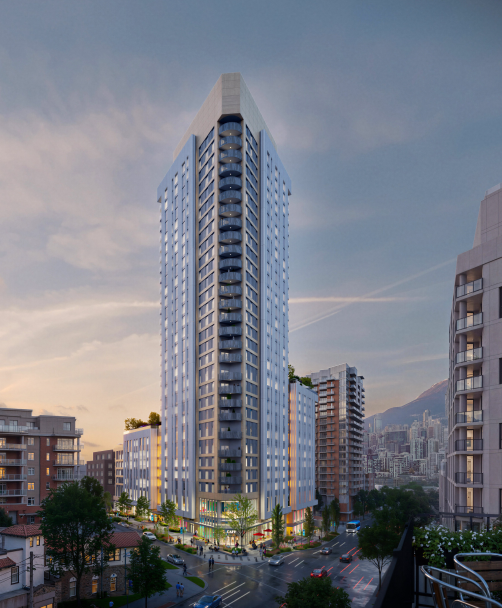
The City of Vancouver has received an application to rezone the subject site from C-3A (Commercial) District to CD-1 (Comprehensive Development) District. The proposal is to allow for the development of a 29-storey mixed-use tower, with a seven-storey podium on East 11th Avenue and a 11-storey podium on Kingsway. This proposal also includes:
- 364 social housing units;
- 17 assisted living units;
- two levels of commercial, office, and social service space;
- A floor space ratio (FSR) of 10.09;
- A building height of 101.7 m (334 ft.); and
- Partial road closure at the north and east portions of the development site.
This application is being considered under the Broadway Plan.
The City’s Tenant Relocation and Protection Policy applies to this site. This policy provides assistance and protections to eligible renters impacted by redevelopment activity. To learn more visit: vancouver.ca/protecting-tenants.
Application drawings and statistics are posted as-submitted to the City. Following staff review, the final project statistics are documented within the referral report.
The City of Vancouver has received an application to rezone the subject site from C-3A (Commercial) District to CD-1 (Comprehensive Development) District. The proposal is to allow for the development of a 29-storey mixed-use tower, with a seven-storey podium on East 11th Avenue and a 11-storey podium on Kingsway. This proposal also includes:
- 364 social housing units;
- 17 assisted living units;
- two levels of commercial, office, and social service space;
- A floor space ratio (FSR) of 10.09;
- A building height of 101.7 m (334 ft.); and
- Partial road closure at the north and east portions of the development site.
This application is being considered under the Broadway Plan.
The City’s Tenant Relocation and Protection Policy applies to this site. This policy provides assistance and protections to eligible renters impacted by redevelopment activity. To learn more visit: vancouver.ca/protecting-tenants.
Application drawings and statistics are posted as-submitted to the City. Following staff review, the final project statistics are documented within the referral report.
The opportunity to ask questions through the Q&A is available from June 17 to July 2, 2026.
We post all questions as-is and aim to respond within two business days. Some questions may require coordination with internal departments and additional time may be needed to post a response.
Please note that the comment form will remain open after the Q&A period. The Rezoning Planner can also be contacted directly for any further feedback or questions.
-
Share 1. On what basis was this application determined to be consistent with the city-wide ODP, and is a public hearing required? 2. What land-use designation does the ODP give this site, and do the proposed height and density fall within it? 3. Does the Broadway Plan authorize averaging the height and density of two policy areas, and has staff confirmed the specific averaged figures (approximately 31 storeys and 10.09 FSR) for this site? 4. What is the floor space ratio calculated on the legal parcel area, excluding the Sophia Street street area to be acquired? 5. How is the road closure / tenure for the Sophia Street triangle being sequenced with the rezoning, and what happens if it is not granted on acceptable terms? 6. How is the reduced public open space provision reconciled with the 60.7 m frontage threshold the application relies on for its scale? 7. What are the site’s frontages with and without the triangle, and do they meet the 45.7 m minimum without it. on Facebook Share 1. On what basis was this application determined to be consistent with the city-wide ODP, and is a public hearing required? 2. What land-use designation does the ODP give this site, and do the proposed height and density fall within it? 3. Does the Broadway Plan authorize averaging the height and density of two policy areas, and has staff confirmed the specific averaged figures (approximately 31 storeys and 10.09 FSR) for this site? 4. What is the floor space ratio calculated on the legal parcel area, excluding the Sophia Street street area to be acquired? 5. How is the road closure / tenure for the Sophia Street triangle being sequenced with the rezoning, and what happens if it is not granted on acceptable terms? 6. How is the reduced public open space provision reconciled with the 60.7 m frontage threshold the application relies on for its scale? 7. What are the site’s frontages with and without the triangle, and do they meet the 45.7 m minimum without it. on X (formerly Twitter) Share 1. On what basis was this application determined to be consistent with the city-wide ODP, and is a public hearing required? 2. What land-use designation does the ODP give this site, and do the proposed height and density fall within it? 3. Does the Broadway Plan authorize averaging the height and density of two policy areas, and has staff confirmed the specific averaged figures (approximately 31 storeys and 10.09 FSR) for this site? 4. What is the floor space ratio calculated on the legal parcel area, excluding the Sophia Street street area to be acquired? 5. How is the road closure / tenure for the Sophia Street triangle being sequenced with the rezoning, and what happens if it is not granted on acceptable terms? 6. How is the reduced public open space provision reconciled with the 60.7 m frontage threshold the application relies on for its scale? 7. What are the site’s frontages with and without the triangle, and do they meet the 45.7 m minimum without it. on Linkedin Email 1. On what basis was this application determined to be consistent with the city-wide ODP, and is a public hearing required? 2. What land-use designation does the ODP give this site, and do the proposed height and density fall within it? 3. Does the Broadway Plan authorize averaging the height and density of two policy areas, and has staff confirmed the specific averaged figures (approximately 31 storeys and 10.09 FSR) for this site? 4. What is the floor space ratio calculated on the legal parcel area, excluding the Sophia Street street area to be acquired? 5. How is the road closure / tenure for the Sophia Street triangle being sequenced with the rezoning, and what happens if it is not granted on acceptable terms? 6. How is the reduced public open space provision reconciled with the 60.7 m frontage threshold the application relies on for its scale? 7. What are the site’s frontages with and without the triangle, and do they meet the 45.7 m minimum without it. link
1. On what basis was this application determined to be consistent with the city-wide ODP, and is a public hearing required? 2. What land-use designation does the ODP give this site, and do the proposed height and density fall within it? 3. Does the Broadway Plan authorize averaging the height and density of two policy areas, and has staff confirmed the specific averaged figures (approximately 31 storeys and 10.09 FSR) for this site? 4. What is the floor space ratio calculated on the legal parcel area, excluding the Sophia Street street area to be acquired? 5. How is the road closure / tenure for the Sophia Street triangle being sequenced with the rezoning, and what happens if it is not granted on acceptable terms? 6. How is the reduced public open space provision reconciled with the 60.7 m frontage threshold the application relies on for its scale? 7. What are the site’s frontages with and without the triangle, and do they meet the 45.7 m minimum without it.
Denise Kendrick asked 3 months agoAn ODP amendment is not required per the Table 3 height exemptions to Generalized Land Use (GLU) designations, for social housing as enabled by policy, which is the Broadway Plan at this location. In accordance with the Vancouver Charter, a Public Hearing is prohibited if a project is consistent with the ODP and contains a majority residential use, which is the case for this rezoning application.
The GLU designations for the site are ‘Mixed-Use - High Rise 1’ (259-293 E 11th Ave) and ‘Mixed-Use - High Rise 2’ (216 Kingsway), which permits buildings up to and above 26 storeys, subject to Table 3 exemptions. The ODP does not prescribe densities.
The Broadway Plan does not provide specific direction on sites with more than one designation (i.e. within two or more policy areas). The applicant proposes a 29-storey tower and 10.09 FSR, with final project statistics to be determined through staff reviews, and the proposal and conditions of rezoning to be considered by Council.
Staff review applications as proposed by the applicant, including for the purchase of roadway. If staff support the proposed road closure and an agreement is reached for its purchase, and if Council approves the rezoning application, a related report on the proposed road closure would be submitted to Council at a subsequent regular Council meeting. In conjunction with consideration of the road closure report, Council would also pass a Resolution authorizing the sale and transfer of the closed road, thereby enabling the transaction to be completed through the Land Title Office. The timing of the road closure report can vary depending on a number of factors; however, authorization of the road closure must be completed prior to enactment of the rezoning by-law. Both the rezoning and road closure proposals would have to be approved by Council, in order to the application to proceed as proposed.
-
Share Where will the entrance(s) that serve the social services hub (i.e. the Recovery and Support Centre, the Community Health Centre with clinical services, and the Community Hub) be located/onto which street will foot traffic flow in and out? How does the City propose that traffic will flow along this section of East 11th Avenue which is already highly congested? How will emergency vehicles access this section of East 11th Avenue in a timely fashion? What is the expected impact on traffic flows of the closure of this section of Sophia Street? on Facebook Share Where will the entrance(s) that serve the social services hub (i.e. the Recovery and Support Centre, the Community Health Centre with clinical services, and the Community Hub) be located/onto which street will foot traffic flow in and out? How does the City propose that traffic will flow along this section of East 11th Avenue which is already highly congested? How will emergency vehicles access this section of East 11th Avenue in a timely fashion? What is the expected impact on traffic flows of the closure of this section of Sophia Street? on X (formerly Twitter) Share Where will the entrance(s) that serve the social services hub (i.e. the Recovery and Support Centre, the Community Health Centre with clinical services, and the Community Hub) be located/onto which street will foot traffic flow in and out? How does the City propose that traffic will flow along this section of East 11th Avenue which is already highly congested? How will emergency vehicles access this section of East 11th Avenue in a timely fashion? What is the expected impact on traffic flows of the closure of this section of Sophia Street? on Linkedin Email Where will the entrance(s) that serve the social services hub (i.e. the Recovery and Support Centre, the Community Health Centre with clinical services, and the Community Hub) be located/onto which street will foot traffic flow in and out? How does the City propose that traffic will flow along this section of East 11th Avenue which is already highly congested? How will emergency vehicles access this section of East 11th Avenue in a timely fashion? What is the expected impact on traffic flows of the closure of this section of Sophia Street? link
Where will the entrance(s) that serve the social services hub (i.e. the Recovery and Support Centre, the Community Health Centre with clinical services, and the Community Hub) be located/onto which street will foot traffic flow in and out? How does the City propose that traffic will flow along this section of East 11th Avenue which is already highly congested? How will emergency vehicles access this section of East 11th Avenue in a timely fashion? What is the expected impact on traffic flows of the closure of this section of Sophia Street?
NatD asked 3 months agoProposed access to the Community Hub is along Kingsway, with the Recovery and Support Centre accessed via elevator or feature stairs from the Community Hub. Entrance to the Community Health Centre is proposed on East 11th Avenue. Please see pages 15-16 for details and the proposed site plan on page 68 in the application booklet. Staff will be reviewing the proposal and a transportation study provided by the applicant. Following staff analysis, off-site improvements and road changes may be recommended through the rezoning conditions.
-
Share I would like to further understand the following: While I recognize the ongoing necessity of non-profit housing and care infrastructure in Vancouver, the sheer scale, height, and density of this specific proposal represent an severe over-concentration of low-barrier and social service facilities within an already vulnerable pocket of Mount Pleasant. My opposition is grounded in the following community safety and urban planning concerns: 1. Severe Over-Concentration and Public Safety Impacts The immediate vicinity of East 11th and Kingsway already serves as an active hub for supportive housing, most notably Burnham Place (205 Kingsway) located directly across the street, and The Biltmore social housing building just one block away. Adding a 29-storey tower containing 364 social housing units, a 12,032 sq. ft. Recovery and Support Centre, and an 8,518 sq. ft. community gathering hub creates an unprecedented density of specialized care services on a single intersection. The community is already dealing with localized property crime, open drug use, and street-level disruptions related to the existing, smaller-scale services. Quadrupling the volume of daily clients and residents to this exact block risks exacerbating these issues, straining local emergency responders, and degrading the safety of local business owners, families, and pedestrians who utilize the adjacent Kingsgate Mall corridor. Has this been taken under consideration? Will there be a local onsite police presence/office here to monitor this large influx in density? 2. Conflict with the Intent of the Broadway Plan While the applicant highlights that the project falls within the Broadway Plan area, a 29-storey tower reaching 334 feet in height and a density of 10.09 FSR significantly exceeds the baseline liveability expectations of this specific Mount Pleasant sub-area. The Broadway Plan was designed to integrate transit-oriented, high-density residential buildings in a manner that maintains neighborhood character, sunlight access, and commercial viability. A 29-storey monolith on this trapezoidal site will cast massive, persistent shadows over neighboring multi-family residences and nearby public parks and conflicts with the Plan's core principles regarding community liveability and environmental design. Is there a planned park or other recreational plan for this area? How do you maintain the character of the neighborhood with such tall building, regardless of whether is plan falls in the parameters of the Broadway Plan? Do you actually think this is going to make the neighborhood better? 3. Incompatibility with C-3A District Transitional Guidelines The site is currently zoned C-3A (Commercial), which mandates that developments must provide pedestrian-friendly streetscapes and a vibrant mix of commercial activity compatible with the surrounding residential community. Transitioning this site to a CD-1 (Comprehensive Development) District to accommodate a massive, multi-tiered institutional campus fundamentally disrupts the commercial fabric of the block.The street-level dynamic will shift heavily toward social service congregation, defeating the City’s own zoning bylaws aimed at maintaining continuous, welcoming retail and commercial corridors along major arterials like Kingsway. How can you possible accept this application when it goes against the city bylaws? A massive tower is anything but welcoming into an already vulnerable part of the neighborhood so what are the options? Again will there police onsite or some other option for security for this level of congregation that is bound to happen? An"integrated mental-wellness campus" of this magnitude behaves more like an institutional facility than a standard neighborhood residential build. Forcing a 29-storey tower onto a block that is already heavily saturated with supportive services is an unsustainable planning decision that fails to balance the needs of the non-profit with the safety, economic health, and well-being of the existing Mount Pleasant community. I urge the Planning Department and City Council to reject this CD-1 application and direct the applicant to downsize the project to a scale that aligns with standard neighborhood height restrictions and does not compromise local public safety. on Facebook Share I would like to further understand the following: While I recognize the ongoing necessity of non-profit housing and care infrastructure in Vancouver, the sheer scale, height, and density of this specific proposal represent an severe over-concentration of low-barrier and social service facilities within an already vulnerable pocket of Mount Pleasant. My opposition is grounded in the following community safety and urban planning concerns: 1. Severe Over-Concentration and Public Safety Impacts The immediate vicinity of East 11th and Kingsway already serves as an active hub for supportive housing, most notably Burnham Place (205 Kingsway) located directly across the street, and The Biltmore social housing building just one block away. Adding a 29-storey tower containing 364 social housing units, a 12,032 sq. ft. Recovery and Support Centre, and an 8,518 sq. ft. community gathering hub creates an unprecedented density of specialized care services on a single intersection. The community is already dealing with localized property crime, open drug use, and street-level disruptions related to the existing, smaller-scale services. Quadrupling the volume of daily clients and residents to this exact block risks exacerbating these issues, straining local emergency responders, and degrading the safety of local business owners, families, and pedestrians who utilize the adjacent Kingsgate Mall corridor. Has this been taken under consideration? Will there be a local onsite police presence/office here to monitor this large influx in density? 2. Conflict with the Intent of the Broadway Plan While the applicant highlights that the project falls within the Broadway Plan area, a 29-storey tower reaching 334 feet in height and a density of 10.09 FSR significantly exceeds the baseline liveability expectations of this specific Mount Pleasant sub-area. The Broadway Plan was designed to integrate transit-oriented, high-density residential buildings in a manner that maintains neighborhood character, sunlight access, and commercial viability. A 29-storey monolith on this trapezoidal site will cast massive, persistent shadows over neighboring multi-family residences and nearby public parks and conflicts with the Plan's core principles regarding community liveability and environmental design. Is there a planned park or other recreational plan for this area? How do you maintain the character of the neighborhood with such tall building, regardless of whether is plan falls in the parameters of the Broadway Plan? Do you actually think this is going to make the neighborhood better? 3. Incompatibility with C-3A District Transitional Guidelines The site is currently zoned C-3A (Commercial), which mandates that developments must provide pedestrian-friendly streetscapes and a vibrant mix of commercial activity compatible with the surrounding residential community. Transitioning this site to a CD-1 (Comprehensive Development) District to accommodate a massive, multi-tiered institutional campus fundamentally disrupts the commercial fabric of the block.The street-level dynamic will shift heavily toward social service congregation, defeating the City’s own zoning bylaws aimed at maintaining continuous, welcoming retail and commercial corridors along major arterials like Kingsway. How can you possible accept this application when it goes against the city bylaws? A massive tower is anything but welcoming into an already vulnerable part of the neighborhood so what are the options? Again will there police onsite or some other option for security for this level of congregation that is bound to happen? An"integrated mental-wellness campus" of this magnitude behaves more like an institutional facility than a standard neighborhood residential build. Forcing a 29-storey tower onto a block that is already heavily saturated with supportive services is an unsustainable planning decision that fails to balance the needs of the non-profit with the safety, economic health, and well-being of the existing Mount Pleasant community. I urge the Planning Department and City Council to reject this CD-1 application and direct the applicant to downsize the project to a scale that aligns with standard neighborhood height restrictions and does not compromise local public safety. on X (formerly Twitter) Share I would like to further understand the following: While I recognize the ongoing necessity of non-profit housing and care infrastructure in Vancouver, the sheer scale, height, and density of this specific proposal represent an severe over-concentration of low-barrier and social service facilities within an already vulnerable pocket of Mount Pleasant. My opposition is grounded in the following community safety and urban planning concerns: 1. Severe Over-Concentration and Public Safety Impacts The immediate vicinity of East 11th and Kingsway already serves as an active hub for supportive housing, most notably Burnham Place (205 Kingsway) located directly across the street, and The Biltmore social housing building just one block away. Adding a 29-storey tower containing 364 social housing units, a 12,032 sq. ft. Recovery and Support Centre, and an 8,518 sq. ft. community gathering hub creates an unprecedented density of specialized care services on a single intersection. The community is already dealing with localized property crime, open drug use, and street-level disruptions related to the existing, smaller-scale services. Quadrupling the volume of daily clients and residents to this exact block risks exacerbating these issues, straining local emergency responders, and degrading the safety of local business owners, families, and pedestrians who utilize the adjacent Kingsgate Mall corridor. Has this been taken under consideration? Will there be a local onsite police presence/office here to monitor this large influx in density? 2. Conflict with the Intent of the Broadway Plan While the applicant highlights that the project falls within the Broadway Plan area, a 29-storey tower reaching 334 feet in height and a density of 10.09 FSR significantly exceeds the baseline liveability expectations of this specific Mount Pleasant sub-area. The Broadway Plan was designed to integrate transit-oriented, high-density residential buildings in a manner that maintains neighborhood character, sunlight access, and commercial viability. A 29-storey monolith on this trapezoidal site will cast massive, persistent shadows over neighboring multi-family residences and nearby public parks and conflicts with the Plan's core principles regarding community liveability and environmental design. Is there a planned park or other recreational plan for this area? How do you maintain the character of the neighborhood with such tall building, regardless of whether is plan falls in the parameters of the Broadway Plan? Do you actually think this is going to make the neighborhood better? 3. Incompatibility with C-3A District Transitional Guidelines The site is currently zoned C-3A (Commercial), which mandates that developments must provide pedestrian-friendly streetscapes and a vibrant mix of commercial activity compatible with the surrounding residential community. Transitioning this site to a CD-1 (Comprehensive Development) District to accommodate a massive, multi-tiered institutional campus fundamentally disrupts the commercial fabric of the block.The street-level dynamic will shift heavily toward social service congregation, defeating the City’s own zoning bylaws aimed at maintaining continuous, welcoming retail and commercial corridors along major arterials like Kingsway. How can you possible accept this application when it goes against the city bylaws? A massive tower is anything but welcoming into an already vulnerable part of the neighborhood so what are the options? Again will there police onsite or some other option for security for this level of congregation that is bound to happen? An"integrated mental-wellness campus" of this magnitude behaves more like an institutional facility than a standard neighborhood residential build. Forcing a 29-storey tower onto a block that is already heavily saturated with supportive services is an unsustainable planning decision that fails to balance the needs of the non-profit with the safety, economic health, and well-being of the existing Mount Pleasant community. I urge the Planning Department and City Council to reject this CD-1 application and direct the applicant to downsize the project to a scale that aligns with standard neighborhood height restrictions and does not compromise local public safety. on Linkedin Email I would like to further understand the following: While I recognize the ongoing necessity of non-profit housing and care infrastructure in Vancouver, the sheer scale, height, and density of this specific proposal represent an severe over-concentration of low-barrier and social service facilities within an already vulnerable pocket of Mount Pleasant. My opposition is grounded in the following community safety and urban planning concerns: 1. Severe Over-Concentration and Public Safety Impacts The immediate vicinity of East 11th and Kingsway already serves as an active hub for supportive housing, most notably Burnham Place (205 Kingsway) located directly across the street, and The Biltmore social housing building just one block away. Adding a 29-storey tower containing 364 social housing units, a 12,032 sq. ft. Recovery and Support Centre, and an 8,518 sq. ft. community gathering hub creates an unprecedented density of specialized care services on a single intersection. The community is already dealing with localized property crime, open drug use, and street-level disruptions related to the existing, smaller-scale services. Quadrupling the volume of daily clients and residents to this exact block risks exacerbating these issues, straining local emergency responders, and degrading the safety of local business owners, families, and pedestrians who utilize the adjacent Kingsgate Mall corridor. Has this been taken under consideration? Will there be a local onsite police presence/office here to monitor this large influx in density? 2. Conflict with the Intent of the Broadway Plan While the applicant highlights that the project falls within the Broadway Plan area, a 29-storey tower reaching 334 feet in height and a density of 10.09 FSR significantly exceeds the baseline liveability expectations of this specific Mount Pleasant sub-area. The Broadway Plan was designed to integrate transit-oriented, high-density residential buildings in a manner that maintains neighborhood character, sunlight access, and commercial viability. A 29-storey monolith on this trapezoidal site will cast massive, persistent shadows over neighboring multi-family residences and nearby public parks and conflicts with the Plan's core principles regarding community liveability and environmental design. Is there a planned park or other recreational plan for this area? How do you maintain the character of the neighborhood with such tall building, regardless of whether is plan falls in the parameters of the Broadway Plan? Do you actually think this is going to make the neighborhood better? 3. Incompatibility with C-3A District Transitional Guidelines The site is currently zoned C-3A (Commercial), which mandates that developments must provide pedestrian-friendly streetscapes and a vibrant mix of commercial activity compatible with the surrounding residential community. Transitioning this site to a CD-1 (Comprehensive Development) District to accommodate a massive, multi-tiered institutional campus fundamentally disrupts the commercial fabric of the block.The street-level dynamic will shift heavily toward social service congregation, defeating the City’s own zoning bylaws aimed at maintaining continuous, welcoming retail and commercial corridors along major arterials like Kingsway. How can you possible accept this application when it goes against the city bylaws? A massive tower is anything but welcoming into an already vulnerable part of the neighborhood so what are the options? Again will there police onsite or some other option for security for this level of congregation that is bound to happen? An"integrated mental-wellness campus" of this magnitude behaves more like an institutional facility than a standard neighborhood residential build. Forcing a 29-storey tower onto a block that is already heavily saturated with supportive services is an unsustainable planning decision that fails to balance the needs of the non-profit with the safety, economic health, and well-being of the existing Mount Pleasant community. I urge the Planning Department and City Council to reject this CD-1 application and direct the applicant to downsize the project to a scale that aligns with standard neighborhood height restrictions and does not compromise local public safety. link
I would like to further understand the following: While I recognize the ongoing necessity of non-profit housing and care infrastructure in Vancouver, the sheer scale, height, and density of this specific proposal represent an severe over-concentration of low-barrier and social service facilities within an already vulnerable pocket of Mount Pleasant. My opposition is grounded in the following community safety and urban planning concerns: 1. Severe Over-Concentration and Public Safety Impacts The immediate vicinity of East 11th and Kingsway already serves as an active hub for supportive housing, most notably Burnham Place (205 Kingsway) located directly across the street, and The Biltmore social housing building just one block away. Adding a 29-storey tower containing 364 social housing units, a 12,032 sq. ft. Recovery and Support Centre, and an 8,518 sq. ft. community gathering hub creates an unprecedented density of specialized care services on a single intersection. The community is already dealing with localized property crime, open drug use, and street-level disruptions related to the existing, smaller-scale services. Quadrupling the volume of daily clients and residents to this exact block risks exacerbating these issues, straining local emergency responders, and degrading the safety of local business owners, families, and pedestrians who utilize the adjacent Kingsgate Mall corridor. Has this been taken under consideration? Will there be a local onsite police presence/office here to monitor this large influx in density? 2. Conflict with the Intent of the Broadway Plan While the applicant highlights that the project falls within the Broadway Plan area, a 29-storey tower reaching 334 feet in height and a density of 10.09 FSR significantly exceeds the baseline liveability expectations of this specific Mount Pleasant sub-area. The Broadway Plan was designed to integrate transit-oriented, high-density residential buildings in a manner that maintains neighborhood character, sunlight access, and commercial viability. A 29-storey monolith on this trapezoidal site will cast massive, persistent shadows over neighboring multi-family residences and nearby public parks and conflicts with the Plan's core principles regarding community liveability and environmental design. Is there a planned park or other recreational plan for this area? How do you maintain the character of the neighborhood with such tall building, regardless of whether is plan falls in the parameters of the Broadway Plan? Do you actually think this is going to make the neighborhood better? 3. Incompatibility with C-3A District Transitional Guidelines The site is currently zoned C-3A (Commercial), which mandates that developments must provide pedestrian-friendly streetscapes and a vibrant mix of commercial activity compatible with the surrounding residential community. Transitioning this site to a CD-1 (Comprehensive Development) District to accommodate a massive, multi-tiered institutional campus fundamentally disrupts the commercial fabric of the block.The street-level dynamic will shift heavily toward social service congregation, defeating the City’s own zoning bylaws aimed at maintaining continuous, welcoming retail and commercial corridors along major arterials like Kingsway. How can you possible accept this application when it goes against the city bylaws? A massive tower is anything but welcoming into an already vulnerable part of the neighborhood so what are the options? Again will there police onsite or some other option for security for this level of congregation that is bound to happen? An"integrated mental-wellness campus" of this magnitude behaves more like an institutional facility than a standard neighborhood residential build. Forcing a 29-storey tower onto a block that is already heavily saturated with supportive services is an unsustainable planning decision that fails to balance the needs of the non-profit with the safety, economic health, and well-being of the existing Mount Pleasant community. I urge the Planning Department and City Council to reject this CD-1 application and direct the applicant to downsize the project to a scale that aligns with standard neighborhood height restrictions and does not compromise local public safety.
Rosar asked 3 months agoThe City's role in reviewing a rezoning application is to assess land use, density, building form, and consistency with Council-approved policies. For rezoning applications, the City does not generally undertake reviews related to demand for emergency responders, and limits its reviews to the location proposed by an applicant. As noted in previous Q&A responses and in the rezoning application booklet, Coast Mental Health (CMH) owns the subject properties and already operates a smaller number of homes at this site. Its current head office and "Clubhouse" programming space at this site will be relocated into the proposed new building. While the proposed increase in density is primarily for new purpose-built rental housing having 30% of units at affordable HILS rates (i.e. social housing), the proposal also includes assisted living units and a “community hub” which are supported by City policies including the Seniors Housing, Community Care Facility and Group Residence Guidelines), City of Reconciliation, Healthy City Strategy, and Spaces to Thrive: Vancouver Social Infrastructure Strategy.
The Public Benefits Strategy Summary in the Broadway Plan policy outlines a 10-year Capital Investment Strategy for the entire Plan area, including $96 million for parks and open spaces and $48 million for community facilities. The Broadway Public Realm Plan also identifies the development site as being in a Park and Public Space priority area. The applicant’s proposed privately-owned public space at 11th Avenue and Kingsway is shown on page 6 of the landscape drawings and the shadow analysis is shown on page 66 of the rezoning booklet. The application proposal is under review by staff.
Section 6 of the Broadway Plan addresses “character areas” to provide a spatial framework for how the Broadway neighbourhoods can grow and change to meet both local and city‑wide needs. For example, maintaining lower building heights for new development to reflect a village character and maximize sunlight on the sidewalks have been identified as directions in Village areas, such as Main Street between 7th and 16th Avenues. In areas identified as Centres, such as at this site, the Plan provides direction to strategically locate new housing opportunities, particularly secured rental and social housing, through increased heights and densities. The C-3A district schedule requires that the front of the first storey be non-dwelling uses. While this district schedule does not apply to a CD-1, the application is generally consistent as it proposes commercial uses and mental health program areas along Kingsway while the entrance to the social housing component is located on 11th Avenue.
-
Share In an earlier response to SaraSG, staff stated that the proposed height is permissible because the Vancouver ODP provides height exemptions for projects where 100% of residential floor space is social housing, referencing Table 3. However, the full clause in ODP Part 4, Table 3, Line 1 specifies that height exemptions apply “as enabled by policy or regulation.” This means the ODP does not independently grant the exemption; it requires a separate enabling Council policy or regulation. Could staff please identify which specific policy or regulation is being relied upon to enable the height exemption in this case? I also note that Broadway Plan Policy 12.2.10 allows social housing to reach the maximum height and density permitted for the site. The current proposal exceeds those maximums. Clarification is needed on how this is being justified under the enabling policy framework. Importantly, the ODP contains no exemption to density for social housing. Part 4 (Future Growth) and FG2 (Generalized Land Use Designations) outline height exceptions, but no density exceptions are provided anywhere in the ODP. Density must therefore comply with the applicable GLU designation unless another Council‑approved policy explicitly enables an increase. Staff’s response did not identify such a policy. Will the City secure the continued provision of social housing through a Housing Agreement or covenant? If so, what is the duration - perpetuity, or a limited term? Can the applicant also clarify whether BC Housing will require any restrictive covenants or operating agreements guaranteeing below‑market rents? The applicant’s booklet states that priority will be given to low‑income families and seniors, with rents ranging “from deeply affordable to near‑market rates.” To understand the long‑term affordability profile of the project, could the applicant specify: How many units will be deeply affordable, and for how long they are guaranteed; and What percentage of units will be offered at near‑market rates. Thanks. on Facebook Share In an earlier response to SaraSG, staff stated that the proposed height is permissible because the Vancouver ODP provides height exemptions for projects where 100% of residential floor space is social housing, referencing Table 3. However, the full clause in ODP Part 4, Table 3, Line 1 specifies that height exemptions apply “as enabled by policy or regulation.” This means the ODP does not independently grant the exemption; it requires a separate enabling Council policy or regulation. Could staff please identify which specific policy or regulation is being relied upon to enable the height exemption in this case? I also note that Broadway Plan Policy 12.2.10 allows social housing to reach the maximum height and density permitted for the site. The current proposal exceeds those maximums. Clarification is needed on how this is being justified under the enabling policy framework. Importantly, the ODP contains no exemption to density for social housing. Part 4 (Future Growth) and FG2 (Generalized Land Use Designations) outline height exceptions, but no density exceptions are provided anywhere in the ODP. Density must therefore comply with the applicable GLU designation unless another Council‑approved policy explicitly enables an increase. Staff’s response did not identify such a policy. Will the City secure the continued provision of social housing through a Housing Agreement or covenant? If so, what is the duration - perpetuity, or a limited term? Can the applicant also clarify whether BC Housing will require any restrictive covenants or operating agreements guaranteeing below‑market rents? The applicant’s booklet states that priority will be given to low‑income families and seniors, with rents ranging “from deeply affordable to near‑market rates.” To understand the long‑term affordability profile of the project, could the applicant specify: How many units will be deeply affordable, and for how long they are guaranteed; and What percentage of units will be offered at near‑market rates. Thanks. on X (formerly Twitter) Share In an earlier response to SaraSG, staff stated that the proposed height is permissible because the Vancouver ODP provides height exemptions for projects where 100% of residential floor space is social housing, referencing Table 3. However, the full clause in ODP Part 4, Table 3, Line 1 specifies that height exemptions apply “as enabled by policy or regulation.” This means the ODP does not independently grant the exemption; it requires a separate enabling Council policy or regulation. Could staff please identify which specific policy or regulation is being relied upon to enable the height exemption in this case? I also note that Broadway Plan Policy 12.2.10 allows social housing to reach the maximum height and density permitted for the site. The current proposal exceeds those maximums. Clarification is needed on how this is being justified under the enabling policy framework. Importantly, the ODP contains no exemption to density for social housing. Part 4 (Future Growth) and FG2 (Generalized Land Use Designations) outline height exceptions, but no density exceptions are provided anywhere in the ODP. Density must therefore comply with the applicable GLU designation unless another Council‑approved policy explicitly enables an increase. Staff’s response did not identify such a policy. Will the City secure the continued provision of social housing through a Housing Agreement or covenant? If so, what is the duration - perpetuity, or a limited term? Can the applicant also clarify whether BC Housing will require any restrictive covenants or operating agreements guaranteeing below‑market rents? The applicant’s booklet states that priority will be given to low‑income families and seniors, with rents ranging “from deeply affordable to near‑market rates.” To understand the long‑term affordability profile of the project, could the applicant specify: How many units will be deeply affordable, and for how long they are guaranteed; and What percentage of units will be offered at near‑market rates. Thanks. on Linkedin Email In an earlier response to SaraSG, staff stated that the proposed height is permissible because the Vancouver ODP provides height exemptions for projects where 100% of residential floor space is social housing, referencing Table 3. However, the full clause in ODP Part 4, Table 3, Line 1 specifies that height exemptions apply “as enabled by policy or regulation.” This means the ODP does not independently grant the exemption; it requires a separate enabling Council policy or regulation. Could staff please identify which specific policy or regulation is being relied upon to enable the height exemption in this case? I also note that Broadway Plan Policy 12.2.10 allows social housing to reach the maximum height and density permitted for the site. The current proposal exceeds those maximums. Clarification is needed on how this is being justified under the enabling policy framework. Importantly, the ODP contains no exemption to density for social housing. Part 4 (Future Growth) and FG2 (Generalized Land Use Designations) outline height exceptions, but no density exceptions are provided anywhere in the ODP. Density must therefore comply with the applicable GLU designation unless another Council‑approved policy explicitly enables an increase. Staff’s response did not identify such a policy. Will the City secure the continued provision of social housing through a Housing Agreement or covenant? If so, what is the duration - perpetuity, or a limited term? Can the applicant also clarify whether BC Housing will require any restrictive covenants or operating agreements guaranteeing below‑market rents? The applicant’s booklet states that priority will be given to low‑income families and seniors, with rents ranging “from deeply affordable to near‑market rates.” To understand the long‑term affordability profile of the project, could the applicant specify: How many units will be deeply affordable, and for how long they are guaranteed; and What percentage of units will be offered at near‑market rates. Thanks. link
In an earlier response to SaraSG, staff stated that the proposed height is permissible because the Vancouver ODP provides height exemptions for projects where 100% of residential floor space is social housing, referencing Table 3. However, the full clause in ODP Part 4, Table 3, Line 1 specifies that height exemptions apply “as enabled by policy or regulation.” This means the ODP does not independently grant the exemption; it requires a separate enabling Council policy or regulation. Could staff please identify which specific policy or regulation is being relied upon to enable the height exemption in this case? I also note that Broadway Plan Policy 12.2.10 allows social housing to reach the maximum height and density permitted for the site. The current proposal exceeds those maximums. Clarification is needed on how this is being justified under the enabling policy framework. Importantly, the ODP contains no exemption to density for social housing. Part 4 (Future Growth) and FG2 (Generalized Land Use Designations) outline height exceptions, but no density exceptions are provided anywhere in the ODP. Density must therefore comply with the applicable GLU designation unless another Council‑approved policy explicitly enables an increase. Staff’s response did not identify such a policy. Will the City secure the continued provision of social housing through a Housing Agreement or covenant? If so, what is the duration - perpetuity, or a limited term? Can the applicant also clarify whether BC Housing will require any restrictive covenants or operating agreements guaranteeing below‑market rents? The applicant’s booklet states that priority will be given to low‑income families and seniors, with rents ranging “from deeply affordable to near‑market rates.” To understand the long‑term affordability profile of the project, could the applicant specify: How many units will be deeply affordable, and for how long they are guaranteed; and What percentage of units will be offered at near‑market rates. Thanks.
Robnordrum asked 3 months agoAn ODP amendment is not required per the Table 3 exemption for social housing. This site is enabled by policy in the Broadway Plan. The table on page 82 allows for modest height increases for larger sites. The ODP does not prescribe densities.
Yes, the City will secure the social housing through a Housing Agreement. The standard term has been for 60 years or the life of the building, whichever is greater. Questions regarding the affordability profile for the project should be directed to the applicant, whose contact information in located in the right sidebar of this webpage.
-
Share RE: Variances, Public Hearing, and Opportunities for input to Mayor and Council - The applicant is requesting significant variances related to height, FSR, floor plate size, and massing. These parameters were intentionally established through the Broadway Plan following extensive public engagement and Council approval. They were created to provide clarity for applicants while ensuring that new development fits appropriately within established neighbourhood contexts and protects existing residents. I am concerned that these core controls are being set aside under the rationale of broader social benefit without a clear policy basis. The majority of the site is designated MCEB, with a maximum height of 25 storeys and an 8.0 FSR. It is unclear why these limits are not being applied. The applicant notes that staff advised using an average of the two applicable designations, yet even under an averaging approach the proposal still seeks the full 10.0 FSR and 30 storeys associated only with the small northern portion of the site. The proposal also includes a floor plate larger than what the Broadway Plan permits. A larger floor plate increases development potential and unit yield for the applicant but does not provide any additional community benefit. It will result in a bulkier and more massive form that will further impact views, solar access, and overall street experience. I respect the social benefit of the proposed uses, but setting aside multiple core planning controls is not an appropriate or sustainable way to achieve those outcomes. It raises the question of why the Broadway Plan was created if its key parameters can be disregarded so readily. I also noted a recent press release stating that because the project meets the Broadway Plan, no public hearing would be required. Based on the number and scale of variances being requested, I do not see how this conclusion can be supported. Q: 1) Can staff clarify specifically how many variances (both with the Broadway Plan, Development Guidelines, and any other Bylaws) will be required to accommodate the proposal, 2) whether a Broadway Plan amendment will be necessary, 3) whether a Public Hearing will be required, and 4) will the public have additional opportunities to address Mayor and Council - other than the digital comment section on the other tab? Thanks on Facebook Share RE: Variances, Public Hearing, and Opportunities for input to Mayor and Council - The applicant is requesting significant variances related to height, FSR, floor plate size, and massing. These parameters were intentionally established through the Broadway Plan following extensive public engagement and Council approval. They were created to provide clarity for applicants while ensuring that new development fits appropriately within established neighbourhood contexts and protects existing residents. I am concerned that these core controls are being set aside under the rationale of broader social benefit without a clear policy basis. The majority of the site is designated MCEB, with a maximum height of 25 storeys and an 8.0 FSR. It is unclear why these limits are not being applied. The applicant notes that staff advised using an average of the two applicable designations, yet even under an averaging approach the proposal still seeks the full 10.0 FSR and 30 storeys associated only with the small northern portion of the site. The proposal also includes a floor plate larger than what the Broadway Plan permits. A larger floor plate increases development potential and unit yield for the applicant but does not provide any additional community benefit. It will result in a bulkier and more massive form that will further impact views, solar access, and overall street experience. I respect the social benefit of the proposed uses, but setting aside multiple core planning controls is not an appropriate or sustainable way to achieve those outcomes. It raises the question of why the Broadway Plan was created if its key parameters can be disregarded so readily. I also noted a recent press release stating that because the project meets the Broadway Plan, no public hearing would be required. Based on the number and scale of variances being requested, I do not see how this conclusion can be supported. Q: 1) Can staff clarify specifically how many variances (both with the Broadway Plan, Development Guidelines, and any other Bylaws) will be required to accommodate the proposal, 2) whether a Broadway Plan amendment will be necessary, 3) whether a Public Hearing will be required, and 4) will the public have additional opportunities to address Mayor and Council - other than the digital comment section on the other tab? Thanks on X (formerly Twitter) Share RE: Variances, Public Hearing, and Opportunities for input to Mayor and Council - The applicant is requesting significant variances related to height, FSR, floor plate size, and massing. These parameters were intentionally established through the Broadway Plan following extensive public engagement and Council approval. They were created to provide clarity for applicants while ensuring that new development fits appropriately within established neighbourhood contexts and protects existing residents. I am concerned that these core controls are being set aside under the rationale of broader social benefit without a clear policy basis. The majority of the site is designated MCEB, with a maximum height of 25 storeys and an 8.0 FSR. It is unclear why these limits are not being applied. The applicant notes that staff advised using an average of the two applicable designations, yet even under an averaging approach the proposal still seeks the full 10.0 FSR and 30 storeys associated only with the small northern portion of the site. The proposal also includes a floor plate larger than what the Broadway Plan permits. A larger floor plate increases development potential and unit yield for the applicant but does not provide any additional community benefit. It will result in a bulkier and more massive form that will further impact views, solar access, and overall street experience. I respect the social benefit of the proposed uses, but setting aside multiple core planning controls is not an appropriate or sustainable way to achieve those outcomes. It raises the question of why the Broadway Plan was created if its key parameters can be disregarded so readily. I also noted a recent press release stating that because the project meets the Broadway Plan, no public hearing would be required. Based on the number and scale of variances being requested, I do not see how this conclusion can be supported. Q: 1) Can staff clarify specifically how many variances (both with the Broadway Plan, Development Guidelines, and any other Bylaws) will be required to accommodate the proposal, 2) whether a Broadway Plan amendment will be necessary, 3) whether a Public Hearing will be required, and 4) will the public have additional opportunities to address Mayor and Council - other than the digital comment section on the other tab? Thanks on Linkedin Email RE: Variances, Public Hearing, and Opportunities for input to Mayor and Council - The applicant is requesting significant variances related to height, FSR, floor plate size, and massing. These parameters were intentionally established through the Broadway Plan following extensive public engagement and Council approval. They were created to provide clarity for applicants while ensuring that new development fits appropriately within established neighbourhood contexts and protects existing residents. I am concerned that these core controls are being set aside under the rationale of broader social benefit without a clear policy basis. The majority of the site is designated MCEB, with a maximum height of 25 storeys and an 8.0 FSR. It is unclear why these limits are not being applied. The applicant notes that staff advised using an average of the two applicable designations, yet even under an averaging approach the proposal still seeks the full 10.0 FSR and 30 storeys associated only with the small northern portion of the site. The proposal also includes a floor plate larger than what the Broadway Plan permits. A larger floor plate increases development potential and unit yield for the applicant but does not provide any additional community benefit. It will result in a bulkier and more massive form that will further impact views, solar access, and overall street experience. I respect the social benefit of the proposed uses, but setting aside multiple core planning controls is not an appropriate or sustainable way to achieve those outcomes. It raises the question of why the Broadway Plan was created if its key parameters can be disregarded so readily. I also noted a recent press release stating that because the project meets the Broadway Plan, no public hearing would be required. Based on the number and scale of variances being requested, I do not see how this conclusion can be supported. Q: 1) Can staff clarify specifically how many variances (both with the Broadway Plan, Development Guidelines, and any other Bylaws) will be required to accommodate the proposal, 2) whether a Broadway Plan amendment will be necessary, 3) whether a Public Hearing will be required, and 4) will the public have additional opportunities to address Mayor and Council - other than the digital comment section on the other tab? Thanks link
RE: Variances, Public Hearing, and Opportunities for input to Mayor and Council - The applicant is requesting significant variances related to height, FSR, floor plate size, and massing. These parameters were intentionally established through the Broadway Plan following extensive public engagement and Council approval. They were created to provide clarity for applicants while ensuring that new development fits appropriately within established neighbourhood contexts and protects existing residents. I am concerned that these core controls are being set aside under the rationale of broader social benefit without a clear policy basis. The majority of the site is designated MCEB, with a maximum height of 25 storeys and an 8.0 FSR. It is unclear why these limits are not being applied. The applicant notes that staff advised using an average of the two applicable designations, yet even under an averaging approach the proposal still seeks the full 10.0 FSR and 30 storeys associated only with the small northern portion of the site. The proposal also includes a floor plate larger than what the Broadway Plan permits. A larger floor plate increases development potential and unit yield for the applicant but does not provide any additional community benefit. It will result in a bulkier and more massive form that will further impact views, solar access, and overall street experience. I respect the social benefit of the proposed uses, but setting aside multiple core planning controls is not an appropriate or sustainable way to achieve those outcomes. It raises the question of why the Broadway Plan was created if its key parameters can be disregarded so readily. I also noted a recent press release stating that because the project meets the Broadway Plan, no public hearing would be required. Based on the number and scale of variances being requested, I do not see how this conclusion can be supported. Q: 1) Can staff clarify specifically how many variances (both with the Broadway Plan, Development Guidelines, and any other Bylaws) will be required to accommodate the proposal, 2) whether a Broadway Plan amendment will be necessary, 3) whether a Public Hearing will be required, and 4) will the public have additional opportunities to address Mayor and Council - other than the digital comment section on the other tab? Thanks
Robnordrum asked 3 months agoFor this site, the relevant form of development guidance is provided in Sections 11.6 and 11.7 of the Broadway Plan. The application booklet (at page 35) notes eight areas where the application proposes variations from the Broadway Plan such as unit mix, podium and tower form, and floor plate size. Variations of the proposal from Broadway Plan policy are set out in the urban design analysis of a Council Report for consideration of the rezoning. Amendments to the Broadway Plan are not required. In accordance with the Vancouver Charter, a Public Hearing is prohibited if a project is consistent with the Official Development Plan (ODP) and contains a majority residential use, which is the case for this rezoning application.
Public comments collected through the rezoning process are summarized in a report to Council when the proposal moves forward for Council consideration. The public will also be notified of future Council decisions and how to submit comments directly to Council at that time. Clerks publish the meeting agenda online at https://vancouver.ca/council-meetings no less than five days before the meeting. Once the agenda is published, the public may submit direct feedback to Council by selecting the rezoning agenda item from the page as "Feedback on an upcoming Council meeting agenda item".
-
Share Does the Vancouver Charter or other relevant policy require CoV to have a road closure Bylaw and Public Hearing prior to raising title and disposing (selling / consolidating) Sophia Street? If so, what is the timeline expected for this? on Facebook Share Does the Vancouver Charter or other relevant policy require CoV to have a road closure Bylaw and Public Hearing prior to raising title and disposing (selling / consolidating) Sophia Street? If so, what is the timeline expected for this? on X (formerly Twitter) Share Does the Vancouver Charter or other relevant policy require CoV to have a road closure Bylaw and Public Hearing prior to raising title and disposing (selling / consolidating) Sophia Street? If so, what is the timeline expected for this? on Linkedin Email Does the Vancouver Charter or other relevant policy require CoV to have a road closure Bylaw and Public Hearing prior to raising title and disposing (selling / consolidating) Sophia Street? If so, what is the timeline expected for this? link
Does the Vancouver Charter or other relevant policy require CoV to have a road closure Bylaw and Public Hearing prior to raising title and disposing (selling / consolidating) Sophia Street? If so, what is the timeline expected for this?
Robnordrum asked 3 months agoThe authority to close, stop up, and convey a street or lane is provided under Sections 291, 291A, and 190 of the Vancouver Charter. If Council approves the rezoning application, a related report would be submitted to Council at a subsequent regular Council meeting. In conjunction with consideration of the road closure report, Council would also pass a Resolution authorizing the sale and transfer of the closed road, thereby enabling the transaction to be completed through the Land Title Office. The timing of the road closure report can vary depending on a number of factors; however, authorization of the road closure must be completed prior to enactment of the rezoning by-law.
-
Share The City’s own Guidelines require that all residential units include a balcony or equivalent private outdoor space. Allowing the applicant to omit balconies appears to contradict these standards and raises serious equity concerns for future residents. If the City is prepared to waive this requirement, what is the rationale? Is this effectively saying that residents in social housing do not need or deserve the same access to private outdoor space as market‑rate residents? This would set a troubling precedent for future projects and undermine long‑standing livability expectations. Given the absence of a clear justification for removing balconies, I do not support this development. on Facebook Share The City’s own Guidelines require that all residential units include a balcony or equivalent private outdoor space. Allowing the applicant to omit balconies appears to contradict these standards and raises serious equity concerns for future residents. If the City is prepared to waive this requirement, what is the rationale? Is this effectively saying that residents in social housing do not need or deserve the same access to private outdoor space as market‑rate residents? This would set a troubling precedent for future projects and undermine long‑standing livability expectations. Given the absence of a clear justification for removing balconies, I do not support this development. on X (formerly Twitter) Share The City’s own Guidelines require that all residential units include a balcony or equivalent private outdoor space. Allowing the applicant to omit balconies appears to contradict these standards and raises serious equity concerns for future residents. If the City is prepared to waive this requirement, what is the rationale? Is this effectively saying that residents in social housing do not need or deserve the same access to private outdoor space as market‑rate residents? This would set a troubling precedent for future projects and undermine long‑standing livability expectations. Given the absence of a clear justification for removing balconies, I do not support this development. on Linkedin Email The City’s own Guidelines require that all residential units include a balcony or equivalent private outdoor space. Allowing the applicant to omit balconies appears to contradict these standards and raises serious equity concerns for future residents. If the City is prepared to waive this requirement, what is the rationale? Is this effectively saying that residents in social housing do not need or deserve the same access to private outdoor space as market‑rate residents? This would set a troubling precedent for future projects and undermine long‑standing livability expectations. Given the absence of a clear justification for removing balconies, I do not support this development. link
The City’s own Guidelines require that all residential units include a balcony or equivalent private outdoor space. Allowing the applicant to omit balconies appears to contradict these standards and raises serious equity concerns for future residents. If the City is prepared to waive this requirement, what is the rationale? Is this effectively saying that residents in social housing do not need or deserve the same access to private outdoor space as market‑rate residents? This would set a troubling precedent for future projects and undermine long‑standing livability expectations. Given the absence of a clear justification for removing balconies, I do not support this development.
Robnordrum asked 3 months ago[June 30, 2026]
Thank you for your Q&A submission. We are working on answers to your questions, and will post responses as soon as we can. Thank you for your patience.[July 3, 2026]
Recently approved and emerging policy allows for exceptions to the provision of a private balcony for each unit. The Broadway Plan recognizes that site conditions may prevent all residential units from having private outdoor space (11.1.23). The draft Citywide Design and Development Guidelines that are being considered by Council in July 2026 will allow for exceptions for units with exposure to high volume streets and for units in non-profit projects (S2.14.2). The approved Design and Development Guidelines applicable to R5 (high rise) districts allows for common amenity space in lieu of balconies for studio and 1-bedroom units in non-profit housing (2.5.2). In this application, the rationale booklet indicates that a minority of 1-bedroom units and no studio units are proposed to have balconies due to Coast Mental Health’s operational needs, while balconies are prioritized for family units. Additional information on the rationale for reducing balconies in smaller units is provided on pg. 38 of the booklet.
-
Share What is the plan to accommodate the increased traffic on 11th ave? One of the major entrances to the underground parking will be off 11th and the street is effectively 1 way when cars are parked on both sides. What about increased demand for street parking? Why a building of this size determined to be the best choice when the biggest nearby tops out at 15? on Facebook Share What is the plan to accommodate the increased traffic on 11th ave? One of the major entrances to the underground parking will be off 11th and the street is effectively 1 way when cars are parked on both sides. What about increased demand for street parking? Why a building of this size determined to be the best choice when the biggest nearby tops out at 15? on X (formerly Twitter) Share What is the plan to accommodate the increased traffic on 11th ave? One of the major entrances to the underground parking will be off 11th and the street is effectively 1 way when cars are parked on both sides. What about increased demand for street parking? Why a building of this size determined to be the best choice when the biggest nearby tops out at 15? on Linkedin Email What is the plan to accommodate the increased traffic on 11th ave? One of the major entrances to the underground parking will be off 11th and the street is effectively 1 way when cars are parked on both sides. What about increased demand for street parking? Why a building of this size determined to be the best choice when the biggest nearby tops out at 15? link
What is the plan to accommodate the increased traffic on 11th ave? One of the major entrances to the underground parking will be off 11th and the street is effectively 1 way when cars are parked on both sides. What about increased demand for street parking? Why a building of this size determined to be the best choice when the biggest nearby tops out at 15?
DWilliams asked 3 months agoStaff will be reviewing the application details and a transportation study provided by the applicant. Following staff analysis, off-site improvements and road changes may be recommended through the rezoning conditions. The applicant proposes a three-level, underground parkade, which is accessed via a ramp at the back of the site and accessible from both a proposed new lane off East 11th Avenue and the existing east-west lane. Rezoning applications are reviewed as submitted by the applicant, noting that the Broadway Plan, which was approved by Council in 2022, allows for building heights of 25 to 30 storeys at this location.
-
Share I have a question regarding the proposed vehicle parking supply for the CMH redevelopment. The existing facility provides 33 on‑site parking spaces, including the rear parking area across the lane. The current application identifies a total of 41 non‑residential parking stalls for a larger CMH head office, multiple future CRUs, and a potential Community Centre. Can you confirm whether this proposed supply meets the minimum requirements of the City of Vancouver Parking Bylaw for the stated uses? While the site is located near transit, the number of stalls appears low relative to the range of uses contemplated. Additionally, how would compliance be assessed if the uses evolve over time - for example, if portions of the building transition to programmed space, commercial recreation, or assembly uses (such as relocation of the recovery centre or Coastal Health services currently operating at the Salvation Army site)? Would the proposed parking supply remain sufficient under those scenarios, and are any variances required to accommodate the current stall count? on Facebook Share I have a question regarding the proposed vehicle parking supply for the CMH redevelopment. The existing facility provides 33 on‑site parking spaces, including the rear parking area across the lane. The current application identifies a total of 41 non‑residential parking stalls for a larger CMH head office, multiple future CRUs, and a potential Community Centre. Can you confirm whether this proposed supply meets the minimum requirements of the City of Vancouver Parking Bylaw for the stated uses? While the site is located near transit, the number of stalls appears low relative to the range of uses contemplated. Additionally, how would compliance be assessed if the uses evolve over time - for example, if portions of the building transition to programmed space, commercial recreation, or assembly uses (such as relocation of the recovery centre or Coastal Health services currently operating at the Salvation Army site)? Would the proposed parking supply remain sufficient under those scenarios, and are any variances required to accommodate the current stall count? on X (formerly Twitter) Share I have a question regarding the proposed vehicle parking supply for the CMH redevelopment. The existing facility provides 33 on‑site parking spaces, including the rear parking area across the lane. The current application identifies a total of 41 non‑residential parking stalls for a larger CMH head office, multiple future CRUs, and a potential Community Centre. Can you confirm whether this proposed supply meets the minimum requirements of the City of Vancouver Parking Bylaw for the stated uses? While the site is located near transit, the number of stalls appears low relative to the range of uses contemplated. Additionally, how would compliance be assessed if the uses evolve over time - for example, if portions of the building transition to programmed space, commercial recreation, or assembly uses (such as relocation of the recovery centre or Coastal Health services currently operating at the Salvation Army site)? Would the proposed parking supply remain sufficient under those scenarios, and are any variances required to accommodate the current stall count? on Linkedin Email I have a question regarding the proposed vehicle parking supply for the CMH redevelopment. The existing facility provides 33 on‑site parking spaces, including the rear parking area across the lane. The current application identifies a total of 41 non‑residential parking stalls for a larger CMH head office, multiple future CRUs, and a potential Community Centre. Can you confirm whether this proposed supply meets the minimum requirements of the City of Vancouver Parking Bylaw for the stated uses? While the site is located near transit, the number of stalls appears low relative to the range of uses contemplated. Additionally, how would compliance be assessed if the uses evolve over time - for example, if portions of the building transition to programmed space, commercial recreation, or assembly uses (such as relocation of the recovery centre or Coastal Health services currently operating at the Salvation Army site)? Would the proposed parking supply remain sufficient under those scenarios, and are any variances required to accommodate the current stall count? link
I have a question regarding the proposed vehicle parking supply for the CMH redevelopment. The existing facility provides 33 on‑site parking spaces, including the rear parking area across the lane. The current application identifies a total of 41 non‑residential parking stalls for a larger CMH head office, multiple future CRUs, and a potential Community Centre. Can you confirm whether this proposed supply meets the minimum requirements of the City of Vancouver Parking Bylaw for the stated uses? While the site is located near transit, the number of stalls appears low relative to the range of uses contemplated. Additionally, how would compliance be assessed if the uses evolve over time - for example, if portions of the building transition to programmed space, commercial recreation, or assembly uses (such as relocation of the recovery centre or Coastal Health services currently operating at the Salvation Army site)? Would the proposed parking supply remain sufficient under those scenarios, and are any variances required to accommodate the current stall count?
Robnordrum asked 3 months agoThe proposed development will be required to meet the Vancouver Parking By-law for minimum accessible spaces, visitor spaces, bicycle spaces, and loading spaces. The site appears to meet the Parking By-law requirements, but this would be confirmed at the Development Permit stage. The site is well located with alternative modes to reduce vehicle trip and parking demand, including the frequent transit network, cycling infrastructure and the future subway station.
-
Share The application appears to be missing a required Transportation Study. Has City staff evaluated the transportation demands associated with 2770 Sophia Street and the commercial activities of Kingsway Honda, particularly given the shared podium interface? During the original Development Permit process for this site, staff emphasized the need for adequate truck access from Sophia Street. By raising title and selling the northern portion of Sophia Street to the proponent, is the City reducing the available right‑of‑way needed for large‑vehicle access to this development and adjacent properties? There are already significant constraints along the lane and street interface, as well as recurring conflicts at the Sophia Street and East 11th Avenue intersection. Reducing roadway width or altering access patterns seems likely to worsen these issues. Additionally, northbound magazine capacity (vehicles) on Sophia Street at East 12th Avenue is already insufficient. The absence of a transportation study is concerning given these existing pressures. Without a complete transportation analysis, I cannot support this proposal. on Facebook Share The application appears to be missing a required Transportation Study. Has City staff evaluated the transportation demands associated with 2770 Sophia Street and the commercial activities of Kingsway Honda, particularly given the shared podium interface? During the original Development Permit process for this site, staff emphasized the need for adequate truck access from Sophia Street. By raising title and selling the northern portion of Sophia Street to the proponent, is the City reducing the available right‑of‑way needed for large‑vehicle access to this development and adjacent properties? There are already significant constraints along the lane and street interface, as well as recurring conflicts at the Sophia Street and East 11th Avenue intersection. Reducing roadway width or altering access patterns seems likely to worsen these issues. Additionally, northbound magazine capacity (vehicles) on Sophia Street at East 12th Avenue is already insufficient. The absence of a transportation study is concerning given these existing pressures. Without a complete transportation analysis, I cannot support this proposal. on X (formerly Twitter) Share The application appears to be missing a required Transportation Study. Has City staff evaluated the transportation demands associated with 2770 Sophia Street and the commercial activities of Kingsway Honda, particularly given the shared podium interface? During the original Development Permit process for this site, staff emphasized the need for adequate truck access from Sophia Street. By raising title and selling the northern portion of Sophia Street to the proponent, is the City reducing the available right‑of‑way needed for large‑vehicle access to this development and adjacent properties? There are already significant constraints along the lane and street interface, as well as recurring conflicts at the Sophia Street and East 11th Avenue intersection. Reducing roadway width or altering access patterns seems likely to worsen these issues. Additionally, northbound magazine capacity (vehicles) on Sophia Street at East 12th Avenue is already insufficient. The absence of a transportation study is concerning given these existing pressures. Without a complete transportation analysis, I cannot support this proposal. on Linkedin Email The application appears to be missing a required Transportation Study. Has City staff evaluated the transportation demands associated with 2770 Sophia Street and the commercial activities of Kingsway Honda, particularly given the shared podium interface? During the original Development Permit process for this site, staff emphasized the need for adequate truck access from Sophia Street. By raising title and selling the northern portion of Sophia Street to the proponent, is the City reducing the available right‑of‑way needed for large‑vehicle access to this development and adjacent properties? There are already significant constraints along the lane and street interface, as well as recurring conflicts at the Sophia Street and East 11th Avenue intersection. Reducing roadway width or altering access patterns seems likely to worsen these issues. Additionally, northbound magazine capacity (vehicles) on Sophia Street at East 12th Avenue is already insufficient. The absence of a transportation study is concerning given these existing pressures. Without a complete transportation analysis, I cannot support this proposal. link
The application appears to be missing a required Transportation Study. Has City staff evaluated the transportation demands associated with 2770 Sophia Street and the commercial activities of Kingsway Honda, particularly given the shared podium interface? During the original Development Permit process for this site, staff emphasized the need for adequate truck access from Sophia Street. By raising title and selling the northern portion of Sophia Street to the proponent, is the City reducing the available right‑of‑way needed for large‑vehicle access to this development and adjacent properties? There are already significant constraints along the lane and street interface, as well as recurring conflicts at the Sophia Street and East 11th Avenue intersection. Reducing roadway width or altering access patterns seems likely to worsen these issues. Additionally, northbound magazine capacity (vehicles) on Sophia Street at East 12th Avenue is already insufficient. The absence of a transportation study is concerning given these existing pressures. Without a complete transportation analysis, I cannot support this proposal.
Robnordrum asked 3 months ago[June 30, 2026]
Thank you for your Q&A submission. We working on answers to your questions, and will post responses as soon as we can. Thank you for your patience.[July 3, 2026]
Staff will be reviewing the application details, in addition to the transportation study provided by the applicant. This includes review of the proposed new lane outlet and vehicle movements into and out of the site. Any off-site improvements, such as road changes to support truck turn movements, may be recommended through rezoning conditions, following staff analysis.
-
May 20 2026
-
June 17 → July 02 2026

-
Phone 604-674-0866 Email npotovszky@dsai.ca
-
Phone 604-829-9615 Email Helen.Chan2@vancouver.ca