

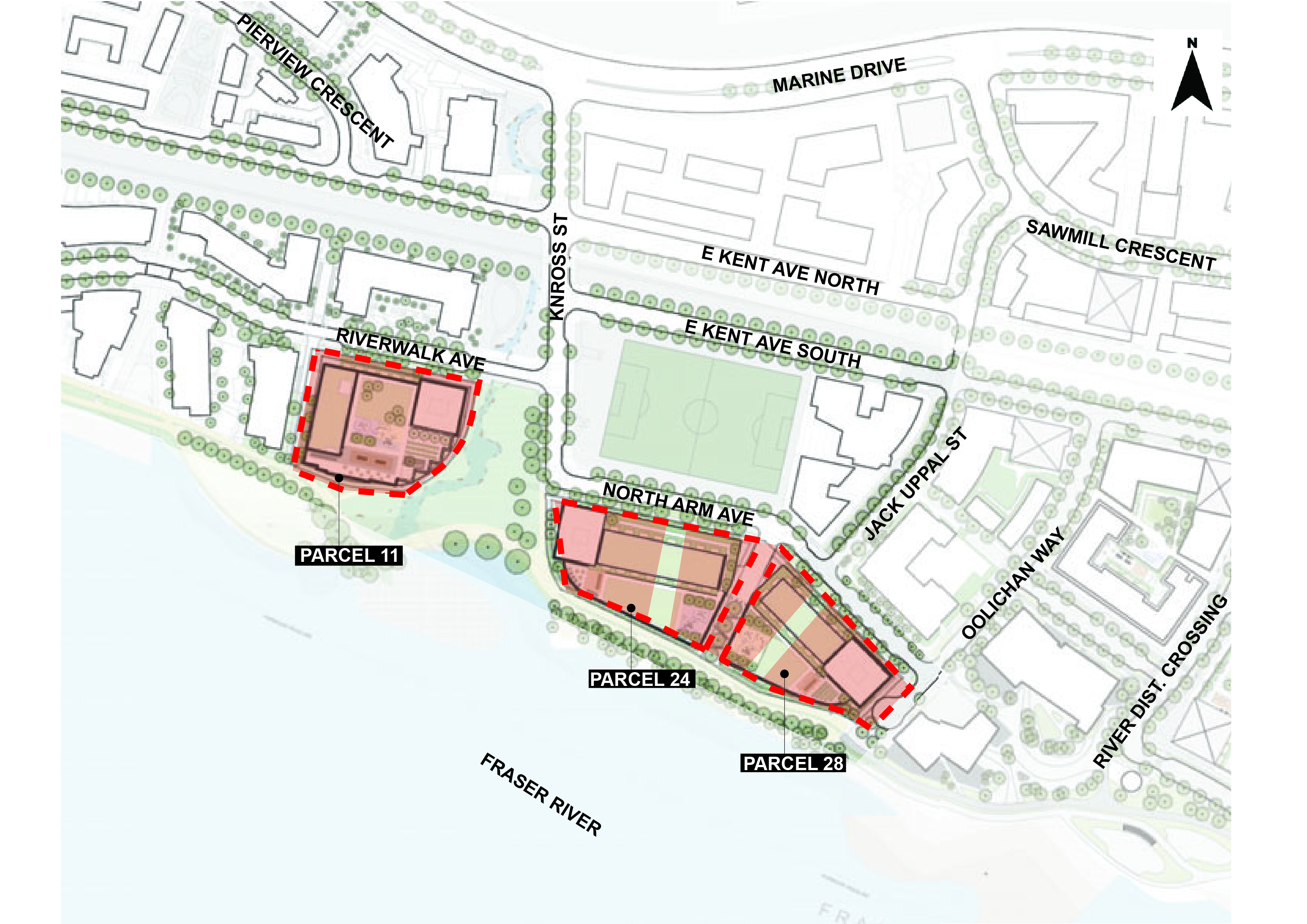
East Fraser Lands (Area 2): 3202 Riverwalk Ave (Parcel 11) and 3302 North Arm Ave (Parcel 24 & Parcel 28) rezoning application
The text amendment for Parcel 11 was approved by Council at the Council meeting on July 14, 2026. Application review of the text amendments proposed for Parcels 24 and 28 ongoing.
Rezoning Application Update (July 21, 2026)
On July 14, 2026, Council approved in principle the text amendment to CD-1(499) to allow a maximum height of 15-storeys on Parcel 11 in Area 2 of East Fraser Lands. Application review of the text amendments proposed for Parcels 24 and 28 are ongoing. Comments and questions are welcome throughout the application review process.
The application proposes to:
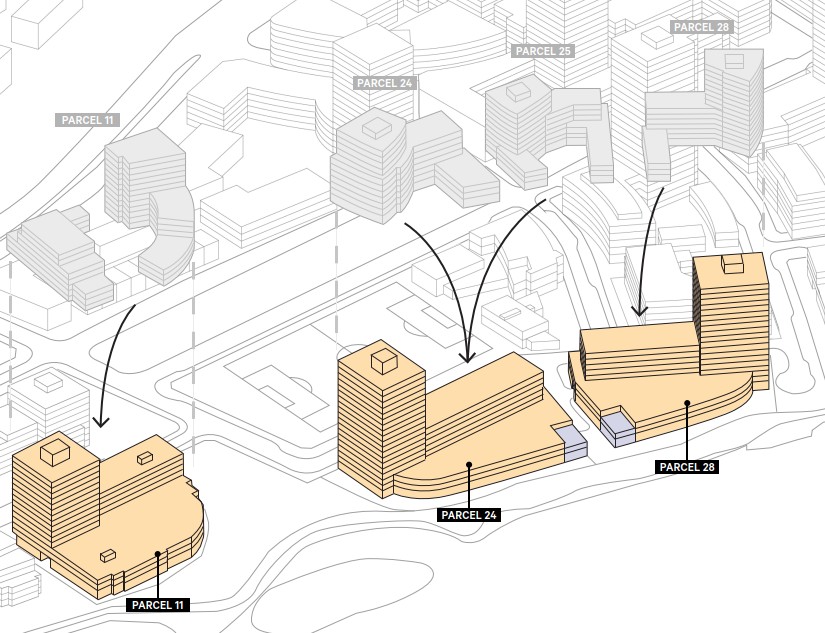
Combine Parcels 24 and 25 into one development block called Parcel 24;
Permit above-grade parking on Parcels 24 and 28; and
Update the maximum building height:
Parcel 24, increase from 11 to 21 storeys; and
Parcel 28, increase from 15 to 21 storeys.
An amendment to the East Fraser Lands Official Development Plan (EFL ODP) is required to permit the proposed heights.
Rezoning Application Addendum (May 1, 2026)
The City of Vancouver has received an addendum to the application to amend the maximum height permitted at 3202 Riverwalk Avenue (Parcel 11).
The application originally proposed a maximum 18-storey building height. The addendum proposes a maximum 15-storey building height. The revised proposal complies with the East Fraser Lands Official Development Plan. No changes are proposed for the Parcels 24 and 28.
Standard rezoning notification will be provided in advance of Council consideration. Comments and questions are welcome at any time through the application review process.
Original Rezoning Application (February 23, 2026)
The proposal seeks to amend CD-1(499) East Fraser Lands Area 2 South. Consequential amendments to the East Fraser Lands Official Development Plan will be required. The application proposes to:
- Combine Parcels 24 and 25 into one development block called Parcel 24;
- Permit above-grade parking on Parcels 11, 24 and 28; and
- Update the maximum building height:
- Parcel 11, increase from 12 to 18 storeys
- Parcel 24, increase from 11 to 21 storeys; and
- Parcel 28, increase from 15 to 21 storeys.
No changes to the overall permitted floor area are proposed.
This application is being considered under the East Fraser Lands Official Development Plan (EFL ODP).
This application is being reviewed in a phased approach, whereby Parcel 11 may proceed for Council consideration in advance of Parcels 24 and 28.
Application drawings and statistics are posted as-submitted to the City. Following staff review, the final project statistics are documented within the referral report.
The text amendment for Parcel 11 was approved by Council at the Council meeting on July 14, 2026. Application review of the text amendments proposed for Parcels 24 and 28 ongoing.
Rezoning Application Update (July 21, 2026)
On July 14, 2026, Council approved in principle the text amendment to CD-1(499) to allow a maximum height of 15-storeys on Parcel 11 in Area 2 of East Fraser Lands. Application review of the text amendments proposed for Parcels 24 and 28 are ongoing. Comments and questions are welcome throughout the application review process.
The application proposes to:
Combine Parcels 24 and 25 into one development block called Parcel 24;
Permit above-grade parking on Parcels 24 and 28; and
Update the maximum building height:
Parcel 24, increase from 11 to 21 storeys; and
Parcel 28, increase from 15 to 21 storeys.
An amendment to the East Fraser Lands Official Development Plan (EFL ODP) is required to permit the proposed heights.
Rezoning Application Addendum (May 1, 2026)
The City of Vancouver has received an addendum to the application to amend the maximum height permitted at 3202 Riverwalk Avenue (Parcel 11).
The application originally proposed a maximum 18-storey building height. The addendum proposes a maximum 15-storey building height. The revised proposal complies with the East Fraser Lands Official Development Plan. No changes are proposed for the Parcels 24 and 28.
Standard rezoning notification will be provided in advance of Council consideration. Comments and questions are welcome at any time through the application review process.
Original Rezoning Application (February 23, 2026)
The proposal seeks to amend CD-1(499) East Fraser Lands Area 2 South. Consequential amendments to the East Fraser Lands Official Development Plan will be required. The application proposes to:
- Combine Parcels 24 and 25 into one development block called Parcel 24;
- Permit above-grade parking on Parcels 11, 24 and 28; and
- Update the maximum building height:
- Parcel 11, increase from 12 to 18 storeys
- Parcel 24, increase from 11 to 21 storeys; and
- Parcel 28, increase from 15 to 21 storeys.
No changes to the overall permitted floor area are proposed.
This application is being considered under the East Fraser Lands Official Development Plan (EFL ODP).
This application is being reviewed in a phased approach, whereby Parcel 11 may proceed for Council consideration in advance of Parcels 24 and 28.
Application drawings and statistics are posted as-submitted to the City. Following staff review, the final project statistics are documented within the referral report.
The opportunity to ask questions through the Q&A is available from March 4 to March 17, 2026.
We post all questions as-is and aim to respond within two business days. Some questions may require coordination with internal departments and additional time may be needed to post a response.
Please note that the comment form will remain open after the Q&A period. The Rezoning Planner can also be contacted directly for any further feedback or questions.
-
Share What is the mitigation outcome or alternative solution proposed from the high negative impact demonstrated by the shadow studies on Kinross Park. What is the threshold of negative impact the Applicant or the City of Vancouver is willing to accept and why? How will emergency vehicle and access and evacuation be handled on the tallest planned tower structure in Parcel 11 and Parcel 21? How will you prevent headlight glare and tire-screeching noise from leaking into neighbouring windows at night? Please expand on the strategy used to allow heat to escape while preventing bleed vehicle engine heat directly into the neighbourhood. Lastly, could you please provide an estimated timeline for the application approval, and following construction, if the application is approved? on Facebook Share What is the mitigation outcome or alternative solution proposed from the high negative impact demonstrated by the shadow studies on Kinross Park. What is the threshold of negative impact the Applicant or the City of Vancouver is willing to accept and why? How will emergency vehicle and access and evacuation be handled on the tallest planned tower structure in Parcel 11 and Parcel 21? How will you prevent headlight glare and tire-screeching noise from leaking into neighbouring windows at night? Please expand on the strategy used to allow heat to escape while preventing bleed vehicle engine heat directly into the neighbourhood. Lastly, could you please provide an estimated timeline for the application approval, and following construction, if the application is approved? on X (formerly Twitter) Share What is the mitigation outcome or alternative solution proposed from the high negative impact demonstrated by the shadow studies on Kinross Park. What is the threshold of negative impact the Applicant or the City of Vancouver is willing to accept and why? How will emergency vehicle and access and evacuation be handled on the tallest planned tower structure in Parcel 11 and Parcel 21? How will you prevent headlight glare and tire-screeching noise from leaking into neighbouring windows at night? Please expand on the strategy used to allow heat to escape while preventing bleed vehicle engine heat directly into the neighbourhood. Lastly, could you please provide an estimated timeline for the application approval, and following construction, if the application is approved? on Linkedin Email What is the mitigation outcome or alternative solution proposed from the high negative impact demonstrated by the shadow studies on Kinross Park. What is the threshold of negative impact the Applicant or the City of Vancouver is willing to accept and why? How will emergency vehicle and access and evacuation be handled on the tallest planned tower structure in Parcel 11 and Parcel 21? How will you prevent headlight glare and tire-screeching noise from leaking into neighbouring windows at night? Please expand on the strategy used to allow heat to escape while preventing bleed vehicle engine heat directly into the neighbourhood. Lastly, could you please provide an estimated timeline for the application approval, and following construction, if the application is approved? link
What is the mitigation outcome or alternative solution proposed from the high negative impact demonstrated by the shadow studies on Kinross Park. What is the threshold of negative impact the Applicant or the City of Vancouver is willing to accept and why? How will emergency vehicle and access and evacuation be handled on the tallest planned tower structure in Parcel 11 and Parcel 21? How will you prevent headlight glare and tire-screeching noise from leaking into neighbouring windows at night? Please expand on the strategy used to allow heat to escape while preventing bleed vehicle engine heat directly into the neighbourhood. Lastly, could you please provide an estimated timeline for the application approval, and following construction, if the application is approved?
Alex89 asked 7 months agoThe proposed density aligns with the previously approved plans for Area 2 and reflects a redistribution of density within the overall building form. As part of the application process, all technical considerations will be reviewed through the City of Vancouver’s rezoning and development permit review processes for alignment with applicable by-laws and policies. With respect to timeline, Wesgroup will be proceeding with the redevelopment of properties in Area 1 and Area 2, informed by market conditions. These areas include a mix of waterfront and mixed-use parcels, each with unique considerations that can influence timing and delivery.
-
Share Our neighbourhood is becoming congested with no amenities to support the density. When will the promised amenities be built before more condos are approved? It has outgrown the limited services and we have been left in the dark. I want to see accountability such as a solid timeline for the community centre first promised back in 2002. It’s not a liveable community. No medical clinic, school, gym, dry cleaners, pub or other services and facilities most neighborhoods have. on Facebook Share Our neighbourhood is becoming congested with no amenities to support the density. When will the promised amenities be built before more condos are approved? It has outgrown the limited services and we have been left in the dark. I want to see accountability such as a solid timeline for the community centre first promised back in 2002. It’s not a liveable community. No medical clinic, school, gym, dry cleaners, pub or other services and facilities most neighborhoods have. on X (formerly Twitter) Share Our neighbourhood is becoming congested with no amenities to support the density. When will the promised amenities be built before more condos are approved? It has outgrown the limited services and we have been left in the dark. I want to see accountability such as a solid timeline for the community centre first promised back in 2002. It’s not a liveable community. No medical clinic, school, gym, dry cleaners, pub or other services and facilities most neighborhoods have. on Linkedin Email Our neighbourhood is becoming congested with no amenities to support the density. When will the promised amenities be built before more condos are approved? It has outgrown the limited services and we have been left in the dark. I want to see accountability such as a solid timeline for the community centre first promised back in 2002. It’s not a liveable community. No medical clinic, school, gym, dry cleaners, pub or other services and facilities most neighborhoods have. link
Our neighbourhood is becoming congested with no amenities to support the density. When will the promised amenities be built before more condos are approved? It has outgrown the limited services and we have been left in the dark. I want to see accountability such as a solid timeline for the community centre first promised back in 2002. It’s not a liveable community. No medical clinic, school, gym, dry cleaners, pub or other services and facilities most neighborhoods have.
WhitneyJ asked 7 months agoThe Community Centre at River District remains a critical priority for both Wesgroup and the City of Vancouver. Wesgroup assumed responsibility for delivering the Community Centre in 2022. Since that time, Wesgroup and the City of Vancouver have been working collaboratively through the required design and approval processes, including Urban Design Panel review and the Development Permit process. It is important to note that the provision of community amenities within River District involves multiple partners and jurisdictions, with responsibilities shared across public agencies and levels of government. River District continues to evolve as a complete community, with more than 25 retail and service businesses now open and serving local residents.
-
Share Can the City clarify how it ensures that changes to building height and form are driven by public policy objectives rather than project-specific financial considerations? In particular, what mechanisms are in place to ensure that the original vision of lower-rise, human-scale development in River District is upheld when proposals are revised to improve project viability? If increased height is being considered to address financial constraints, what alternative options were evaluated to maintain the originally intended scale? on Facebook Share Can the City clarify how it ensures that changes to building height and form are driven by public policy objectives rather than project-specific financial considerations? In particular, what mechanisms are in place to ensure that the original vision of lower-rise, human-scale development in River District is upheld when proposals are revised to improve project viability? If increased height is being considered to address financial constraints, what alternative options were evaluated to maintain the originally intended scale? on X (formerly Twitter) Share Can the City clarify how it ensures that changes to building height and form are driven by public policy objectives rather than project-specific financial considerations? In particular, what mechanisms are in place to ensure that the original vision of lower-rise, human-scale development in River District is upheld when proposals are revised to improve project viability? If increased height is being considered to address financial constraints, what alternative options were evaluated to maintain the originally intended scale? on Linkedin Email Can the City clarify how it ensures that changes to building height and form are driven by public policy objectives rather than project-specific financial considerations? In particular, what mechanisms are in place to ensure that the original vision of lower-rise, human-scale development in River District is upheld when proposals are revised to improve project viability? If increased height is being considered to address financial constraints, what alternative options were evaluated to maintain the originally intended scale? link
Can the City clarify how it ensures that changes to building height and form are driven by public policy objectives rather than project-specific financial considerations? In particular, what mechanisms are in place to ensure that the original vision of lower-rise, human-scale development in River District is upheld when proposals are revised to improve project viability? If increased height is being considered to address financial constraints, what alternative options were evaluated to maintain the originally intended scale?
Nilla asked 7 months agoResponse from City: The City assesses proposed changes to building height and form in accordance with the EFL Official Development Plan (ODP), applicable design guidelines, and Council-adopted policy objectives. Applications are reviewed on a comprehensive, interdepartmental basis to ensure consistency with established urban design, livability, and public realm priorities.
While applicants may identify project viability considerations, these are not determinative. Any proposed increases in height or density must be supported by policy rationale and demonstrate alignment with approved objectives, including neighbourhood fit and human-scale design.
Where amendments are contemplated, staff evaluate alternative design approaches—such as adjustments to massing, unit configuration, or site layout—to maintain the intended scale and character. Urban design measures, including setbacks, modulation, and street-level activation, are applied to reinforce pedestrian-oriented development
-
Share Can the City explain what appears to be a clear double standard in how planning policy is being applied within River District? Earlier phases of the neighbourhood were required to adhere to lower building heights and reduced parking ratios (approximately one stall per unit), consistent with a walkable, lower-scale community vision. Why are Parcels 11, 24, and 28 now being treated differently—allowing increased parking supply and significantly greater building heights—rather than requiring the project to proceed within the same framework applied to neighbouring developments? Is this shift being driven by project-specific financial considerations, and if so, how does the City ensure that private profitability does not override established planning principles? on Facebook Share Can the City explain what appears to be a clear double standard in how planning policy is being applied within River District? Earlier phases of the neighbourhood were required to adhere to lower building heights and reduced parking ratios (approximately one stall per unit), consistent with a walkable, lower-scale community vision. Why are Parcels 11, 24, and 28 now being treated differently—allowing increased parking supply and significantly greater building heights—rather than requiring the project to proceed within the same framework applied to neighbouring developments? Is this shift being driven by project-specific financial considerations, and if so, how does the City ensure that private profitability does not override established planning principles? on X (formerly Twitter) Share Can the City explain what appears to be a clear double standard in how planning policy is being applied within River District? Earlier phases of the neighbourhood were required to adhere to lower building heights and reduced parking ratios (approximately one stall per unit), consistent with a walkable, lower-scale community vision. Why are Parcels 11, 24, and 28 now being treated differently—allowing increased parking supply and significantly greater building heights—rather than requiring the project to proceed within the same framework applied to neighbouring developments? Is this shift being driven by project-specific financial considerations, and if so, how does the City ensure that private profitability does not override established planning principles? on Linkedin Email Can the City explain what appears to be a clear double standard in how planning policy is being applied within River District? Earlier phases of the neighbourhood were required to adhere to lower building heights and reduced parking ratios (approximately one stall per unit), consistent with a walkable, lower-scale community vision. Why are Parcels 11, 24, and 28 now being treated differently—allowing increased parking supply and significantly greater building heights—rather than requiring the project to proceed within the same framework applied to neighbouring developments? Is this shift being driven by project-specific financial considerations, and if so, how does the City ensure that private profitability does not override established planning principles? link
Can the City explain what appears to be a clear double standard in how planning policy is being applied within River District? Earlier phases of the neighbourhood were required to adhere to lower building heights and reduced parking ratios (approximately one stall per unit), consistent with a walkable, lower-scale community vision. Why are Parcels 11, 24, and 28 now being treated differently—allowing increased parking supply and significantly greater building heights—rather than requiring the project to proceed within the same framework applied to neighbouring developments? Is this shift being driven by project-specific financial considerations, and if so, how does the City ensure that private profitability does not override established planning principles?
Nilla asked 7 months agoResponse from City: Thanks for the questions. This is an application put forward by Wesgroup requesting consideration of additional building heights to accommodate above grade parking in order to address technical and financial challenges with building below-grade. Particularly, the concern of the impact of groundwater conditions on below-grade parking, which is increasingly incompatible with the site’s geography and financial feasibility. This rezoning application does not seek any additional density, rather an increase in permitted building height and adjustment to the form of development to include above grade parking and redistribute approved density. The overarching policy framework (i.e. Official Development Plan, Design Guidelines, other applicable city policies) related to supporting a complete, sustainable community, with a variety of housing opportunities together with a range of supporting facilities and amenities remain generally in place.
The appropriate provision of parking is determined with each rezoning for all uses in accordance with the Parking By-law. Recent updates to the Parking By-law have removed minimum parking requirements for residential developments. In the case of these specific parcels within EFL, the applicant is proposing a ratio of approximately 1.35 stalls per unit based on area being relatively underserved by paid transit. The application materials note that “current market expectations still require the delivery of a significant amount of parking to support residential and commercial uses…”.
This rezoning application is currently under review. Staff are seeking public feedback in review of the application
-
Share Application Booklet Statement: “Concurrently, evolving City policy on groundwater management now restricts long-term sump pumping and prohibits storm system discharge of groundwater…” I have not been able to locate any specific City policy changes regarding discharging groundwater or sump water. During the previous hearing, a Councillor asked the applicant about these changes but the WG representative unable to identify any specific policy or bylaw amendment. Could staff or the applicant please identify the exact policy, bylaw, or regulatory change being referenced, including when it came into effect? The applicant has already demonstrated that excavation and underground parking construction are feasible in this area. Multiple nearby buildings have been completed with deeper excavations than those originally proposed for parcels 24/25, 29, and 11. For example, the Harlin building includes five levels of underground parking. These developments exist within the same hydrogeological conditions, which the applicant should be fully aware of. Given this, it is unclear what material change has occurred that would now make the originally proposed excavation levels infeasible. What specifically has changed since those projects were approved and constructed? on Facebook Share Application Booklet Statement: “Concurrently, evolving City policy on groundwater management now restricts long-term sump pumping and prohibits storm system discharge of groundwater…” I have not been able to locate any specific City policy changes regarding discharging groundwater or sump water. During the previous hearing, a Councillor asked the applicant about these changes but the WG representative unable to identify any specific policy or bylaw amendment. Could staff or the applicant please identify the exact policy, bylaw, or regulatory change being referenced, including when it came into effect? The applicant has already demonstrated that excavation and underground parking construction are feasible in this area. Multiple nearby buildings have been completed with deeper excavations than those originally proposed for parcels 24/25, 29, and 11. For example, the Harlin building includes five levels of underground parking. These developments exist within the same hydrogeological conditions, which the applicant should be fully aware of. Given this, it is unclear what material change has occurred that would now make the originally proposed excavation levels infeasible. What specifically has changed since those projects were approved and constructed? on X (formerly Twitter) Share Application Booklet Statement: “Concurrently, evolving City policy on groundwater management now restricts long-term sump pumping and prohibits storm system discharge of groundwater…” I have not been able to locate any specific City policy changes regarding discharging groundwater or sump water. During the previous hearing, a Councillor asked the applicant about these changes but the WG representative unable to identify any specific policy or bylaw amendment. Could staff or the applicant please identify the exact policy, bylaw, or regulatory change being referenced, including when it came into effect? The applicant has already demonstrated that excavation and underground parking construction are feasible in this area. Multiple nearby buildings have been completed with deeper excavations than those originally proposed for parcels 24/25, 29, and 11. For example, the Harlin building includes five levels of underground parking. These developments exist within the same hydrogeological conditions, which the applicant should be fully aware of. Given this, it is unclear what material change has occurred that would now make the originally proposed excavation levels infeasible. What specifically has changed since those projects were approved and constructed? on Linkedin Email Application Booklet Statement: “Concurrently, evolving City policy on groundwater management now restricts long-term sump pumping and prohibits storm system discharge of groundwater…” I have not been able to locate any specific City policy changes regarding discharging groundwater or sump water. During the previous hearing, a Councillor asked the applicant about these changes but the WG representative unable to identify any specific policy or bylaw amendment. Could staff or the applicant please identify the exact policy, bylaw, or regulatory change being referenced, including when it came into effect? The applicant has already demonstrated that excavation and underground parking construction are feasible in this area. Multiple nearby buildings have been completed with deeper excavations than those originally proposed for parcels 24/25, 29, and 11. For example, the Harlin building includes five levels of underground parking. These developments exist within the same hydrogeological conditions, which the applicant should be fully aware of. Given this, it is unclear what material change has occurred that would now make the originally proposed excavation levels infeasible. What specifically has changed since those projects were approved and constructed? link
Application Booklet Statement: “Concurrently, evolving City policy on groundwater management now restricts long-term sump pumping and prohibits storm system discharge of groundwater…” I have not been able to locate any specific City policy changes regarding discharging groundwater or sump water. During the previous hearing, a Councillor asked the applicant about these changes but the WG representative unable to identify any specific policy or bylaw amendment. Could staff or the applicant please identify the exact policy, bylaw, or regulatory change being referenced, including when it came into effect? The applicant has already demonstrated that excavation and underground parking construction are feasible in this area. Multiple nearby buildings have been completed with deeper excavations than those originally proposed for parcels 24/25, 29, and 11. For example, the Harlin building includes five levels of underground parking. These developments exist within the same hydrogeological conditions, which the applicant should be fully aware of. Given this, it is unclear what material change has occurred that would now make the originally proposed excavation levels infeasible. What specifically has changed since those projects were approved and constructed?
L. Knope asked 7 months agoResponse from Applicant: Policies and regulatory requirements related to groundwater management have evolved over time, resulting in complex requirements and increased costs for below grade construction. While these changes do not make below grade parking technically infeasible, when combines with significant increases in construction costs, they have raised costs to a level that makes it no longer viable to deliver in this area. As such, a change in the form of development is required to support continued progress and delivery of the community.
Response from Staff: Groundwater management requirements can be found here: https://guidelines.vancouver.ca/bulletins/bulletin-groundwater-management.pdf
Construction sites also require wastewater discharge permits in order to discharge water into the City’s sewers. More info can be found here: https://vancouver.ca/home-property-development/wastewater-discharge-permit-for-construction-at-contaminated-sites.aspx”
-
Share Given that Vancouver’s family-housing guidelines state that children’s play areas should be strictly segregated from vehicular routes, parking and loading areas, and the City’s childcare guidelines state that parking garage exhaust vents should not be located adjacent to outdoor play areas, how does the City conclude that multiple levels of above-grade parking immediately beside a children’s park is an acceptable design outcome in this case? on Facebook Share Given that Vancouver’s family-housing guidelines state that children’s play areas should be strictly segregated from vehicular routes, parking and loading areas, and the City’s childcare guidelines state that parking garage exhaust vents should not be located adjacent to outdoor play areas, how does the City conclude that multiple levels of above-grade parking immediately beside a children’s park is an acceptable design outcome in this case? on X (formerly Twitter) Share Given that Vancouver’s family-housing guidelines state that children’s play areas should be strictly segregated from vehicular routes, parking and loading areas, and the City’s childcare guidelines state that parking garage exhaust vents should not be located adjacent to outdoor play areas, how does the City conclude that multiple levels of above-grade parking immediately beside a children’s park is an acceptable design outcome in this case? on Linkedin Email Given that Vancouver’s family-housing guidelines state that children’s play areas should be strictly segregated from vehicular routes, parking and loading areas, and the City’s childcare guidelines state that parking garage exhaust vents should not be located adjacent to outdoor play areas, how does the City conclude that multiple levels of above-grade parking immediately beside a children’s park is an acceptable design outcome in this case? link
Given that Vancouver’s family-housing guidelines state that children’s play areas should be strictly segregated from vehicular routes, parking and loading areas, and the City’s childcare guidelines state that parking garage exhaust vents should not be located adjacent to outdoor play areas, how does the City conclude that multiple levels of above-grade parking immediately beside a children’s park is an acceptable design outcome in this case?
Daria asked 7 months agoResponse from Staff: Thanks for the question. The application design is currently under review by staff. Your concerns have been heard and will be considered by staff in the review of the application. You may share your comments directly with Council at the time of Public Hearing, noting a hearing has not been scheduled at this time.
-
Share The building forms proposed in this amendment represent a significant departure from the original approved concept. The earlier design featured terraced buildings, with higher levels positioned toward the north of the parcels and stepping down toward the river. The building footprints were also more thoughtfully articulated, including openings and view corridors toward the water. In contrast, the newly proposed forms appear as large, continuous blocks with far less articulation and no terracing toward the river. This change substantially alters both the architectural quality and the original neighbourhood vision. Is this proposed building form an absolute last-resort solution intended primarily to accommodate parking requirements if underground parking is no longer feasible? If so, what alternative options were explored before arriving at this design? For example, were any of the following alternatives evaluated: • Could the area beneath the playing field be a large central extended parking area that can connect to the adjacent buildings underground? That could significantly reduce the need to add so many levels of parking for the adjacent buildings, which could make the excavations and currently planned building forms possible • Is there a City requirement for a minimum parking ratio per residential unit in this development? If so, has the applicant explored reducing this ratio? River District already benefits from strong transit connections that will likely improve as the community grows and as TransLink adjusts service to demand. In addition, the neighbourhood’s walkability and proximity to daily amenities reduce the need for frequent vehicle use. • Is there no feasible way to increase building heights modestly while maintaining the terraced form and upper-level step-backs that were part of the original design concept? • Why has the separation between parcels 24 and 25 been removed? Maintaining breaks between buildings contributes significantly to visual relief, view corridors, and neighbourhood character. • Has the applicant considered reducing density in certain locations to accommodate parking in ways that do not significantly alter the intended urban design? • Alternatively, could lower building heights and reduced density be maintained closer to the river, with taller buildings located farther inland where their visual and environmental impact would be less significant? Overall, it appears that the proposed changes prioritize development efficiency over the architectural quality, public realm experience, and neighbourhood character that residents were originally promised. Many residents invested in this community based on the previously presented vision. While some evolution in design is expected over time, the changes proposed here represent a substantial shift from that vision and warrant careful reconsideration. on Facebook Share The building forms proposed in this amendment represent a significant departure from the original approved concept. The earlier design featured terraced buildings, with higher levels positioned toward the north of the parcels and stepping down toward the river. The building footprints were also more thoughtfully articulated, including openings and view corridors toward the water. In contrast, the newly proposed forms appear as large, continuous blocks with far less articulation and no terracing toward the river. This change substantially alters both the architectural quality and the original neighbourhood vision. Is this proposed building form an absolute last-resort solution intended primarily to accommodate parking requirements if underground parking is no longer feasible? If so, what alternative options were explored before arriving at this design? For example, were any of the following alternatives evaluated: • Could the area beneath the playing field be a large central extended parking area that can connect to the adjacent buildings underground? That could significantly reduce the need to add so many levels of parking for the adjacent buildings, which could make the excavations and currently planned building forms possible • Is there a City requirement for a minimum parking ratio per residential unit in this development? If so, has the applicant explored reducing this ratio? River District already benefits from strong transit connections that will likely improve as the community grows and as TransLink adjusts service to demand. In addition, the neighbourhood’s walkability and proximity to daily amenities reduce the need for frequent vehicle use. • Is there no feasible way to increase building heights modestly while maintaining the terraced form and upper-level step-backs that were part of the original design concept? • Why has the separation between parcels 24 and 25 been removed? Maintaining breaks between buildings contributes significantly to visual relief, view corridors, and neighbourhood character. • Has the applicant considered reducing density in certain locations to accommodate parking in ways that do not significantly alter the intended urban design? • Alternatively, could lower building heights and reduced density be maintained closer to the river, with taller buildings located farther inland where their visual and environmental impact would be less significant? Overall, it appears that the proposed changes prioritize development efficiency over the architectural quality, public realm experience, and neighbourhood character that residents were originally promised. Many residents invested in this community based on the previously presented vision. While some evolution in design is expected over time, the changes proposed here represent a substantial shift from that vision and warrant careful reconsideration. on X (formerly Twitter) Share The building forms proposed in this amendment represent a significant departure from the original approved concept. The earlier design featured terraced buildings, with higher levels positioned toward the north of the parcels and stepping down toward the river. The building footprints were also more thoughtfully articulated, including openings and view corridors toward the water. In contrast, the newly proposed forms appear as large, continuous blocks with far less articulation and no terracing toward the river. This change substantially alters both the architectural quality and the original neighbourhood vision. Is this proposed building form an absolute last-resort solution intended primarily to accommodate parking requirements if underground parking is no longer feasible? If so, what alternative options were explored before arriving at this design? For example, were any of the following alternatives evaluated: • Could the area beneath the playing field be a large central extended parking area that can connect to the adjacent buildings underground? That could significantly reduce the need to add so many levels of parking for the adjacent buildings, which could make the excavations and currently planned building forms possible • Is there a City requirement for a minimum parking ratio per residential unit in this development? If so, has the applicant explored reducing this ratio? River District already benefits from strong transit connections that will likely improve as the community grows and as TransLink adjusts service to demand. In addition, the neighbourhood’s walkability and proximity to daily amenities reduce the need for frequent vehicle use. • Is there no feasible way to increase building heights modestly while maintaining the terraced form and upper-level step-backs that were part of the original design concept? • Why has the separation between parcels 24 and 25 been removed? Maintaining breaks between buildings contributes significantly to visual relief, view corridors, and neighbourhood character. • Has the applicant considered reducing density in certain locations to accommodate parking in ways that do not significantly alter the intended urban design? • Alternatively, could lower building heights and reduced density be maintained closer to the river, with taller buildings located farther inland where their visual and environmental impact would be less significant? Overall, it appears that the proposed changes prioritize development efficiency over the architectural quality, public realm experience, and neighbourhood character that residents were originally promised. Many residents invested in this community based on the previously presented vision. While some evolution in design is expected over time, the changes proposed here represent a substantial shift from that vision and warrant careful reconsideration. on Linkedin Email The building forms proposed in this amendment represent a significant departure from the original approved concept. The earlier design featured terraced buildings, with higher levels positioned toward the north of the parcels and stepping down toward the river. The building footprints were also more thoughtfully articulated, including openings and view corridors toward the water. In contrast, the newly proposed forms appear as large, continuous blocks with far less articulation and no terracing toward the river. This change substantially alters both the architectural quality and the original neighbourhood vision. Is this proposed building form an absolute last-resort solution intended primarily to accommodate parking requirements if underground parking is no longer feasible? If so, what alternative options were explored before arriving at this design? For example, were any of the following alternatives evaluated: • Could the area beneath the playing field be a large central extended parking area that can connect to the adjacent buildings underground? That could significantly reduce the need to add so many levels of parking for the adjacent buildings, which could make the excavations and currently planned building forms possible • Is there a City requirement for a minimum parking ratio per residential unit in this development? If so, has the applicant explored reducing this ratio? River District already benefits from strong transit connections that will likely improve as the community grows and as TransLink adjusts service to demand. In addition, the neighbourhood’s walkability and proximity to daily amenities reduce the need for frequent vehicle use. • Is there no feasible way to increase building heights modestly while maintaining the terraced form and upper-level step-backs that were part of the original design concept? • Why has the separation between parcels 24 and 25 been removed? Maintaining breaks between buildings contributes significantly to visual relief, view corridors, and neighbourhood character. • Has the applicant considered reducing density in certain locations to accommodate parking in ways that do not significantly alter the intended urban design? • Alternatively, could lower building heights and reduced density be maintained closer to the river, with taller buildings located farther inland where their visual and environmental impact would be less significant? Overall, it appears that the proposed changes prioritize development efficiency over the architectural quality, public realm experience, and neighbourhood character that residents were originally promised. Many residents invested in this community based on the previously presented vision. While some evolution in design is expected over time, the changes proposed here represent a substantial shift from that vision and warrant careful reconsideration. link
The building forms proposed in this amendment represent a significant departure from the original approved concept. The earlier design featured terraced buildings, with higher levels positioned toward the north of the parcels and stepping down toward the river. The building footprints were also more thoughtfully articulated, including openings and view corridors toward the water. In contrast, the newly proposed forms appear as large, continuous blocks with far less articulation and no terracing toward the river. This change substantially alters both the architectural quality and the original neighbourhood vision. Is this proposed building form an absolute last-resort solution intended primarily to accommodate parking requirements if underground parking is no longer feasible? If so, what alternative options were explored before arriving at this design? For example, were any of the following alternatives evaluated: • Could the area beneath the playing field be a large central extended parking area that can connect to the adjacent buildings underground? That could significantly reduce the need to add so many levels of parking for the adjacent buildings, which could make the excavations and currently planned building forms possible • Is there a City requirement for a minimum parking ratio per residential unit in this development? If so, has the applicant explored reducing this ratio? River District already benefits from strong transit connections that will likely improve as the community grows and as TransLink adjusts service to demand. In addition, the neighbourhood’s walkability and proximity to daily amenities reduce the need for frequent vehicle use. • Is there no feasible way to increase building heights modestly while maintaining the terraced form and upper-level step-backs that were part of the original design concept? • Why has the separation between parcels 24 and 25 been removed? Maintaining breaks between buildings contributes significantly to visual relief, view corridors, and neighbourhood character. • Has the applicant considered reducing density in certain locations to accommodate parking in ways that do not significantly alter the intended urban design? • Alternatively, could lower building heights and reduced density be maintained closer to the river, with taller buildings located farther inland where their visual and environmental impact would be less significant? Overall, it appears that the proposed changes prioritize development efficiency over the architectural quality, public realm experience, and neighbourhood character that residents were originally promised. Many residents invested in this community based on the previously presented vision. While some evolution in design is expected over time, the changes proposed here represent a substantial shift from that vision and warrant careful reconsideration.
L. Knope asked 7 months agoResponse from Applicant: River District is planned as a complete community with a mix of building forms, including towers, podiums, townhomes, retail, and public amenities, all guided by the approved Official Development Plan (ODP). That vision remains unchanged and continues to guide development across all parcels. The proposed changes reflect an evolution of the design in response to increasing technical complexity and costs associated with below-grade construction. They are not intended to reduce the quality of the community, but rather to ensure that projects remain viable and can proceed. Delivering housing, commercial space, parks, and amenities is dependent on projects moving forward; when projects are delayed or become unfeasible, the delivery of these elements is also delayed. The proposed approach shifts parking into the building in a way that allows development to proceed while still supporting active uses at grade and a high-quality public realm.
With respect to alternative approaches, a range of options have been considered as part of the design process. However, certain constraints limit what can be pursued. For example, lands dedicated as public parks cannot accommodate privately owned underground parkades or infrastructure. While transit options in the area continue to improve, parking demand from residents and purchasers remains a consistent ask and important consideration, and historically parking has been provided in response to that local demand, often exceeding bylaw requirements. As the application advances, further design refinement will occur through the City’s review process. It should be noted that while earlier concepts in the ODP explored more terraced or stepped building forms, evolving energy performance requirements have significantly influenced building design, as such forms are more challenging to achieve under current high-performance envelope standards. The intent remains to deliver a well-designed, livable neighbourhood that aligns with the broader vision for River District.. The intent remains to deliver a well-designed, livable neighbourhood that aligns with the broader vision for River District
-
Share The ODP and Area 2 materials contemplated differentiated neighbourhood character, with lower-scale conditions in parts of the waterfront and higher forms used selectively. What built-form rationale supports moving from the previously approved 11–15 storey range on Parcels 24 and 28 to 21 storeys, and from 12 to 18 storeys on Parcel 11, when nearby Riverwalk context in earlier City material was described as apartments and townhouses generally in the 3 to 11 storey range, with riverfront buildings immediately south in the 4 to 7 storey range? on Facebook Share The ODP and Area 2 materials contemplated differentiated neighbourhood character, with lower-scale conditions in parts of the waterfront and higher forms used selectively. What built-form rationale supports moving from the previously approved 11–15 storey range on Parcels 24 and 28 to 21 storeys, and from 12 to 18 storeys on Parcel 11, when nearby Riverwalk context in earlier City material was described as apartments and townhouses generally in the 3 to 11 storey range, with riverfront buildings immediately south in the 4 to 7 storey range? on X (formerly Twitter) Share The ODP and Area 2 materials contemplated differentiated neighbourhood character, with lower-scale conditions in parts of the waterfront and higher forms used selectively. What built-form rationale supports moving from the previously approved 11–15 storey range on Parcels 24 and 28 to 21 storeys, and from 12 to 18 storeys on Parcel 11, when nearby Riverwalk context in earlier City material was described as apartments and townhouses generally in the 3 to 11 storey range, with riverfront buildings immediately south in the 4 to 7 storey range? on Linkedin Email The ODP and Area 2 materials contemplated differentiated neighbourhood character, with lower-scale conditions in parts of the waterfront and higher forms used selectively. What built-form rationale supports moving from the previously approved 11–15 storey range on Parcels 24 and 28 to 21 storeys, and from 12 to 18 storeys on Parcel 11, when nearby Riverwalk context in earlier City material was described as apartments and townhouses generally in the 3 to 11 storey range, with riverfront buildings immediately south in the 4 to 7 storey range? link
The ODP and Area 2 materials contemplated differentiated neighbourhood character, with lower-scale conditions in parts of the waterfront and higher forms used selectively. What built-form rationale supports moving from the previously approved 11–15 storey range on Parcels 24 and 28 to 21 storeys, and from 12 to 18 storeys on Parcel 11, when nearby Riverwalk context in earlier City material was described as apartments and townhouses generally in the 3 to 11 storey range, with riverfront buildings immediately south in the 4 to 7 storey range?
Constantine asked 7 months agoResponse from Applicant: River District is planned as a complete community with a mix of building forms, including towers, podiums, townhomes, retail, and public amenities, all guided by the approved Official Development Plan (ODP). That vision remains unchanged and continues to guide development across all parcels. The proposed changes reflect an evolution of the design in response to increasing technical complexity and costs associated with below-grade construction. They are not intended to reduce the quality of the community, but rather to ensure that projects remain viable and can proceed. Delivering housing, commercial space, parks, and amenities is dependent on projects moving forward; when projects are delayed or become unfeasible, the delivery of these elements is also delayed. The proposed approach shifts parking into the building in a way that allows development to proceed while still supporting active uses at grade and a high-quality public realm.
-
Share Why does parcell 11 design have the highest part of at the outside corner by the playground? It is going to affect the light at the park and it will have unplesasnt imposing effect. Why are the apartments not redistributed more evenly across the site, and with the higher portion on on the westisde of the lot, as originally intended? on Facebook Share Why does parcell 11 design have the highest part of at the outside corner by the playground? It is going to affect the light at the park and it will have unplesasnt imposing effect. Why are the apartments not redistributed more evenly across the site, and with the higher portion on on the westisde of the lot, as originally intended? on X (formerly Twitter) Share Why does parcell 11 design have the highest part of at the outside corner by the playground? It is going to affect the light at the park and it will have unplesasnt imposing effect. Why are the apartments not redistributed more evenly across the site, and with the higher portion on on the westisde of the lot, as originally intended? on Linkedin Email Why does parcell 11 design have the highest part of at the outside corner by the playground? It is going to affect the light at the park and it will have unplesasnt imposing effect. Why are the apartments not redistributed more evenly across the site, and with the higher portion on on the westisde of the lot, as originally intended? link
Why does parcell 11 design have the highest part of at the outside corner by the playground? It is going to affect the light at the park and it will have unplesasnt imposing effect. Why are the apartments not redistributed more evenly across the site, and with the higher portion on on the westisde of the lot, as originally intended?
emmi asked 7 months agoResponse from Applicant: The preliminary concept for Parcel 11 locates the taller portion of the building toward the northeast corner of the site to support site access, respond to surrounding building conditions, and accommodate the proposed podium and parking configuration. As the design progresses, the application will undergo review by all relevant City departments in accordance with the City’s approval process.
-
Share I am concerned about the wind impacts along the waterfront around parcels 24/25 and 29. River corridors already generate significant wind, and long, higher-height buildings with above-ground parking will act as barriers that redirect and intensify those winds. If wind cannot pass through or around these block-length structures, where will it go? This will create uncomfortable conditions for residents trying to use balconies, parks, and other outdoor spaces. There are also sensitive ecological areas immediately adjacent to these parcels, including the ecological corridor west of parcels 24/25 and 29 and east of Parcel 11, as well as the ecological red zone along the river to the south. How will the wind impacts on these ecological areas be assessed and mitigated? I understand from a response from a previous comment here that a wind study will be done, but what happens if the wind study concludes that these proposed structures cause adverse wind conditions? And what are the acceptable limits for wind? How is this assessed and who determines if it is acceptable? on Facebook Share I am concerned about the wind impacts along the waterfront around parcels 24/25 and 29. River corridors already generate significant wind, and long, higher-height buildings with above-ground parking will act as barriers that redirect and intensify those winds. If wind cannot pass through or around these block-length structures, where will it go? This will create uncomfortable conditions for residents trying to use balconies, parks, and other outdoor spaces. There are also sensitive ecological areas immediately adjacent to these parcels, including the ecological corridor west of parcels 24/25 and 29 and east of Parcel 11, as well as the ecological red zone along the river to the south. How will the wind impacts on these ecological areas be assessed and mitigated? I understand from a response from a previous comment here that a wind study will be done, but what happens if the wind study concludes that these proposed structures cause adverse wind conditions? And what are the acceptable limits for wind? How is this assessed and who determines if it is acceptable? on X (formerly Twitter) Share I am concerned about the wind impacts along the waterfront around parcels 24/25 and 29. River corridors already generate significant wind, and long, higher-height buildings with above-ground parking will act as barriers that redirect and intensify those winds. If wind cannot pass through or around these block-length structures, where will it go? This will create uncomfortable conditions for residents trying to use balconies, parks, and other outdoor spaces. There are also sensitive ecological areas immediately adjacent to these parcels, including the ecological corridor west of parcels 24/25 and 29 and east of Parcel 11, as well as the ecological red zone along the river to the south. How will the wind impacts on these ecological areas be assessed and mitigated? I understand from a response from a previous comment here that a wind study will be done, but what happens if the wind study concludes that these proposed structures cause adverse wind conditions? And what are the acceptable limits for wind? How is this assessed and who determines if it is acceptable? on Linkedin Email I am concerned about the wind impacts along the waterfront around parcels 24/25 and 29. River corridors already generate significant wind, and long, higher-height buildings with above-ground parking will act as barriers that redirect and intensify those winds. If wind cannot pass through or around these block-length structures, where will it go? This will create uncomfortable conditions for residents trying to use balconies, parks, and other outdoor spaces. There are also sensitive ecological areas immediately adjacent to these parcels, including the ecological corridor west of parcels 24/25 and 29 and east of Parcel 11, as well as the ecological red zone along the river to the south. How will the wind impacts on these ecological areas be assessed and mitigated? I understand from a response from a previous comment here that a wind study will be done, but what happens if the wind study concludes that these proposed structures cause adverse wind conditions? And what are the acceptable limits for wind? How is this assessed and who determines if it is acceptable? link
I am concerned about the wind impacts along the waterfront around parcels 24/25 and 29. River corridors already generate significant wind, and long, higher-height buildings with above-ground parking will act as barriers that redirect and intensify those winds. If wind cannot pass through or around these block-length structures, where will it go? This will create uncomfortable conditions for residents trying to use balconies, parks, and other outdoor spaces. There are also sensitive ecological areas immediately adjacent to these parcels, including the ecological corridor west of parcels 24/25 and 29 and east of Parcel 11, as well as the ecological red zone along the river to the south. How will the wind impacts on these ecological areas be assessed and mitigated? I understand from a response from a previous comment here that a wind study will be done, but what happens if the wind study concludes that these proposed structures cause adverse wind conditions? And what are the acceptable limits for wind? How is this assessed and who determines if it is acceptable?
L. Knope asked 7 months agoResponse from Applicant: A detailed wind study has not been completed as part of this Rezoning Text Amendment and is not a requirement of the application. As the application advances, more detailed design work will be undertaken, and technical studies required through the City’s review process will be completed at the Development Permit stage, in accordance with City requirements.
-
January 08 2026
-
March 04 → March 17 2026
-
May 01 2026
-
July 14 2026


-
Phone 604-648-1820 Email kblomkamp@wesgroup.ca
-
Phone 604-673-8496 Email andrew.misiak@vancouver.ca