

5027-5053 Boundary Rd rezoning application
This application was approved by Council on July 29, 2026 following the Council Meeting on July 28, 2026.
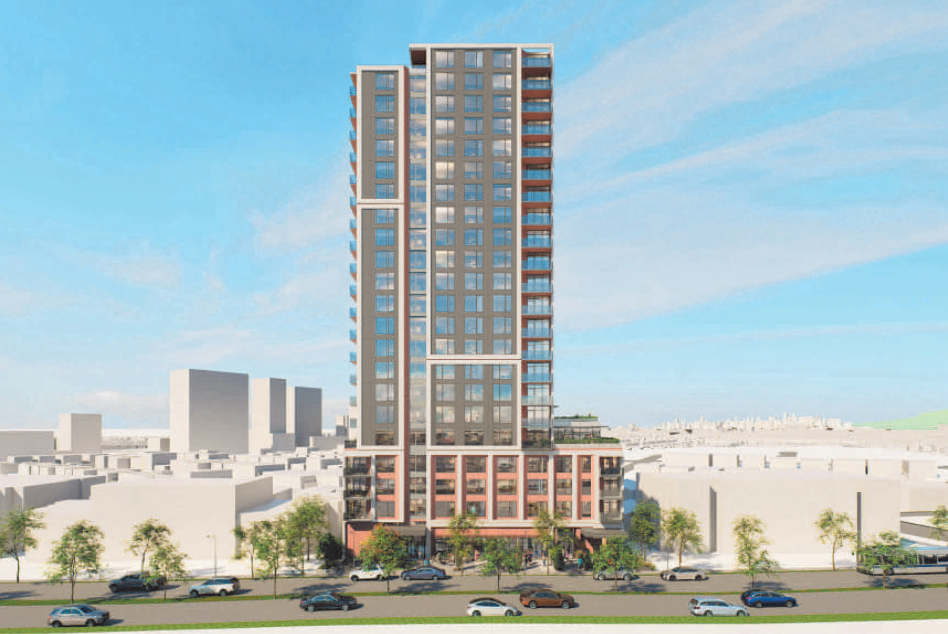
Revised application (May 4, 2026)
This application booklet has been revised to reflect the following changes:
- Removal of 33 Commercial pay-per-use EV charging parking stalls; and
- Reallocate the 33 Commercial EV charging parking stalls to residential parking.
Original application (September 12, 2025)
The City of Vancouver has received an application to rezone the subject site from CD-1 (241) (Comprehensive Development) District to CD-1 (Comprehensive Development) District. The proposal is to allow for the development of a 21-storey mixed-use residential building with a four-storey podium and includes:
- 216 social housing units;
- A private childcare centre in a commercial space;
- Commercial and retail use on the ground floor;
- A floor space ratio (FSR) of 7.98; and
- A building height of 70.2 m (230 ft.) with a rooftop amenity space.
This application is being considered under the Transit-Oriented Areas Rezoning Policy.
Application drawings and statistics are posted as-submitted to the City. Following staff review, the final project statistics are documented within the referral report.
Revised application (May 4, 2026)
This application booklet has been revised to reflect the following changes:
- Removal of 33 Commercial pay-per-use EV charging parking stalls; and
- Reallocate the 33 Commercial EV charging parking stalls to residential parking.
Original application (September 12, 2025)
The City of Vancouver has received an application to rezone the subject site from CD-1 (241) (Comprehensive Development) District to CD-1 (Comprehensive Development) District. The proposal is to allow for the development of a 21-storey mixed-use residential building with a four-storey podium and includes:
- 216 social housing units;
- A private childcare centre in a commercial space;
- Commercial and retail use on the ground floor;
- A floor space ratio (FSR) of 7.98; and
- A building height of 70.2 m (230 ft.) with a rooftop amenity space.
This application is being considered under the Transit-Oriented Areas Rezoning Policy.
Application drawings and statistics are posted as-submitted to the City. Following staff review, the final project statistics are documented within the referral report.
This application was approved by Council on July 29, 2026 following the Council Meeting on July 28, 2026.
The opportunity to ask questions through the Q&A is available from April 8 to April 21, 2026.
We post all questions as-is and aim to respond within two business days. Some questions may require coordination with internal departments and additional time may be needed to post a response.
Please note that the comment form will remain open after the Q&A period. The Rezoning Planner can also be contacted directly for any further feedback or questions.
-
Share Will there be enough space at surrounding elementary and secondary schools to accomodate the increased number of young families that this building will attract? on Facebook Share Will there be enough space at surrounding elementary and secondary schools to accomodate the increased number of young families that this building will attract? on X (formerly Twitter) Share Will there be enough space at surrounding elementary and secondary schools to accomodate the increased number of young families that this building will attract? on Linkedin Email Will there be enough space at surrounding elementary and secondary schools to accomodate the increased number of young families that this building will attract? link
Will there be enough space at surrounding elementary and secondary schools to accomodate the increased number of young families that this building will attract?
vnpt asked 6 months agoThank you for this important question. Schools are a responsibility of the provincial government. The City of Vancouver meets with the Vancouver School Board (VSB) to discuss planning matters on a regular basis. The VSB continues to monitor development and work with City staff to help plan for future growth.
-
Share I write as a follow-up to my formal objection letter previously submitted within the Q&A period for the above application. Since that submission I have obtained and reviewed the full text of the Transit-Oriented Areas Rezoning Policy (approved June 30, 2024, amended March 31, 2026) and wish to submit this supplementary letter to sharpen the policy concerns I have raised. I acknowledge that Section 5.2.4 of the TOA Rezoning Policy provides that 100% social housing projects “may be considered at heights and densities exceeding those identified in Tables 1 and 2 on a case-by-case basis.” I accept this provision as written. However, this supplementary submission identifies five distinct policy questions that must be answered before that discretion can be lawfully and transparently exercised at the scale proposed. These are not objections to social housing — they are questions of process, compliance, and documented justification that the referral report must address. QUESTION 1 — IS THIS SITE ACTUALLY WITHIN A DESIGNATED TOA? This is the threshold question. If the site is not within a designated TOA boundary, the entire TOA Rezoning Policy — including Section 5.2.4 — does not apply. The TOA Rezoning Policy states explicitly in Section 2 that it “guides rezoning applications that are being considered under the provincial regulations for Transit-Oriented Areas within lands in the City of Vancouver identified in the Transit-Oriented Areas Designation By-law.” The subject site at 5027–5053 Boundary Road is approximately 1,555 metres from Joyce–Collingwood Station — a 20-minute walk. The TOA tiers extend to a maximum of 800 m from a SkyTrain station (Tier 3). The site therefore appears to lie well outside the outer boundary of any defined TOA tier. The provincial TOA regulations designate specific parcels within defined catchment distances from prescribed transit stations. A parcel at this distance from the nearest SkyTrain station may not qualify as a designated TOA parcel at all. Formal Request 1: Please confirm in writing whether 5027–5053 Boundary Road is identified as a TOA parcel under the Transit-Oriented Areas Designation By-law, specifying the prescribed transit station, the measured distance used, and the resulting tier classification. If the site is not a designated TOA parcel, please clarify the policy basis under which this application is being considered. QUESTION 2 — WHAT IS THE SPECIFIC JUSTIFICATION FOR EXERCISING SECTION 5.2.4 DISCRETION AT THIS SCALE? Section 5.2.4 uses permissive and discretionary language: 100% social housing projects “may be considered” at exceeding heights and densities, and only “on a case-by-case basis.” This is not an automatic entitlement. It requires staff to affirmatively document the specific planning rationale for why this particular site, at this particular height and density, warrants the exercise of that discretion. The application proposes a building of 70.2 m / 21 storeys at FSR 7.98. Even within Tier 1 (the highest tier, requiring a site within 200 m of SkyTrain), the base maximum is 20 storeys and 5.5 FSR. The proposed FSR exceeds the Tier 1 ceiling by 45%, and the site — if it qualifies as a TOA parcel at all — would more plausibly fall within Tier 3 (8 storeys, 3.0 FSR). The following table summarises the gap between policy baseline and proposal: Metric Tier 1 Max (<200 m) Tier 3 Max (400–800 m) This Proposal Height Up to 20 storeys Up to 8 storeys 21 storeys FSR Up to 5.50 Up to 3.00 7.98 Station distance < 200 m 400–800 m ~1,555 m (est.) FSR vs Tier 1 max — — +45% above Tier 1 Formal Request 2: The referral report must document the specific planning rationale for exercising Section 5.2.4 discretion at 21 storeys / FSR 7.98 at this location. 'It is 100% social housing' is not a sufficient rationale — that establishes eligibility for the discretion, not the exercise of it. The report must explain: what site-specific factors justify this particular height above the applicable base tier, and why a more moderate height (e.g. 10–12 storeys) does not adequately deliver the social housing objectives. QUESTION 3 — DOES THE SITE MEET THE MINIMUM FRONTAGE REQUIREMENT FOR A TOWER? Section 6.1 of the TOA Rezoning Policy states: Section 6.1 "The minimum frontage required for all tower sites (12 storeys and above) is 45.7 m (150 ft.), except for corner sites where the minimum frontage is 40.2 m (132 ft.)." A 21-storey building is unambiguously a tower site. The frontage requirement applies. The four subject lots — 5027, 5035, 5045, and 5053 Boundary Road — are mid-block, non-corner lots. The minimum frontage required for a tower on a non-corner mid-block site is therefore 45.7 m (150 ft.). Standard Vancouver residential lots on Boundary Road in this area are typically 10–12 m wide each. Four such lots would produce an estimated combined frontage of 40–48 m. Depending on the exact lot widths, the consolidated site may be at or below the 45.7 m minimum required for a mid-block tower. Formal Request 3: Please confirm the measured frontage of the consolidated site at 5027–5053 Boundary Road and confirm whether this satisfies the 45.7 m minimum frontage requirement under Section 6.1 for a non-corner tower site. If the frontage is below 45.7 m, please explain the policy basis for proceeding with a 21-storey tower typology. QUESTION 4 — HAS SOLAR ACCESS BEEN ASSESSED AS REQUIRED BY SECTION 4.1? Section 4.1 of the TOA Rezoning Policy states that rezoning proposals “should adhere to all other relevant Council-approved policies, guidelines, and by-laws, including, but not limited to those related to solar access, public views and proximity to rail.” It further states that “in some cases, these may limit the heights and density that can be accommodated on a site.” This provision applies independently of the Section 5.2.4 social housing discretion. It is not overridden by the social housing exemption — it applies to all applications under this policy. A 70.2 m (230 ft.) tower inserted mid-block into a street of 1–2 storey single-family dwellings will cast substantial shadows on adjacent residential properties to the north and west for prolonged periods during morning and midday hours. No shadow study or solar access analysis has been made publicly available as part of this application. Formal Request 4: Please confirm whether a solar access and shadow study has been completed or commissioned for this application, and if so, provide it as part of the public record. If not yet completed, please confirm it will be required before the referral report is finalised and that its findings will be made publicly available prior to any public hearing. QUESTION 5 — HOW DOES THIS APPLICATION RELATE TO THE JOYCE–COLLINGWOOD STATION AREA PRECINCT PLAN? The Appendix to the TOA Rezoning Policy lists the Joyce–Collingwood Station Area Precinct Plan as an existing area plan that has NOT been integrated with TOA considerations. The TOA Policy states that it applies “until such time as a new area plan is complete, an existing area plan is amended to integrate TOA considerations, or until this policy has been repealed.” This is significant for two reasons: • First, it confirms that the Joyce–Collingwood area — the nearest station precinct to this site — has not yet been through the planning process needed to assess how TOA density should be distributed across the neighbourhood. The TOA Policy is explicitly designed as an interim instrument pending that work. • Second, it means that any 21-storey approval granted under the interim TOA policy and the Section 5.2.4 social housing discretion will set a de facto height precedent in a precinct whose area plan has not yet assessed cumulative density impacts. Subsequent applicants will be able to cite this approval as precedent, making it significantly harder for staff to deny comparable applications in the same area. This is not a hypothetical risk — it is a well-documented pattern in Vancouver's planning history. The referral report should explicitly address the precedent implications of approving 21 storeys in this location before the Joyce–Collingwood Station Area Precinct Plan has been updated to guide density at a neighbourhood scale. Formal Request 5: Please confirm the current status of the Joyce–Collingwood Station Area Precinct Plan update and explain in the referral report how the approval of this application at 21 storeys is consistent with the intent of the TOA Policy as an interim instrument pending area plan completion. Please also address the precedent implications for adjacent and nearby sites. SUMMARY OF FORMAL REQUESTS To assist staff in processing this supplementary submission, I summarise my five formal requests for information and referral report content: 1. TOA boundary confirmation: Confirm in writing whether 5027–5053 Boundary Road is a designated TOA parcel, which station it is measured from, the measured distance, and the resulting tier. 2. Section 5.2.4 rationale: Document in the referral report the specific site-by-site planning rationale for exercising the 5.2.4 discretion at 21 storeys / FSR 7.98, beyond the bare fact of social housing tenure. 3. Frontage compliance: Confirm the measured frontage of the consolidated site and confirm compliance with the 45.7 m minimum tower frontage requirement under Section 6.1. 4. Solar access study: Confirm whether a shadow / solar access study has been completed and commit to publishing it as part of the public record before any public hearing. 5. Precedent and area plan: Address in the referral report the status of the Joyce–Collingwood Station Area Precinct Plan update and the precedent implications of this approval for the broader neighbourhood. These are specific, answerable questions grounded in the text of the City’s own policy document. They are not objections to the social purpose of this project. I respectfully submit that each deserves a direct written response in the referral report, and that residents should not be required to raise them for the first time at a public hearing. I continue to request that I be notified of all subsequent steps in this application, including the referral report publication date, public hearing scheduling, and any Urban Design Panel review. on Facebook Share I write as a follow-up to my formal objection letter previously submitted within the Q&A period for the above application. Since that submission I have obtained and reviewed the full text of the Transit-Oriented Areas Rezoning Policy (approved June 30, 2024, amended March 31, 2026) and wish to submit this supplementary letter to sharpen the policy concerns I have raised. I acknowledge that Section 5.2.4 of the TOA Rezoning Policy provides that 100% social housing projects “may be considered at heights and densities exceeding those identified in Tables 1 and 2 on a case-by-case basis.” I accept this provision as written. However, this supplementary submission identifies five distinct policy questions that must be answered before that discretion can be lawfully and transparently exercised at the scale proposed. These are not objections to social housing — they are questions of process, compliance, and documented justification that the referral report must address. QUESTION 1 — IS THIS SITE ACTUALLY WITHIN A DESIGNATED TOA? This is the threshold question. If the site is not within a designated TOA boundary, the entire TOA Rezoning Policy — including Section 5.2.4 — does not apply. The TOA Rezoning Policy states explicitly in Section 2 that it “guides rezoning applications that are being considered under the provincial regulations for Transit-Oriented Areas within lands in the City of Vancouver identified in the Transit-Oriented Areas Designation By-law.” The subject site at 5027–5053 Boundary Road is approximately 1,555 metres from Joyce–Collingwood Station — a 20-minute walk. The TOA tiers extend to a maximum of 800 m from a SkyTrain station (Tier 3). The site therefore appears to lie well outside the outer boundary of any defined TOA tier. The provincial TOA regulations designate specific parcels within defined catchment distances from prescribed transit stations. A parcel at this distance from the nearest SkyTrain station may not qualify as a designated TOA parcel at all. Formal Request 1: Please confirm in writing whether 5027–5053 Boundary Road is identified as a TOA parcel under the Transit-Oriented Areas Designation By-law, specifying the prescribed transit station, the measured distance used, and the resulting tier classification. If the site is not a designated TOA parcel, please clarify the policy basis under which this application is being considered. QUESTION 2 — WHAT IS THE SPECIFIC JUSTIFICATION FOR EXERCISING SECTION 5.2.4 DISCRETION AT THIS SCALE? Section 5.2.4 uses permissive and discretionary language: 100% social housing projects “may be considered” at exceeding heights and densities, and only “on a case-by-case basis.” This is not an automatic entitlement. It requires staff to affirmatively document the specific planning rationale for why this particular site, at this particular height and density, warrants the exercise of that discretion. The application proposes a building of 70.2 m / 21 storeys at FSR 7.98. Even within Tier 1 (the highest tier, requiring a site within 200 m of SkyTrain), the base maximum is 20 storeys and 5.5 FSR. The proposed FSR exceeds the Tier 1 ceiling by 45%, and the site — if it qualifies as a TOA parcel at all — would more plausibly fall within Tier 3 (8 storeys, 3.0 FSR). The following table summarises the gap between policy baseline and proposal: Metric Tier 1 Max (<200 m) Tier 3 Max (400–800 m) This Proposal Height Up to 20 storeys Up to 8 storeys 21 storeys FSR Up to 5.50 Up to 3.00 7.98 Station distance < 200 m 400–800 m ~1,555 m (est.) FSR vs Tier 1 max — — +45% above Tier 1 Formal Request 2: The referral report must document the specific planning rationale for exercising Section 5.2.4 discretion at 21 storeys / FSR 7.98 at this location. 'It is 100% social housing' is not a sufficient rationale — that establishes eligibility for the discretion, not the exercise of it. The report must explain: what site-specific factors justify this particular height above the applicable base tier, and why a more moderate height (e.g. 10–12 storeys) does not adequately deliver the social housing objectives. QUESTION 3 — DOES THE SITE MEET THE MINIMUM FRONTAGE REQUIREMENT FOR A TOWER? Section 6.1 of the TOA Rezoning Policy states: Section 6.1 "The minimum frontage required for all tower sites (12 storeys and above) is 45.7 m (150 ft.), except for corner sites where the minimum frontage is 40.2 m (132 ft.)." A 21-storey building is unambiguously a tower site. The frontage requirement applies. The four subject lots — 5027, 5035, 5045, and 5053 Boundary Road — are mid-block, non-corner lots. The minimum frontage required for a tower on a non-corner mid-block site is therefore 45.7 m (150 ft.). Standard Vancouver residential lots on Boundary Road in this area are typically 10–12 m wide each. Four such lots would produce an estimated combined frontage of 40–48 m. Depending on the exact lot widths, the consolidated site may be at or below the 45.7 m minimum required for a mid-block tower. Formal Request 3: Please confirm the measured frontage of the consolidated site at 5027–5053 Boundary Road and confirm whether this satisfies the 45.7 m minimum frontage requirement under Section 6.1 for a non-corner tower site. If the frontage is below 45.7 m, please explain the policy basis for proceeding with a 21-storey tower typology. QUESTION 4 — HAS SOLAR ACCESS BEEN ASSESSED AS REQUIRED BY SECTION 4.1? Section 4.1 of the TOA Rezoning Policy states that rezoning proposals “should adhere to all other relevant Council-approved policies, guidelines, and by-laws, including, but not limited to those related to solar access, public views and proximity to rail.” It further states that “in some cases, these may limit the heights and density that can be accommodated on a site.” This provision applies independently of the Section 5.2.4 social housing discretion. It is not overridden by the social housing exemption — it applies to all applications under this policy. A 70.2 m (230 ft.) tower inserted mid-block into a street of 1–2 storey single-family dwellings will cast substantial shadows on adjacent residential properties to the north and west for prolonged periods during morning and midday hours. No shadow study or solar access analysis has been made publicly available as part of this application. Formal Request 4: Please confirm whether a solar access and shadow study has been completed or commissioned for this application, and if so, provide it as part of the public record. If not yet completed, please confirm it will be required before the referral report is finalised and that its findings will be made publicly available prior to any public hearing. QUESTION 5 — HOW DOES THIS APPLICATION RELATE TO THE JOYCE–COLLINGWOOD STATION AREA PRECINCT PLAN? The Appendix to the TOA Rezoning Policy lists the Joyce–Collingwood Station Area Precinct Plan as an existing area plan that has NOT been integrated with TOA considerations. The TOA Policy states that it applies “until such time as a new area plan is complete, an existing area plan is amended to integrate TOA considerations, or until this policy has been repealed.” This is significant for two reasons: • First, it confirms that the Joyce–Collingwood area — the nearest station precinct to this site — has not yet been through the planning process needed to assess how TOA density should be distributed across the neighbourhood. The TOA Policy is explicitly designed as an interim instrument pending that work. • Second, it means that any 21-storey approval granted under the interim TOA policy and the Section 5.2.4 social housing discretion will set a de facto height precedent in a precinct whose area plan has not yet assessed cumulative density impacts. Subsequent applicants will be able to cite this approval as precedent, making it significantly harder for staff to deny comparable applications in the same area. This is not a hypothetical risk — it is a well-documented pattern in Vancouver's planning history. The referral report should explicitly address the precedent implications of approving 21 storeys in this location before the Joyce–Collingwood Station Area Precinct Plan has been updated to guide density at a neighbourhood scale. Formal Request 5: Please confirm the current status of the Joyce–Collingwood Station Area Precinct Plan update and explain in the referral report how the approval of this application at 21 storeys is consistent with the intent of the TOA Policy as an interim instrument pending area plan completion. Please also address the precedent implications for adjacent and nearby sites. SUMMARY OF FORMAL REQUESTS To assist staff in processing this supplementary submission, I summarise my five formal requests for information and referral report content: 1. TOA boundary confirmation: Confirm in writing whether 5027–5053 Boundary Road is a designated TOA parcel, which station it is measured from, the measured distance, and the resulting tier. 2. Section 5.2.4 rationale: Document in the referral report the specific site-by-site planning rationale for exercising the 5.2.4 discretion at 21 storeys / FSR 7.98, beyond the bare fact of social housing tenure. 3. Frontage compliance: Confirm the measured frontage of the consolidated site and confirm compliance with the 45.7 m minimum tower frontage requirement under Section 6.1. 4. Solar access study: Confirm whether a shadow / solar access study has been completed and commit to publishing it as part of the public record before any public hearing. 5. Precedent and area plan: Address in the referral report the status of the Joyce–Collingwood Station Area Precinct Plan update and the precedent implications of this approval for the broader neighbourhood. These are specific, answerable questions grounded in the text of the City’s own policy document. They are not objections to the social purpose of this project. I respectfully submit that each deserves a direct written response in the referral report, and that residents should not be required to raise them for the first time at a public hearing. I continue to request that I be notified of all subsequent steps in this application, including the referral report publication date, public hearing scheduling, and any Urban Design Panel review. on X (formerly Twitter) Share I write as a follow-up to my formal objection letter previously submitted within the Q&A period for the above application. Since that submission I have obtained and reviewed the full text of the Transit-Oriented Areas Rezoning Policy (approved June 30, 2024, amended March 31, 2026) and wish to submit this supplementary letter to sharpen the policy concerns I have raised. I acknowledge that Section 5.2.4 of the TOA Rezoning Policy provides that 100% social housing projects “may be considered at heights and densities exceeding those identified in Tables 1 and 2 on a case-by-case basis.” I accept this provision as written. However, this supplementary submission identifies five distinct policy questions that must be answered before that discretion can be lawfully and transparently exercised at the scale proposed. These are not objections to social housing — they are questions of process, compliance, and documented justification that the referral report must address. QUESTION 1 — IS THIS SITE ACTUALLY WITHIN A DESIGNATED TOA? This is the threshold question. If the site is not within a designated TOA boundary, the entire TOA Rezoning Policy — including Section 5.2.4 — does not apply. The TOA Rezoning Policy states explicitly in Section 2 that it “guides rezoning applications that are being considered under the provincial regulations for Transit-Oriented Areas within lands in the City of Vancouver identified in the Transit-Oriented Areas Designation By-law.” The subject site at 5027–5053 Boundary Road is approximately 1,555 metres from Joyce–Collingwood Station — a 20-minute walk. The TOA tiers extend to a maximum of 800 m from a SkyTrain station (Tier 3). The site therefore appears to lie well outside the outer boundary of any defined TOA tier. The provincial TOA regulations designate specific parcels within defined catchment distances from prescribed transit stations. A parcel at this distance from the nearest SkyTrain station may not qualify as a designated TOA parcel at all. Formal Request 1: Please confirm in writing whether 5027–5053 Boundary Road is identified as a TOA parcel under the Transit-Oriented Areas Designation By-law, specifying the prescribed transit station, the measured distance used, and the resulting tier classification. If the site is not a designated TOA parcel, please clarify the policy basis under which this application is being considered. QUESTION 2 — WHAT IS THE SPECIFIC JUSTIFICATION FOR EXERCISING SECTION 5.2.4 DISCRETION AT THIS SCALE? Section 5.2.4 uses permissive and discretionary language: 100% social housing projects “may be considered” at exceeding heights and densities, and only “on a case-by-case basis.” This is not an automatic entitlement. It requires staff to affirmatively document the specific planning rationale for why this particular site, at this particular height and density, warrants the exercise of that discretion. The application proposes a building of 70.2 m / 21 storeys at FSR 7.98. Even within Tier 1 (the highest tier, requiring a site within 200 m of SkyTrain), the base maximum is 20 storeys and 5.5 FSR. The proposed FSR exceeds the Tier 1 ceiling by 45%, and the site — if it qualifies as a TOA parcel at all — would more plausibly fall within Tier 3 (8 storeys, 3.0 FSR). The following table summarises the gap between policy baseline and proposal: Metric Tier 1 Max (<200 m) Tier 3 Max (400–800 m) This Proposal Height Up to 20 storeys Up to 8 storeys 21 storeys FSR Up to 5.50 Up to 3.00 7.98 Station distance < 200 m 400–800 m ~1,555 m (est.) FSR vs Tier 1 max — — +45% above Tier 1 Formal Request 2: The referral report must document the specific planning rationale for exercising Section 5.2.4 discretion at 21 storeys / FSR 7.98 at this location. 'It is 100% social housing' is not a sufficient rationale — that establishes eligibility for the discretion, not the exercise of it. The report must explain: what site-specific factors justify this particular height above the applicable base tier, and why a more moderate height (e.g. 10–12 storeys) does not adequately deliver the social housing objectives. QUESTION 3 — DOES THE SITE MEET THE MINIMUM FRONTAGE REQUIREMENT FOR A TOWER? Section 6.1 of the TOA Rezoning Policy states: Section 6.1 "The minimum frontage required for all tower sites (12 storeys and above) is 45.7 m (150 ft.), except for corner sites where the minimum frontage is 40.2 m (132 ft.)." A 21-storey building is unambiguously a tower site. The frontage requirement applies. The four subject lots — 5027, 5035, 5045, and 5053 Boundary Road — are mid-block, non-corner lots. The minimum frontage required for a tower on a non-corner mid-block site is therefore 45.7 m (150 ft.). Standard Vancouver residential lots on Boundary Road in this area are typically 10–12 m wide each. Four such lots would produce an estimated combined frontage of 40–48 m. Depending on the exact lot widths, the consolidated site may be at or below the 45.7 m minimum required for a mid-block tower. Formal Request 3: Please confirm the measured frontage of the consolidated site at 5027–5053 Boundary Road and confirm whether this satisfies the 45.7 m minimum frontage requirement under Section 6.1 for a non-corner tower site. If the frontage is below 45.7 m, please explain the policy basis for proceeding with a 21-storey tower typology. QUESTION 4 — HAS SOLAR ACCESS BEEN ASSESSED AS REQUIRED BY SECTION 4.1? Section 4.1 of the TOA Rezoning Policy states that rezoning proposals “should adhere to all other relevant Council-approved policies, guidelines, and by-laws, including, but not limited to those related to solar access, public views and proximity to rail.” It further states that “in some cases, these may limit the heights and density that can be accommodated on a site.” This provision applies independently of the Section 5.2.4 social housing discretion. It is not overridden by the social housing exemption — it applies to all applications under this policy. A 70.2 m (230 ft.) tower inserted mid-block into a street of 1–2 storey single-family dwellings will cast substantial shadows on adjacent residential properties to the north and west for prolonged periods during morning and midday hours. No shadow study or solar access analysis has been made publicly available as part of this application. Formal Request 4: Please confirm whether a solar access and shadow study has been completed or commissioned for this application, and if so, provide it as part of the public record. If not yet completed, please confirm it will be required before the referral report is finalised and that its findings will be made publicly available prior to any public hearing. QUESTION 5 — HOW DOES THIS APPLICATION RELATE TO THE JOYCE–COLLINGWOOD STATION AREA PRECINCT PLAN? The Appendix to the TOA Rezoning Policy lists the Joyce–Collingwood Station Area Precinct Plan as an existing area plan that has NOT been integrated with TOA considerations. The TOA Policy states that it applies “until such time as a new area plan is complete, an existing area plan is amended to integrate TOA considerations, or until this policy has been repealed.” This is significant for two reasons: • First, it confirms that the Joyce–Collingwood area — the nearest station precinct to this site — has not yet been through the planning process needed to assess how TOA density should be distributed across the neighbourhood. The TOA Policy is explicitly designed as an interim instrument pending that work. • Second, it means that any 21-storey approval granted under the interim TOA policy and the Section 5.2.4 social housing discretion will set a de facto height precedent in a precinct whose area plan has not yet assessed cumulative density impacts. Subsequent applicants will be able to cite this approval as precedent, making it significantly harder for staff to deny comparable applications in the same area. This is not a hypothetical risk — it is a well-documented pattern in Vancouver's planning history. The referral report should explicitly address the precedent implications of approving 21 storeys in this location before the Joyce–Collingwood Station Area Precinct Plan has been updated to guide density at a neighbourhood scale. Formal Request 5: Please confirm the current status of the Joyce–Collingwood Station Area Precinct Plan update and explain in the referral report how the approval of this application at 21 storeys is consistent with the intent of the TOA Policy as an interim instrument pending area plan completion. Please also address the precedent implications for adjacent and nearby sites. SUMMARY OF FORMAL REQUESTS To assist staff in processing this supplementary submission, I summarise my five formal requests for information and referral report content: 1. TOA boundary confirmation: Confirm in writing whether 5027–5053 Boundary Road is a designated TOA parcel, which station it is measured from, the measured distance, and the resulting tier. 2. Section 5.2.4 rationale: Document in the referral report the specific site-by-site planning rationale for exercising the 5.2.4 discretion at 21 storeys / FSR 7.98, beyond the bare fact of social housing tenure. 3. Frontage compliance: Confirm the measured frontage of the consolidated site and confirm compliance with the 45.7 m minimum tower frontage requirement under Section 6.1. 4. Solar access study: Confirm whether a shadow / solar access study has been completed and commit to publishing it as part of the public record before any public hearing. 5. Precedent and area plan: Address in the referral report the status of the Joyce–Collingwood Station Area Precinct Plan update and the precedent implications of this approval for the broader neighbourhood. These are specific, answerable questions grounded in the text of the City’s own policy document. They are not objections to the social purpose of this project. I respectfully submit that each deserves a direct written response in the referral report, and that residents should not be required to raise them for the first time at a public hearing. I continue to request that I be notified of all subsequent steps in this application, including the referral report publication date, public hearing scheduling, and any Urban Design Panel review. on Linkedin Email I write as a follow-up to my formal objection letter previously submitted within the Q&A period for the above application. Since that submission I have obtained and reviewed the full text of the Transit-Oriented Areas Rezoning Policy (approved June 30, 2024, amended March 31, 2026) and wish to submit this supplementary letter to sharpen the policy concerns I have raised. I acknowledge that Section 5.2.4 of the TOA Rezoning Policy provides that 100% social housing projects “may be considered at heights and densities exceeding those identified in Tables 1 and 2 on a case-by-case basis.” I accept this provision as written. However, this supplementary submission identifies five distinct policy questions that must be answered before that discretion can be lawfully and transparently exercised at the scale proposed. These are not objections to social housing — they are questions of process, compliance, and documented justification that the referral report must address. QUESTION 1 — IS THIS SITE ACTUALLY WITHIN A DESIGNATED TOA? This is the threshold question. If the site is not within a designated TOA boundary, the entire TOA Rezoning Policy — including Section 5.2.4 — does not apply. The TOA Rezoning Policy states explicitly in Section 2 that it “guides rezoning applications that are being considered under the provincial regulations for Transit-Oriented Areas within lands in the City of Vancouver identified in the Transit-Oriented Areas Designation By-law.” The subject site at 5027–5053 Boundary Road is approximately 1,555 metres from Joyce–Collingwood Station — a 20-minute walk. The TOA tiers extend to a maximum of 800 m from a SkyTrain station (Tier 3). The site therefore appears to lie well outside the outer boundary of any defined TOA tier. The provincial TOA regulations designate specific parcels within defined catchment distances from prescribed transit stations. A parcel at this distance from the nearest SkyTrain station may not qualify as a designated TOA parcel at all. Formal Request 1: Please confirm in writing whether 5027–5053 Boundary Road is identified as a TOA parcel under the Transit-Oriented Areas Designation By-law, specifying the prescribed transit station, the measured distance used, and the resulting tier classification. If the site is not a designated TOA parcel, please clarify the policy basis under which this application is being considered. QUESTION 2 — WHAT IS THE SPECIFIC JUSTIFICATION FOR EXERCISING SECTION 5.2.4 DISCRETION AT THIS SCALE? Section 5.2.4 uses permissive and discretionary language: 100% social housing projects “may be considered” at exceeding heights and densities, and only “on a case-by-case basis.” This is not an automatic entitlement. It requires staff to affirmatively document the specific planning rationale for why this particular site, at this particular height and density, warrants the exercise of that discretion. The application proposes a building of 70.2 m / 21 storeys at FSR 7.98. Even within Tier 1 (the highest tier, requiring a site within 200 m of SkyTrain), the base maximum is 20 storeys and 5.5 FSR. The proposed FSR exceeds the Tier 1 ceiling by 45%, and the site — if it qualifies as a TOA parcel at all — would more plausibly fall within Tier 3 (8 storeys, 3.0 FSR). The following table summarises the gap between policy baseline and proposal: Metric Tier 1 Max (<200 m) Tier 3 Max (400–800 m) This Proposal Height Up to 20 storeys Up to 8 storeys 21 storeys FSR Up to 5.50 Up to 3.00 7.98 Station distance < 200 m 400–800 m ~1,555 m (est.) FSR vs Tier 1 max — — +45% above Tier 1 Formal Request 2: The referral report must document the specific planning rationale for exercising Section 5.2.4 discretion at 21 storeys / FSR 7.98 at this location. 'It is 100% social housing' is not a sufficient rationale — that establishes eligibility for the discretion, not the exercise of it. The report must explain: what site-specific factors justify this particular height above the applicable base tier, and why a more moderate height (e.g. 10–12 storeys) does not adequately deliver the social housing objectives. QUESTION 3 — DOES THE SITE MEET THE MINIMUM FRONTAGE REQUIREMENT FOR A TOWER? Section 6.1 of the TOA Rezoning Policy states: Section 6.1 "The minimum frontage required for all tower sites (12 storeys and above) is 45.7 m (150 ft.), except for corner sites where the minimum frontage is 40.2 m (132 ft.)." A 21-storey building is unambiguously a tower site. The frontage requirement applies. The four subject lots — 5027, 5035, 5045, and 5053 Boundary Road — are mid-block, non-corner lots. The minimum frontage required for a tower on a non-corner mid-block site is therefore 45.7 m (150 ft.). Standard Vancouver residential lots on Boundary Road in this area are typically 10–12 m wide each. Four such lots would produce an estimated combined frontage of 40–48 m. Depending on the exact lot widths, the consolidated site may be at or below the 45.7 m minimum required for a mid-block tower. Formal Request 3: Please confirm the measured frontage of the consolidated site at 5027–5053 Boundary Road and confirm whether this satisfies the 45.7 m minimum frontage requirement under Section 6.1 for a non-corner tower site. If the frontage is below 45.7 m, please explain the policy basis for proceeding with a 21-storey tower typology. QUESTION 4 — HAS SOLAR ACCESS BEEN ASSESSED AS REQUIRED BY SECTION 4.1? Section 4.1 of the TOA Rezoning Policy states that rezoning proposals “should adhere to all other relevant Council-approved policies, guidelines, and by-laws, including, but not limited to those related to solar access, public views and proximity to rail.” It further states that “in some cases, these may limit the heights and density that can be accommodated on a site.” This provision applies independently of the Section 5.2.4 social housing discretion. It is not overridden by the social housing exemption — it applies to all applications under this policy. A 70.2 m (230 ft.) tower inserted mid-block into a street of 1–2 storey single-family dwellings will cast substantial shadows on adjacent residential properties to the north and west for prolonged periods during morning and midday hours. No shadow study or solar access analysis has been made publicly available as part of this application. Formal Request 4: Please confirm whether a solar access and shadow study has been completed or commissioned for this application, and if so, provide it as part of the public record. If not yet completed, please confirm it will be required before the referral report is finalised and that its findings will be made publicly available prior to any public hearing. QUESTION 5 — HOW DOES THIS APPLICATION RELATE TO THE JOYCE–COLLINGWOOD STATION AREA PRECINCT PLAN? The Appendix to the TOA Rezoning Policy lists the Joyce–Collingwood Station Area Precinct Plan as an existing area plan that has NOT been integrated with TOA considerations. The TOA Policy states that it applies “until such time as a new area plan is complete, an existing area plan is amended to integrate TOA considerations, or until this policy has been repealed.” This is significant for two reasons: • First, it confirms that the Joyce–Collingwood area — the nearest station precinct to this site — has not yet been through the planning process needed to assess how TOA density should be distributed across the neighbourhood. The TOA Policy is explicitly designed as an interim instrument pending that work. • Second, it means that any 21-storey approval granted under the interim TOA policy and the Section 5.2.4 social housing discretion will set a de facto height precedent in a precinct whose area plan has not yet assessed cumulative density impacts. Subsequent applicants will be able to cite this approval as precedent, making it significantly harder for staff to deny comparable applications in the same area. This is not a hypothetical risk — it is a well-documented pattern in Vancouver's planning history. The referral report should explicitly address the precedent implications of approving 21 storeys in this location before the Joyce–Collingwood Station Area Precinct Plan has been updated to guide density at a neighbourhood scale. Formal Request 5: Please confirm the current status of the Joyce–Collingwood Station Area Precinct Plan update and explain in the referral report how the approval of this application at 21 storeys is consistent with the intent of the TOA Policy as an interim instrument pending area plan completion. Please also address the precedent implications for adjacent and nearby sites. SUMMARY OF FORMAL REQUESTS To assist staff in processing this supplementary submission, I summarise my five formal requests for information and referral report content: 1. TOA boundary confirmation: Confirm in writing whether 5027–5053 Boundary Road is a designated TOA parcel, which station it is measured from, the measured distance, and the resulting tier. 2. Section 5.2.4 rationale: Document in the referral report the specific site-by-site planning rationale for exercising the 5.2.4 discretion at 21 storeys / FSR 7.98, beyond the bare fact of social housing tenure. 3. Frontage compliance: Confirm the measured frontage of the consolidated site and confirm compliance with the 45.7 m minimum tower frontage requirement under Section 6.1. 4. Solar access study: Confirm whether a shadow / solar access study has been completed and commit to publishing it as part of the public record before any public hearing. 5. Precedent and area plan: Address in the referral report the status of the Joyce–Collingwood Station Area Precinct Plan update and the precedent implications of this approval for the broader neighbourhood. These are specific, answerable questions grounded in the text of the City’s own policy document. They are not objections to the social purpose of this project. I respectfully submit that each deserves a direct written response in the referral report, and that residents should not be required to raise them for the first time at a public hearing. I continue to request that I be notified of all subsequent steps in this application, including the referral report publication date, public hearing scheduling, and any Urban Design Panel review. link
I write as a follow-up to my formal objection letter previously submitted within the Q&A period for the above application. Since that submission I have obtained and reviewed the full text of the Transit-Oriented Areas Rezoning Policy (approved June 30, 2024, amended March 31, 2026) and wish to submit this supplementary letter to sharpen the policy concerns I have raised. I acknowledge that Section 5.2.4 of the TOA Rezoning Policy provides that 100% social housing projects “may be considered at heights and densities exceeding those identified in Tables 1 and 2 on a case-by-case basis.” I accept this provision as written. However, this supplementary submission identifies five distinct policy questions that must be answered before that discretion can be lawfully and transparently exercised at the scale proposed. These are not objections to social housing — they are questions of process, compliance, and documented justification that the referral report must address. QUESTION 1 — IS THIS SITE ACTUALLY WITHIN A DESIGNATED TOA? This is the threshold question. If the site is not within a designated TOA boundary, the entire TOA Rezoning Policy — including Section 5.2.4 — does not apply. The TOA Rezoning Policy states explicitly in Section 2 that it “guides rezoning applications that are being considered under the provincial regulations for Transit-Oriented Areas within lands in the City of Vancouver identified in the Transit-Oriented Areas Designation By-law.” The subject site at 5027–5053 Boundary Road is approximately 1,555 metres from Joyce–Collingwood Station — a 20-minute walk. The TOA tiers extend to a maximum of 800 m from a SkyTrain station (Tier 3). The site therefore appears to lie well outside the outer boundary of any defined TOA tier. The provincial TOA regulations designate specific parcels within defined catchment distances from prescribed transit stations. A parcel at this distance from the nearest SkyTrain station may not qualify as a designated TOA parcel at all. Formal Request 1: Please confirm in writing whether 5027–5053 Boundary Road is identified as a TOA parcel under the Transit-Oriented Areas Designation By-law, specifying the prescribed transit station, the measured distance used, and the resulting tier classification. If the site is not a designated TOA parcel, please clarify the policy basis under which this application is being considered. QUESTION 2 — WHAT IS THE SPECIFIC JUSTIFICATION FOR EXERCISING SECTION 5.2.4 DISCRETION AT THIS SCALE? Section 5.2.4 uses permissive and discretionary language: 100% social housing projects “may be considered” at exceeding heights and densities, and only “on a case-by-case basis.” This is not an automatic entitlement. It requires staff to affirmatively document the specific planning rationale for why this particular site, at this particular height and density, warrants the exercise of that discretion. The application proposes a building of 70.2 m / 21 storeys at FSR 7.98. Even within Tier 1 (the highest tier, requiring a site within 200 m of SkyTrain), the base maximum is 20 storeys and 5.5 FSR. The proposed FSR exceeds the Tier 1 ceiling by 45%, and the site — if it qualifies as a TOA parcel at all — would more plausibly fall within Tier 3 (8 storeys, 3.0 FSR). The following table summarises the gap between policy baseline and proposal: Metric Tier 1 Max (<200 m) Tier 3 Max (400–800 m) This Proposal Height Up to 20 storeys Up to 8 storeys 21 storeys FSR Up to 5.50 Up to 3.00 7.98 Station distance < 200 m 400–800 m ~1,555 m (est.) FSR vs Tier 1 max — — +45% above Tier 1 Formal Request 2: The referral report must document the specific planning rationale for exercising Section 5.2.4 discretion at 21 storeys / FSR 7.98 at this location. 'It is 100% social housing' is not a sufficient rationale — that establishes eligibility for the discretion, not the exercise of it. The report must explain: what site-specific factors justify this particular height above the applicable base tier, and why a more moderate height (e.g. 10–12 storeys) does not adequately deliver the social housing objectives. QUESTION 3 — DOES THE SITE MEET THE MINIMUM FRONTAGE REQUIREMENT FOR A TOWER? Section 6.1 of the TOA Rezoning Policy states: Section 6.1 "The minimum frontage required for all tower sites (12 storeys and above) is 45.7 m (150 ft.), except for corner sites where the minimum frontage is 40.2 m (132 ft.)." A 21-storey building is unambiguously a tower site. The frontage requirement applies. The four subject lots — 5027, 5035, 5045, and 5053 Boundary Road — are mid-block, non-corner lots. The minimum frontage required for a tower on a non-corner mid-block site is therefore 45.7 m (150 ft.). Standard Vancouver residential lots on Boundary Road in this area are typically 10–12 m wide each. Four such lots would produce an estimated combined frontage of 40–48 m. Depending on the exact lot widths, the consolidated site may be at or below the 45.7 m minimum required for a mid-block tower. Formal Request 3: Please confirm the measured frontage of the consolidated site at 5027–5053 Boundary Road and confirm whether this satisfies the 45.7 m minimum frontage requirement under Section 6.1 for a non-corner tower site. If the frontage is below 45.7 m, please explain the policy basis for proceeding with a 21-storey tower typology. QUESTION 4 — HAS SOLAR ACCESS BEEN ASSESSED AS REQUIRED BY SECTION 4.1? Section 4.1 of the TOA Rezoning Policy states that rezoning proposals “should adhere to all other relevant Council-approved policies, guidelines, and by-laws, including, but not limited to those related to solar access, public views and proximity to rail.” It further states that “in some cases, these may limit the heights and density that can be accommodated on a site.” This provision applies independently of the Section 5.2.4 social housing discretion. It is not overridden by the social housing exemption — it applies to all applications under this policy. A 70.2 m (230 ft.) tower inserted mid-block into a street of 1–2 storey single-family dwellings will cast substantial shadows on adjacent residential properties to the north and west for prolonged periods during morning and midday hours. No shadow study or solar access analysis has been made publicly available as part of this application. Formal Request 4: Please confirm whether a solar access and shadow study has been completed or commissioned for this application, and if so, provide it as part of the public record. If not yet completed, please confirm it will be required before the referral report is finalised and that its findings will be made publicly available prior to any public hearing. QUESTION 5 — HOW DOES THIS APPLICATION RELATE TO THE JOYCE–COLLINGWOOD STATION AREA PRECINCT PLAN? The Appendix to the TOA Rezoning Policy lists the Joyce–Collingwood Station Area Precinct Plan as an existing area plan that has NOT been integrated with TOA considerations. The TOA Policy states that it applies “until such time as a new area plan is complete, an existing area plan is amended to integrate TOA considerations, or until this policy has been repealed.” This is significant for two reasons: • First, it confirms that the Joyce–Collingwood area — the nearest station precinct to this site — has not yet been through the planning process needed to assess how TOA density should be distributed across the neighbourhood. The TOA Policy is explicitly designed as an interim instrument pending that work. • Second, it means that any 21-storey approval granted under the interim TOA policy and the Section 5.2.4 social housing discretion will set a de facto height precedent in a precinct whose area plan has not yet assessed cumulative density impacts. Subsequent applicants will be able to cite this approval as precedent, making it significantly harder for staff to deny comparable applications in the same area. This is not a hypothetical risk — it is a well-documented pattern in Vancouver's planning history. The referral report should explicitly address the precedent implications of approving 21 storeys in this location before the Joyce–Collingwood Station Area Precinct Plan has been updated to guide density at a neighbourhood scale. Formal Request 5: Please confirm the current status of the Joyce–Collingwood Station Area Precinct Plan update and explain in the referral report how the approval of this application at 21 storeys is consistent with the intent of the TOA Policy as an interim instrument pending area plan completion. Please also address the precedent implications for adjacent and nearby sites. SUMMARY OF FORMAL REQUESTS To assist staff in processing this supplementary submission, I summarise my five formal requests for information and referral report content: 1. TOA boundary confirmation: Confirm in writing whether 5027–5053 Boundary Road is a designated TOA parcel, which station it is measured from, the measured distance, and the resulting tier. 2. Section 5.2.4 rationale: Document in the referral report the specific site-by-site planning rationale for exercising the 5.2.4 discretion at 21 storeys / FSR 7.98, beyond the bare fact of social housing tenure. 3. Frontage compliance: Confirm the measured frontage of the consolidated site and confirm compliance with the 45.7 m minimum tower frontage requirement under Section 6.1. 4. Solar access study: Confirm whether a shadow / solar access study has been completed and commit to publishing it as part of the public record before any public hearing. 5. Precedent and area plan: Address in the referral report the status of the Joyce–Collingwood Station Area Precinct Plan update and the precedent implications of this approval for the broader neighbourhood. These are specific, answerable questions grounded in the text of the City’s own policy document. They are not objections to the social purpose of this project. I respectfully submit that each deserves a direct written response in the referral report, and that residents should not be required to raise them for the first time at a public hearing. I continue to request that I be notified of all subsequent steps in this application, including the referral report publication date, public hearing scheduling, and any Urban Design Panel review.
cheungcceddie asked 5 months agoThank you for your question. Staff has reviewed your five requests and have the following answers:
- The subject site is within Tier 3 of the Transit Oriented Area Rezoning Policy which allows up to 8 storeys. Height exceptions can be considered for Social Housing on a site-by-site basis.
- Thank you for this suggestion. Staff review is still underway on this project. The public will have the opportunity to review the Council Report approximately a week prior its considered by Council.
- The site frontage of 42.2m (138’ 6”) is less than the minimum in section 6.1, which will be noted in the report to Council for their consideration in making a decision on this application.
- Shadow studies apply to rezoning applications. The project as proposed meets the requirements of the Solar Access Guidelines for Areas Outside of Downtown. Please see their studies here.
- The subject site is located outside of the Joyce-Collingwood Station Precinct Area Plan, and consequently, the policies included in that area plan do not apply at this site. The Transit-Oriented Area (TOA) Rezoning Policy is the rezoning enabling policy for this project. As noted earlier, the TOA RZ Policy enables staff the discretion to consider heights and densities that exceed those identified in Table 1 for projects proposing 100% social housing on a case-by-case basis. Any additional height and density permitted to deliver a 100% social housing project is not anticipated to be precedent setting for the broader neighbourhood, especially where projects seek to deliver secured market rental or strata units.
-
Share I know the 5027-5053 location is transit oriented. And It is allowed to build 8-story building. However when I bought my house in 2007 across the price park, I was told there was a by-law on heights in this corridor. Because of that by-law, my house roof was cut to meet that by-law code. Now I am asking the city : is this by-law removed? 21 stories of a social housing will be way passed that height limit. Thanks for taking time on answering my question. on Facebook Share I know the 5027-5053 location is transit oriented. And It is allowed to build 8-story building. However when I bought my house in 2007 across the price park, I was told there was a by-law on heights in this corridor. Because of that by-law, my house roof was cut to meet that by-law code. Now I am asking the city : is this by-law removed? 21 stories of a social housing will be way passed that height limit. Thanks for taking time on answering my question. on X (formerly Twitter) Share I know the 5027-5053 location is transit oriented. And It is allowed to build 8-story building. However when I bought my house in 2007 across the price park, I was told there was a by-law on heights in this corridor. Because of that by-law, my house roof was cut to meet that by-law code. Now I am asking the city : is this by-law removed? 21 stories of a social housing will be way passed that height limit. Thanks for taking time on answering my question. on Linkedin Email I know the 5027-5053 location is transit oriented. And It is allowed to build 8-story building. However when I bought my house in 2007 across the price park, I was told there was a by-law on heights in this corridor. Because of that by-law, my house roof was cut to meet that by-law code. Now I am asking the city : is this by-law removed? 21 stories of a social housing will be way passed that height limit. Thanks for taking time on answering my question. link
I know the 5027-5053 location is transit oriented. And It is allowed to build 8-story building. However when I bought my house in 2007 across the price park, I was told there was a by-law on heights in this corridor. Because of that by-law, my house roof was cut to meet that by-law code. Now I am asking the city : is this by-law removed? 21 stories of a social housing will be way passed that height limit. Thanks for taking time on answering my question.
Theresa Yan asked 6 months agoThank you for your question. There are city zoning by-laws that applies to this site. However, the applicant is seeking to rezone. The Vancouver Official Development Plan identifies this site as “Low rise residential apartments” which translates up to 8 storeys if located within a Transit Oriented Area. Within Table 3 of the Vancouver ODP, there is a case-by-case exception for height if the proposal is Social Housing. City Staff are currently reviewing the rezoning application which includes built form and site design comments and considerations.
-
Share Is this building going to house people with addiction issues, and mental health issues, or is this building going to house young families that need subsidized housing? on Facebook Share Is this building going to house people with addiction issues, and mental health issues, or is this building going to house young families that need subsidized housing? on X (formerly Twitter) Share Is this building going to house people with addiction issues, and mental health issues, or is this building going to house young families that need subsidized housing? on Linkedin Email Is this building going to house people with addiction issues, and mental health issues, or is this building going to house young families that need subsidized housing? link
Is this building going to house people with addiction issues, and mental health issues, or is this building going to house young families that need subsidized housing?
JALMM asked 6 months agoThe City defines social housing as “rental housing in which at least 30 percent of the dwelling units are occupied by households with incomes below housing income limits, as set out in the current Housing Income Limits (HILs) table published by BC Housing; which is owned by a non-profit corporation, non-profit co-operative association, or by or on behalf of the City, the Province of British Columbia, or Canada; and which is secured by a housing agreement or other legal commitment.” The remaining 70% of units will be market rental. This proposal is not for supportive housing. Please note that social housing is intended to house a range of residents who may not be able to afford market rents including seniors, young professionals, families and other households who cannot afford market rents.
-
Share Do you know that there is a height limit in this corridor? Why is this location chosen? on Facebook Share Do you know that there is a height limit in this corridor? Why is this location chosen? on X (formerly Twitter) Share Do you know that there is a height limit in this corridor? Why is this location chosen? on Linkedin Email Do you know that there is a height limit in this corridor? Why is this location chosen? link
Do you know that there is a height limit in this corridor? Why is this location chosen?
Theresa Yan asked 6 months agoThe proposal has been submitted by a private applicant who is intending to develop social housing. Once an applicant submits a rezoning application, the City has an obligation to review.
The Vancouver Official Development Plan identifies this site as “Low rise residential apartments” which translates up to 8 storeys if located within a Transit Oriented Area. Within Table 3 of the Vancouver ODP, there is a case-by-case exception for height if the proposal is Social Housing. City Staff are currently reviewing the application which includes built form and site design comments and considerations.
-
Share Please expand on social housing, what residents will this be open to on Facebook Share Please expand on social housing, what residents will this be open to on X (formerly Twitter) Share Please expand on social housing, what residents will this be open to on Linkedin Email Please expand on social housing, what residents will this be open to link
Please expand on social housing, what residents will this be open to
J000 asked 6 months agoThe City defines social housing as “rental housing in which at least 30 percent of the dwelling units are occupied by households with incomes below housing income limits, as set out in the current Housing Income Limits (HILs) table published by BC Housing; which is owned by a non-profit corporation, non-profit co-operative association, or by or on behalf of the City, the Province of British Columbia, or Canada; and which is secured by a housing agreement or other legal commitment.” The remaining 70% of units will be market rental. Please note that social housing is intended to house a range of residents who may not be able to afford market rents including seniors, young professionals, families and other households who cannot afford market rents.
-
September 12 2025
-
April 08 → April 21 2026
-
May 04 2026
-
July 28 2026
-
Phone 604-688-7582 Email agruchala@formosis.ca
-
Phone 604-673-8496 Email andrew.misiak@vancouver.ca