

575-595 W Georgia St and 620-692 Seymour St rezoning application
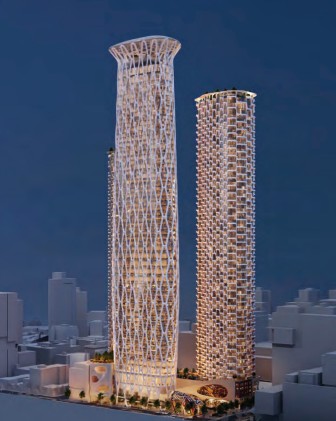
The City of Vancouver has received an application to rezone the subject site from DD (Downtown) District to CD-1 (Comprehensive Development) District. The proposal is to allow for the development of a 68-storey hotel building, and it includes:
- 920 hotel rooms with conference facilities;
- Commercial space on the ground floor;
- Observation deck;
- A floor space ratio (FSR) of 24.13; and
- A building height of 315.0 m (1,034 ft.) with additional height for rooftop appurtenances.
This application is being considered under the Downtown Rezoning Policy.
This application is being processed and reviewed concurrently with the application to rezone 501-525 W Georgia St, 619 Richards St, and 500 Dunsmuir St, and 388 Abbott St. The application proposes to transfer ownership of the building at 388 Abbott Street to the City.
The rendering displays the applications for 501-525 W Georgia St, 619 Richards St, and 500 Dunsmuir St & 575-595 W Georgia St and 620-692 Seymour St.
The City of Vancouver has received an application to rezone the subject site from DD (Downtown) District to CD-1 (Comprehensive Development) District. The proposal is to allow for the development of a 68-storey hotel building, and it includes:
- 920 hotel rooms with conference facilities;
- Commercial space on the ground floor;
- Observation deck;
- A floor space ratio (FSR) of 24.13; and
- A building height of 315.0 m (1,034 ft.) with additional height for rooftop appurtenances.
This application is being considered under the Downtown Rezoning Policy.
This application is being processed and reviewed concurrently with the application to rezone 501-525 W Georgia St, 619 Richards St, and 500 Dunsmuir St, and 388 Abbott St. The application proposes to transfer ownership of the building at 388 Abbott Street to the City.
The rendering displays the applications for 501-525 W Georgia St, 619 Richards St, and 500 Dunsmuir St & 575-595 W Georgia St and 620-692 Seymour St.
The opportunity to ask questions through the Q&A is available from November 19 to December 2, 2025.
We post all questions as-is and aim to respond within two business days. Some questions may require coordination with internal departments and additional time may be needed to post a response.
Please note that the comment form will remain open after the Q&A period. The Rezoning Planner can also be contacted directly for any further feedback or questions.
-
Share Understanding that there are two rezoning applications, divided between two halves of the same block, for the anticipated redevelopment enabled by the requested rezoning, my questions below reference specific properties included in each rezoning application. I’m submitting the exact same questions for both rezoning applications. As City Council unanimously passed a motion at their Dec. 18, 2024 Special Meeting which included an item to “direct staff to report back on any avenues Council has to seek compensation as part of future rezoning applications the property owner may pursue,” how is the City holding the property owner (c/o of the applicant) accountable for the willful negligence of both a heritage landmark and an SRA (Single Room Accommodation) which resulted in the demolition of the Dunsmuir Hotel building at 500 Dunsmuir Street? In lieu of the loss of the Dunsmuir Hotel building at 500 Dunsmuir Street (which may or may not have been envisioned prior to be incorporated as part the redevelopment sought as part of this rezoning), has the City and/or applicant made any considerations into the conservation and restoration of the building (or portion of the building) located at 692 Seymour Street? While substantially altered, the building at 692 Seymour Street was constructed 1909-1910 as a Masonic Temple, and while not listed on the City’s Heritage Register (which is NOT an exhaustive listing of heritage buildings in the city, so please do not brush these questions off due to the building not being listed on the City’s Heritage Register), has the City’s heritage planning staff completed any heritage evaluation of this building, or requested the applicant to do so? And if not, why has the City overlooked the possible conservation of this building as a condition of this rezoning application? Lastly, if the proposed development as part of this rezoning application is to proceed, it appears that that only the façade of the 1929-built Randall Building (555 West Georgia Street) is expected to be conserved, though this building is legally protected through a municipal Heritage Designation Bylaw. Why is the City entertaining the potential demolition and façadism of a protected building? A recent development in downtown Vancouver, known as the Exchange at 475 Howe Street, was able to conserve the entire heritage structure (also built in 1929), while simultaneously incorporated a contemporary highrise immediately above the building. Why would the City consider anything less than the full retention of a protected heritage building (understanding that required seismic rehabilitation would still be required) in this situation? I hope to hear responses back both from the applicant and City staff on the above questions. Thank you. on Facebook Share Understanding that there are two rezoning applications, divided between two halves of the same block, for the anticipated redevelopment enabled by the requested rezoning, my questions below reference specific properties included in each rezoning application. I’m submitting the exact same questions for both rezoning applications. As City Council unanimously passed a motion at their Dec. 18, 2024 Special Meeting which included an item to “direct staff to report back on any avenues Council has to seek compensation as part of future rezoning applications the property owner may pursue,” how is the City holding the property owner (c/o of the applicant) accountable for the willful negligence of both a heritage landmark and an SRA (Single Room Accommodation) which resulted in the demolition of the Dunsmuir Hotel building at 500 Dunsmuir Street? In lieu of the loss of the Dunsmuir Hotel building at 500 Dunsmuir Street (which may or may not have been envisioned prior to be incorporated as part the redevelopment sought as part of this rezoning), has the City and/or applicant made any considerations into the conservation and restoration of the building (or portion of the building) located at 692 Seymour Street? While substantially altered, the building at 692 Seymour Street was constructed 1909-1910 as a Masonic Temple, and while not listed on the City’s Heritage Register (which is NOT an exhaustive listing of heritage buildings in the city, so please do not brush these questions off due to the building not being listed on the City’s Heritage Register), has the City’s heritage planning staff completed any heritage evaluation of this building, or requested the applicant to do so? And if not, why has the City overlooked the possible conservation of this building as a condition of this rezoning application? Lastly, if the proposed development as part of this rezoning application is to proceed, it appears that that only the façade of the 1929-built Randall Building (555 West Georgia Street) is expected to be conserved, though this building is legally protected through a municipal Heritage Designation Bylaw. Why is the City entertaining the potential demolition and façadism of a protected building? A recent development in downtown Vancouver, known as the Exchange at 475 Howe Street, was able to conserve the entire heritage structure (also built in 1929), while simultaneously incorporated a contemporary highrise immediately above the building. Why would the City consider anything less than the full retention of a protected heritage building (understanding that required seismic rehabilitation would still be required) in this situation? I hope to hear responses back both from the applicant and City staff on the above questions. Thank you. on Twitter Share Understanding that there are two rezoning applications, divided between two halves of the same block, for the anticipated redevelopment enabled by the requested rezoning, my questions below reference specific properties included in each rezoning application. I’m submitting the exact same questions for both rezoning applications. As City Council unanimously passed a motion at their Dec. 18, 2024 Special Meeting which included an item to “direct staff to report back on any avenues Council has to seek compensation as part of future rezoning applications the property owner may pursue,” how is the City holding the property owner (c/o of the applicant) accountable for the willful negligence of both a heritage landmark and an SRA (Single Room Accommodation) which resulted in the demolition of the Dunsmuir Hotel building at 500 Dunsmuir Street? In lieu of the loss of the Dunsmuir Hotel building at 500 Dunsmuir Street (which may or may not have been envisioned prior to be incorporated as part the redevelopment sought as part of this rezoning), has the City and/or applicant made any considerations into the conservation and restoration of the building (or portion of the building) located at 692 Seymour Street? While substantially altered, the building at 692 Seymour Street was constructed 1909-1910 as a Masonic Temple, and while not listed on the City’s Heritage Register (which is NOT an exhaustive listing of heritage buildings in the city, so please do not brush these questions off due to the building not being listed on the City’s Heritage Register), has the City’s heritage planning staff completed any heritage evaluation of this building, or requested the applicant to do so? And if not, why has the City overlooked the possible conservation of this building as a condition of this rezoning application? Lastly, if the proposed development as part of this rezoning application is to proceed, it appears that that only the façade of the 1929-built Randall Building (555 West Georgia Street) is expected to be conserved, though this building is legally protected through a municipal Heritage Designation Bylaw. Why is the City entertaining the potential demolition and façadism of a protected building? A recent development in downtown Vancouver, known as the Exchange at 475 Howe Street, was able to conserve the entire heritage structure (also built in 1929), while simultaneously incorporated a contemporary highrise immediately above the building. Why would the City consider anything less than the full retention of a protected heritage building (understanding that required seismic rehabilitation would still be required) in this situation? I hope to hear responses back both from the applicant and City staff on the above questions. Thank you. on Linkedin Email Understanding that there are two rezoning applications, divided between two halves of the same block, for the anticipated redevelopment enabled by the requested rezoning, my questions below reference specific properties included in each rezoning application. I’m submitting the exact same questions for both rezoning applications. As City Council unanimously passed a motion at their Dec. 18, 2024 Special Meeting which included an item to “direct staff to report back on any avenues Council has to seek compensation as part of future rezoning applications the property owner may pursue,” how is the City holding the property owner (c/o of the applicant) accountable for the willful negligence of both a heritage landmark and an SRA (Single Room Accommodation) which resulted in the demolition of the Dunsmuir Hotel building at 500 Dunsmuir Street? In lieu of the loss of the Dunsmuir Hotel building at 500 Dunsmuir Street (which may or may not have been envisioned prior to be incorporated as part the redevelopment sought as part of this rezoning), has the City and/or applicant made any considerations into the conservation and restoration of the building (or portion of the building) located at 692 Seymour Street? While substantially altered, the building at 692 Seymour Street was constructed 1909-1910 as a Masonic Temple, and while not listed on the City’s Heritage Register (which is NOT an exhaustive listing of heritage buildings in the city, so please do not brush these questions off due to the building not being listed on the City’s Heritage Register), has the City’s heritage planning staff completed any heritage evaluation of this building, or requested the applicant to do so? And if not, why has the City overlooked the possible conservation of this building as a condition of this rezoning application? Lastly, if the proposed development as part of this rezoning application is to proceed, it appears that that only the façade of the 1929-built Randall Building (555 West Georgia Street) is expected to be conserved, though this building is legally protected through a municipal Heritage Designation Bylaw. Why is the City entertaining the potential demolition and façadism of a protected building? A recent development in downtown Vancouver, known as the Exchange at 475 Howe Street, was able to conserve the entire heritage structure (also built in 1929), while simultaneously incorporated a contemporary highrise immediately above the building. Why would the City consider anything less than the full retention of a protected heritage building (understanding that required seismic rehabilitation would still be required) in this situation? I hope to hear responses back both from the applicant and City staff on the above questions. Thank you. link
Understanding that there are two rezoning applications, divided between two halves of the same block, for the anticipated redevelopment enabled by the requested rezoning, my questions below reference specific properties included in each rezoning application. I’m submitting the exact same questions for both rezoning applications. As City Council unanimously passed a motion at their Dec. 18, 2024 Special Meeting which included an item to “direct staff to report back on any avenues Council has to seek compensation as part of future rezoning applications the property owner may pursue,” how is the City holding the property owner (c/o of the applicant) accountable for the willful negligence of both a heritage landmark and an SRA (Single Room Accommodation) which resulted in the demolition of the Dunsmuir Hotel building at 500 Dunsmuir Street? In lieu of the loss of the Dunsmuir Hotel building at 500 Dunsmuir Street (which may or may not have been envisioned prior to be incorporated as part the redevelopment sought as part of this rezoning), has the City and/or applicant made any considerations into the conservation and restoration of the building (or portion of the building) located at 692 Seymour Street? While substantially altered, the building at 692 Seymour Street was constructed 1909-1910 as a Masonic Temple, and while not listed on the City’s Heritage Register (which is NOT an exhaustive listing of heritage buildings in the city, so please do not brush these questions off due to the building not being listed on the City’s Heritage Register), has the City’s heritage planning staff completed any heritage evaluation of this building, or requested the applicant to do so? And if not, why has the City overlooked the possible conservation of this building as a condition of this rezoning application? Lastly, if the proposed development as part of this rezoning application is to proceed, it appears that that only the façade of the 1929-built Randall Building (555 West Georgia Street) is expected to be conserved, though this building is legally protected through a municipal Heritage Designation Bylaw. Why is the City entertaining the potential demolition and façadism of a protected building? A recent development in downtown Vancouver, known as the Exchange at 475 Howe Street, was able to conserve the entire heritage structure (also built in 1929), while simultaneously incorporated a contemporary highrise immediately above the building. Why would the City consider anything less than the full retention of a protected heritage building (understanding that required seismic rehabilitation would still be required) in this situation? I hope to hear responses back both from the applicant and City staff on the above questions. Thank you.
ThomasCrush asked 5 months agoThanks for the questions. Regarding 500 Dunsmuir Street, the site is listed on the Single Room Accommodation (SRA) By-law meaning Council must approve an SRA permit for the demolition or conversion of the building. Conditions of approval can include the one-for-one replacement for lost rooms with self-contained social housing delivered turn-key to the City or a fee of 300,000 per room lost. Staff are currently reviewing the application and will include consideration of an SRA permit based on the conditions agreed upon by staff and the applicant.
Regarding the heritage buildings, staff review is underway, with particular attention to buildings on the proposed rezoning site that are listed on the Vancouver Heritage Register. 692 Seymour Street is not listed on the Heritage Register. For all other historic buildings, a heritage evaluation process may be initiated through the Heritage Evaluation Process, which has not been contemplated by the applicant at this point in time.
Randall Building is designated as a protected heritage property. Heritage Policies are applicable to this rezoning review process that is still underway.
-
Share Question 1: Fire Escape Redundancy for Super-Tall Structures With the proposed building height of 315 meters (68 storeys) , which is roughly 57% taller than the current tallest building in Vancouver, what specific redundancies are being engineered into the fire escape routes beyond standard minimum code requirements? In light of recent global high-rise tragedies, how does the evacuation plan account for residents—particularly an aging population—who would be physically unable to descend 60+ flights of stairs if elevators are disabled during a fire event? Question 2: Emergency Rescue Capabilities Given that this building’s height significantly exceeds the reach of standard ground-based fire fighting equipment, what specific specialized infrastructure (e.g., refuge floors, hardened elevator shafts for evacuation) is being included to ensure residents on upper floors can escape "worst-case" scenarios where stairwells may be compromised? Question 3: Long-Term Maintenance and System Failure Risks Super-tall structures involve exponential increases in engineering complexity regarding vertical water pumps, elevator mechanics, and life-safety systems. Has a long-term maintenance feasibility study been conducted to ensure that the costs and technical challenges of maintaining these critical life-safety systems do not lead to degradation or failure 10 or 20 years post-construction? We are concerned about the sustainability of maintaining such extreme heights safely. on Facebook Share Question 1: Fire Escape Redundancy for Super-Tall Structures With the proposed building height of 315 meters (68 storeys) , which is roughly 57% taller than the current tallest building in Vancouver, what specific redundancies are being engineered into the fire escape routes beyond standard minimum code requirements? In light of recent global high-rise tragedies, how does the evacuation plan account for residents—particularly an aging population—who would be physically unable to descend 60+ flights of stairs if elevators are disabled during a fire event? Question 2: Emergency Rescue Capabilities Given that this building’s height significantly exceeds the reach of standard ground-based fire fighting equipment, what specific specialized infrastructure (e.g., refuge floors, hardened elevator shafts for evacuation) is being included to ensure residents on upper floors can escape "worst-case" scenarios where stairwells may be compromised? Question 3: Long-Term Maintenance and System Failure Risks Super-tall structures involve exponential increases in engineering complexity regarding vertical water pumps, elevator mechanics, and life-safety systems. Has a long-term maintenance feasibility study been conducted to ensure that the costs and technical challenges of maintaining these critical life-safety systems do not lead to degradation or failure 10 or 20 years post-construction? We are concerned about the sustainability of maintaining such extreme heights safely. on Twitter Share Question 1: Fire Escape Redundancy for Super-Tall Structures With the proposed building height of 315 meters (68 storeys) , which is roughly 57% taller than the current tallest building in Vancouver, what specific redundancies are being engineered into the fire escape routes beyond standard minimum code requirements? In light of recent global high-rise tragedies, how does the evacuation plan account for residents—particularly an aging population—who would be physically unable to descend 60+ flights of stairs if elevators are disabled during a fire event? Question 2: Emergency Rescue Capabilities Given that this building’s height significantly exceeds the reach of standard ground-based fire fighting equipment, what specific specialized infrastructure (e.g., refuge floors, hardened elevator shafts for evacuation) is being included to ensure residents on upper floors can escape "worst-case" scenarios where stairwells may be compromised? Question 3: Long-Term Maintenance and System Failure Risks Super-tall structures involve exponential increases in engineering complexity regarding vertical water pumps, elevator mechanics, and life-safety systems. Has a long-term maintenance feasibility study been conducted to ensure that the costs and technical challenges of maintaining these critical life-safety systems do not lead to degradation or failure 10 or 20 years post-construction? We are concerned about the sustainability of maintaining such extreme heights safely. on Linkedin Email Question 1: Fire Escape Redundancy for Super-Tall Structures With the proposed building height of 315 meters (68 storeys) , which is roughly 57% taller than the current tallest building in Vancouver, what specific redundancies are being engineered into the fire escape routes beyond standard minimum code requirements? In light of recent global high-rise tragedies, how does the evacuation plan account for residents—particularly an aging population—who would be physically unable to descend 60+ flights of stairs if elevators are disabled during a fire event? Question 2: Emergency Rescue Capabilities Given that this building’s height significantly exceeds the reach of standard ground-based fire fighting equipment, what specific specialized infrastructure (e.g., refuge floors, hardened elevator shafts for evacuation) is being included to ensure residents on upper floors can escape "worst-case" scenarios where stairwells may be compromised? Question 3: Long-Term Maintenance and System Failure Risks Super-tall structures involve exponential increases in engineering complexity regarding vertical water pumps, elevator mechanics, and life-safety systems. Has a long-term maintenance feasibility study been conducted to ensure that the costs and technical challenges of maintaining these critical life-safety systems do not lead to degradation or failure 10 or 20 years post-construction? We are concerned about the sustainability of maintaining such extreme heights safely. link
Question 1: Fire Escape Redundancy for Super-Tall Structures With the proposed building height of 315 meters (68 storeys) , which is roughly 57% taller than the current tallest building in Vancouver, what specific redundancies are being engineered into the fire escape routes beyond standard minimum code requirements? In light of recent global high-rise tragedies, how does the evacuation plan account for residents—particularly an aging population—who would be physically unable to descend 60+ flights of stairs if elevators are disabled during a fire event? Question 2: Emergency Rescue Capabilities Given that this building’s height significantly exceeds the reach of standard ground-based fire fighting equipment, what specific specialized infrastructure (e.g., refuge floors, hardened elevator shafts for evacuation) is being included to ensure residents on upper floors can escape "worst-case" scenarios where stairwells may be compromised? Question 3: Long-Term Maintenance and System Failure Risks Super-tall structures involve exponential increases in engineering complexity regarding vertical water pumps, elevator mechanics, and life-safety systems. Has a long-term maintenance feasibility study been conducted to ensure that the costs and technical challenges of maintaining these critical life-safety systems do not lead to degradation or failure 10 or 20 years post-construction? We are concerned about the sustainability of maintaining such extreme heights safely.
C Zhao asked 5 months ago“Response provided by the applicant:
Answer to Questions 1 and 2:
The strategies for achieving building code compliance are being developed and will continue to develop as the project design evolves past the rezoning process. Many of the solutions/measures you have noted will be evaluated and incorporated as best seen fit for each tower to ensure fire and life safety is held paramount and is not compromised due to the increased heights of the towers. Performance-based measures such as refuge floors, elevator vestibules, smoke protected corridors, smoke control redundancy within exit stairs, and secondary water supply (additional fire pumps), will be evaluated accordingly. The building systems will be designed using an integrated approach which will maintain fire and smoke protected zones that will allow safe evacuation. This approach will include dedicated ventilation and communication systems, backup power and water protection as well as the ability to deal with any issues resulting from the height of the structure.There are currently over 250 supertall structures throughout the world that are built and safely occupied. Our team will work with the City of Vancouver Building Services and Fire Rescue Services to ensure that the building design and construction meets all their requirements for life safety and fire department response.
Answer to Question 3:
A Maintenance Management Plan for the buildings will establish a process that includes ongoing monitoring as well as regularly scheduled servicing and inspections. All of the equipment proposed will have integrated preventive maintenance technologies and systems. A rigorous protocol monitored by highly trained staff will follow strict procedures and perform regular testing to provide ongoing sustainable maintenance of the life safety systems. The equipment selected will meet durability and efficiency requirements for buildings of this scale.”
-
Share A 1,034 ft. tower would have a profound impact on the view of the North Shore Mountains from numerous locations. Given this backdrop, the materials only show two skyline renderings that are not really representative of view impacts. Do staff have any plans to make their own renderings, like they did for the Vancouver Heights Study, to allow for a more fulsome communication of the view impacts of the proposal? It's surprising that no in person open house has been scheduled given the scope of this rezoning. on Facebook Share A 1,034 ft. tower would have a profound impact on the view of the North Shore Mountains from numerous locations. Given this backdrop, the materials only show two skyline renderings that are not really representative of view impacts. Do staff have any plans to make their own renderings, like they did for the Vancouver Heights Study, to allow for a more fulsome communication of the view impacts of the proposal? It's surprising that no in person open house has been scheduled given the scope of this rezoning. on Twitter Share A 1,034 ft. tower would have a profound impact on the view of the North Shore Mountains from numerous locations. Given this backdrop, the materials only show two skyline renderings that are not really representative of view impacts. Do staff have any plans to make their own renderings, like they did for the Vancouver Heights Study, to allow for a more fulsome communication of the view impacts of the proposal? It's surprising that no in person open house has been scheduled given the scope of this rezoning. on Linkedin Email A 1,034 ft. tower would have a profound impact on the view of the North Shore Mountains from numerous locations. Given this backdrop, the materials only show two skyline renderings that are not really representative of view impacts. Do staff have any plans to make their own renderings, like they did for the Vancouver Heights Study, to allow for a more fulsome communication of the view impacts of the proposal? It's surprising that no in person open house has been scheduled given the scope of this rezoning. link
A 1,034 ft. tower would have a profound impact on the view of the North Shore Mountains from numerous locations. Given this backdrop, the materials only show two skyline renderings that are not really representative of view impacts. Do staff have any plans to make their own renderings, like they did for the Vancouver Heights Study, to allow for a more fulsome communication of the view impacts of the proposal? It's surprising that no in person open house has been scheduled given the scope of this rezoning.
waterlily asked 5 months agoThanks for the question. As this proposal includes an encroachment into Council-approved public view 3.2.3 (Queen Elizabeth Park), it is being reviewed through the Higher Buildings Policy process, which includes evaluation by the special Higher Buildings Panel of the Urban Design Panel. As part of this process, staff will be requiring the applicant to provide a more robust set of visual materials that clearly illustrate potential impacts to public views, including additional skyline studies and view simulations from key public locations.
In addition, staff are preparing supplemental internal view analyses to ensure that the full range of potential impacts is comprehensively understood and accurately communicated. These materials, together with the applicant’s updated submission for the UDP, will be incorporated into the staff report and presentation at the Public Hearing.
Key dates
-
June 11 2025
-
November 19 → December 02 2025
Location
Application documents

Applicable plans and policies
Contact applicant
-
Phone 604-687-5681 Email ruinunes@henriquezpartners.com
Contact us
-
Phone 604-871-6121 Email nicholas.danford@vancouver.ca