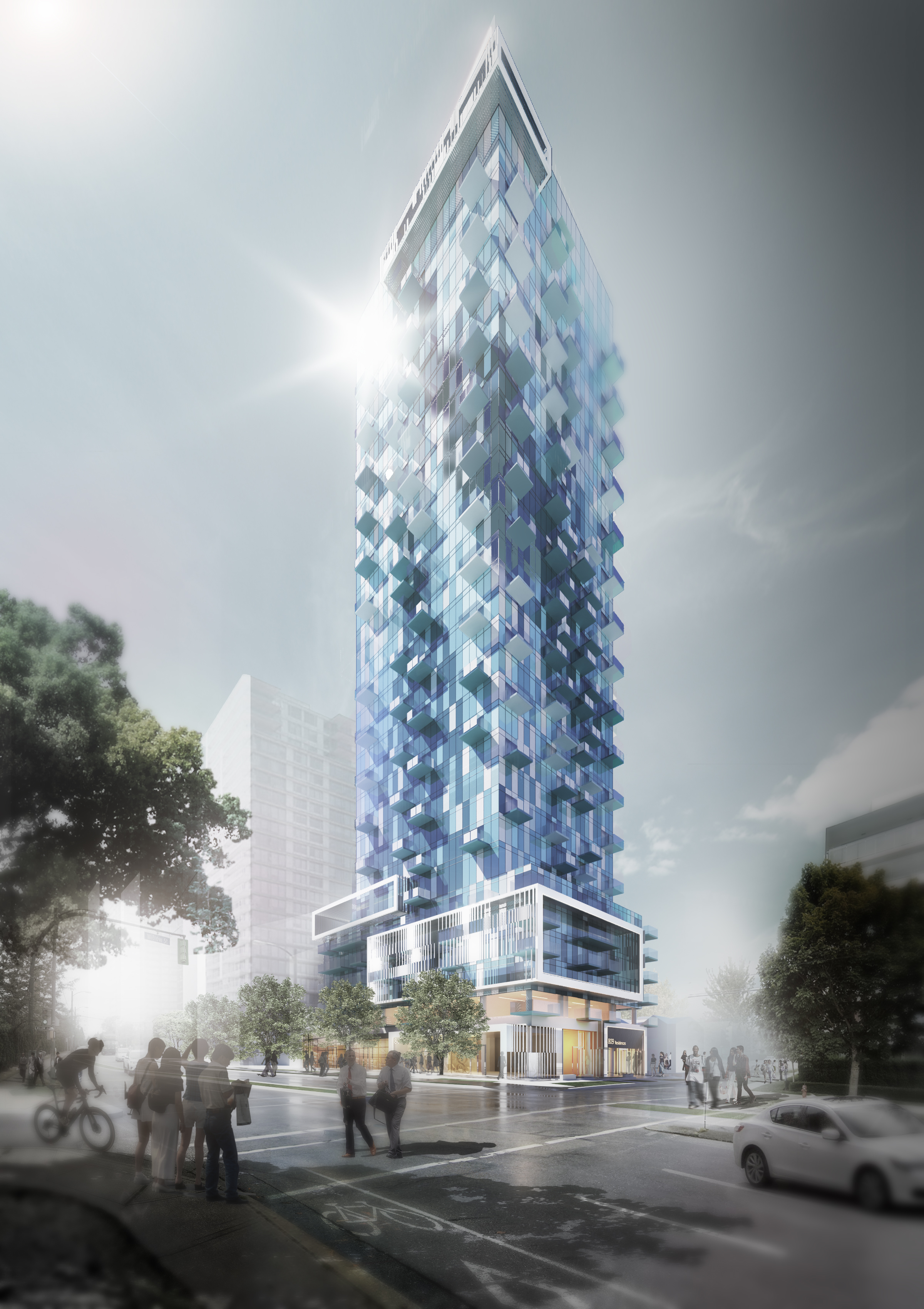
Share Do you have a plan for reducing or eliminating bird window strikes with the building?
Birds can’t see glass, but do see the reflection of the sky or habitat on it and commonly fly towards it.
Window collisions kill 16 to 42 million birds a year in Canada. It is one of the top sources of human-caused bird mortality, despite being easily preventable.
This building is on the pacific flyway, a migratory route used by at least 1 billion birds migrating between north and south in the spring and fall.
It also sits near Van Dusen gardens, Queen Elizabeth park, Oak Meadows park and near the Fraser River Estuary, a major stop along the Pacific Flyway migration.
The height that presents the highest collision probability is at or below mature tree height, or up to the fourth floor of a building, approximately 12 meters, whichever is highest.
Possible solutions are given in Vancouver’s bird friendly building guidelines https://guidelines.vancouver.ca/guidelines-bird-friendly-design.pdf
and in UBCs bird friendly design guidelines- see strategies starting on page 6 https://sustain.ubc.ca/sites/default/files/files/3276_UBC_BirdFriendlyDesignGuidelines.pdf
Would it be possible to incorporate bird friendly design focused on the first 4 floors or to the height of the surrounding trees to reduce bird collisions?
on Facebook
Share Do you have a plan for reducing or eliminating bird window strikes with the building?
Birds can’t see glass, but do see the reflection of the sky or habitat on it and commonly fly towards it.
Window collisions kill 16 to 42 million birds a year in Canada. It is one of the top sources of human-caused bird mortality, despite being easily preventable.
This building is on the pacific flyway, a migratory route used by at least 1 billion birds migrating between north and south in the spring and fall.
It also sits near Van Dusen gardens, Queen Elizabeth park, Oak Meadows park and near the Fraser River Estuary, a major stop along the Pacific Flyway migration.
The height that presents the highest collision probability is at or below mature tree height, or up to the fourth floor of a building, approximately 12 meters, whichever is highest.
Possible solutions are given in Vancouver’s bird friendly building guidelines https://guidelines.vancouver.ca/guidelines-bird-friendly-design.pdf
and in UBCs bird friendly design guidelines- see strategies starting on page 6 https://sustain.ubc.ca/sites/default/files/files/3276_UBC_BirdFriendlyDesignGuidelines.pdf
Would it be possible to incorporate bird friendly design focused on the first 4 floors or to the height of the surrounding trees to reduce bird collisions?
on X (formerly Twitter)
Share Do you have a plan for reducing or eliminating bird window strikes with the building?
Birds can’t see glass, but do see the reflection of the sky or habitat on it and commonly fly towards it.
Window collisions kill 16 to 42 million birds a year in Canada. It is one of the top sources of human-caused bird mortality, despite being easily preventable.
This building is on the pacific flyway, a migratory route used by at least 1 billion birds migrating between north and south in the spring and fall.
It also sits near Van Dusen gardens, Queen Elizabeth park, Oak Meadows park and near the Fraser River Estuary, a major stop along the Pacific Flyway migration.
The height that presents the highest collision probability is at or below mature tree height, or up to the fourth floor of a building, approximately 12 meters, whichever is highest.
Possible solutions are given in Vancouver’s bird friendly building guidelines https://guidelines.vancouver.ca/guidelines-bird-friendly-design.pdf
and in UBCs bird friendly design guidelines- see strategies starting on page 6 https://sustain.ubc.ca/sites/default/files/files/3276_UBC_BirdFriendlyDesignGuidelines.pdf
Would it be possible to incorporate bird friendly design focused on the first 4 floors or to the height of the surrounding trees to reduce bird collisions?
on Linkedin
Email Do you have a plan for reducing or eliminating bird window strikes with the building?
Birds can’t see glass, but do see the reflection of the sky or habitat on it and commonly fly towards it.
Window collisions kill 16 to 42 million birds a year in Canada. It is one of the top sources of human-caused bird mortality, despite being easily preventable.
This building is on the pacific flyway, a migratory route used by at least 1 billion birds migrating between north and south in the spring and fall.
It also sits near Van Dusen gardens, Queen Elizabeth park, Oak Meadows park and near the Fraser River Estuary, a major stop along the Pacific Flyway migration.
The height that presents the highest collision probability is at or below mature tree height, or up to the fourth floor of a building, approximately 12 meters, whichever is highest.
Possible solutions are given in Vancouver’s bird friendly building guidelines https://guidelines.vancouver.ca/guidelines-bird-friendly-design.pdf
and in UBCs bird friendly design guidelines- see strategies starting on page 6 https://sustain.ubc.ca/sites/default/files/files/3276_UBC_BirdFriendlyDesignGuidelines.pdf
Would it be possible to incorporate bird friendly design focused on the first 4 floors or to the height of the surrounding trees to reduce bird collisions?
link
Do you have a plan for reducing or eliminating bird window strikes with the building?
Birds can’t see glass, but do see the reflection of the sky or habitat on it and commonly fly towards it.
Window collisions kill 16 to 42 million birds a year in Canada. It is one of the top sources of human-caused bird mortality, despite being easily preventable.
This building is on the pacific flyway, a migratory route used by at least 1 billion birds migrating between north and south in the spring and fall.
It also sits near Van Dusen gardens, Queen Elizabeth park, Oak Meadows park and near the Fraser River Estuary, a major stop along the Pacific Flyway migration.
The height that presents the highest collision probability is at or below mature tree height, or up to the fourth floor of a building, approximately 12 meters, whichever is highest.
Possible solutions are given in Vancouver’s bird friendly building guidelines https://guidelines.vancouver.ca/guidelines-bird-friendly-design.pdf
and in UBCs bird friendly design guidelines- see strategies starting on page 6 https://sustain.ubc.ca/sites/default/files/files/3276_UBC_BirdFriendlyDesignGuidelines.pdf
Would it be possible to incorporate bird friendly design focused on the first 4 floors or to the height of the surrounding trees to reduce bird collisions?
JMcC.
asked
6 months ago
Thank you for your comment and feedback, which as been shared with Staff for their consideration as they review this application.