
Vancouver General Hospital Campus rezoning application and planning process

Share Vancouver General Hospital Campus rezoning application and planning process on Facebook Share Vancouver General Hospital Campus rezoning application and planning process on Twitter Share Vancouver General Hospital Campus rezoning application and planning process on Linkedin Email Vancouver General Hospital Campus rezoning application and planning process link
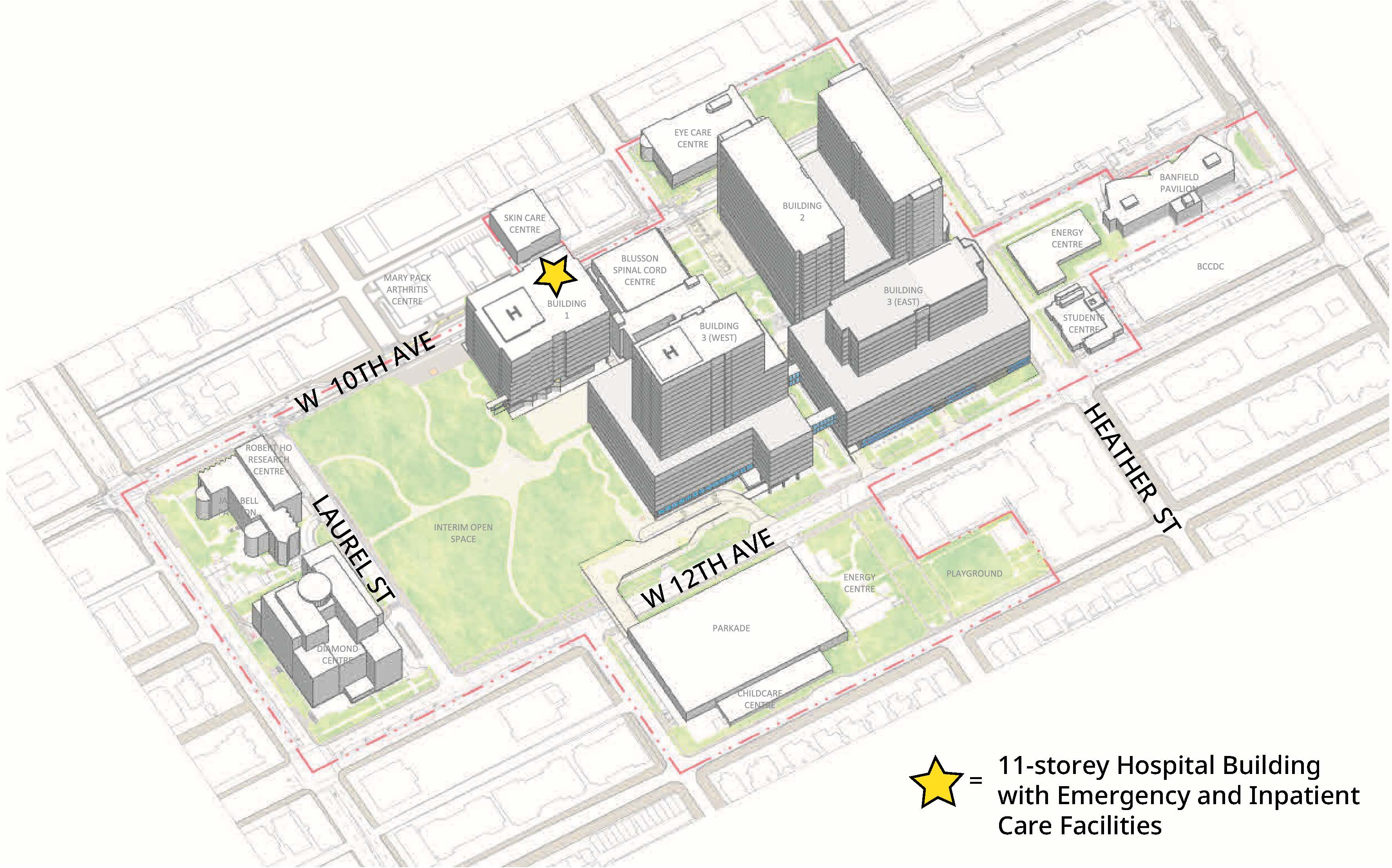

The City of Vancouver has received an application from Kasian Architecture Interior Design and Planning Ltd. on behalf of Vancouver Coastal Health Authority to rezone the Vancouver General Hospital (VGH) campus site, to allow for the long-term redevelopment of the VGH campus site over the next 30+ years. Ten phases with over 300,000 sq. m of modernized healthcare facilities in buildings up to 24 storeys are proposed. See Proposal Summary below for more information.

The City of Vancouver is seeking input on three planning processes for the Vancouver General Hospital (VGH):

  1. VGH Campus Rezoning: A campus-wide rezoning application proposes a new site-specific CD-1 zoning by-law to support the long-term redevelopment and modernization of the VGH Campus over the next 30+ years. The rezoning application proposes updates to development parameters including but not limited to height, density, use, setbacks, site-wide transportation networks, and heritage and open space requirements for the entire VGH campus. The campus rezoning is targeting consideration by Council following steps 2 and 3 below.

  2. Interim Zoning Amendment: As the overall VGH campus rezoning progresses, an interim minor amendment is proposed to site coverage and density in the existing CD-1 (59) (Comprehensive Development) District By-law to permit development of a new 11-storey hospital building with Emergency and Inpatient Care facilities. The interim zoning amendment is targeting consideration by Council during summer 2026.

  3. VGH Campus Policy Update: Concurrently with the interim zoning amendment, the City of Vancouver is preparing to update site-specific policies in the Broadway Plan to guide the overall VGH campus rezoning process. The policy update is also targeting consideration by Council during summer 2026.

Proposal Summary

The applications from Kasian Architecture Interior Design and Planning Ltd. on behalf of Vancouver Coastal Health Authority to rezone the Vancouver General Hospital (VGH) campus site propose:

  • Long-term phased redevelopment vision to modernize healthcare infrastructure and replace aging facilities, addressing the immediate and long-term healthcare needs of the community and expanding service capacity;
  • 10 phases of redevelopment with new buildings up to 24 storeys;
  • Over 300,000 sq. m of modernized healthcare facilities, with a maximum site density of approximately 5.0 FSR;
  • Near-term request to amend site coverage and density in the CD-1 (59) (Comprehensive Development) District By-law to allow for a new 11-storey Emergency and Inpatient Care Building on West 10th Avenue;
  • Framework for redevelopment that ensures the hospital remains fully operational throughout all phases of construction;
  • Zoning boundary adjustments;
  • Updates to zoning parameters including uses, density, site coverage, heights, and building setbacks;
  • Updates to open space requirements;
  • Revisions to heritage conservation requirements, including demolition of the Heather Pavilion a municipally-designated heritage building (see submitted Heritage Document);
  • Proposed changes to circulation and access, including vehicle access and drop-off, service and loading, bikeways, and pedestrian pathways (see p. 179-201 of Rezoning Booklet);
  • New heliports;
  • A commitment to reconciliation; and
  • A commitment to environmental sustainability and climate resilience.

The rezoning applications and policy work are being considered under the Broadway Plan.

Application drawings and statistics are posted as-submitted to the City. Following staff review, the final project statistics are documented within the referral report.



The City of Vancouver has received an application from Kasian Architecture Interior Design and Planning Ltd. on behalf of Vancouver Coastal Health Authority to rezone the Vancouver General Hospital (VGH) campus site, to allow for the long-term redevelopment of the VGH campus site over the next 30+ years. Ten phases with over 300,000 sq. m of modernized healthcare facilities in buildings up to 24 storeys are proposed. See Proposal Summary below for more information.

The City of Vancouver is seeking input on three planning processes for the Vancouver General Hospital (VGH):

  1. VGH Campus Rezoning: A campus-wide rezoning application proposes a new site-specific CD-1 zoning by-law to support the long-term redevelopment and modernization of the VGH Campus over the next 30+ years. The rezoning application proposes updates to development parameters including but not limited to height, density, use, setbacks, site-wide transportation networks, and heritage and open space requirements for the entire VGH campus. The campus rezoning is targeting consideration by Council following steps 2 and 3 below.

  2. Interim Zoning Amendment: As the overall VGH campus rezoning progresses, an interim minor amendment is proposed to site coverage and density in the existing CD-1 (59) (Comprehensive Development) District By-law to permit development of a new 11-storey hospital building with Emergency and Inpatient Care facilities. The interim zoning amendment is targeting consideration by Council during summer 2026.

  3. VGH Campus Policy Update: Concurrently with the interim zoning amendment, the City of Vancouver is preparing to update site-specific policies in the Broadway Plan to guide the overall VGH campus rezoning process. The policy update is also targeting consideration by Council during summer 2026.

Proposal Summary

The applications from Kasian Architecture Interior Design and Planning Ltd. on behalf of Vancouver Coastal Health Authority to rezone the Vancouver General Hospital (VGH) campus site propose:

  • Long-term phased redevelopment vision to modernize healthcare infrastructure and replace aging facilities, addressing the immediate and long-term healthcare needs of the community and expanding service capacity;
  • 10 phases of redevelopment with new buildings up to 24 storeys;
  • Over 300,000 sq. m of modernized healthcare facilities, with a maximum site density of approximately 5.0 FSR;
  • Near-term request to amend site coverage and density in the CD-1 (59) (Comprehensive Development) District By-law to allow for a new 11-storey Emergency and Inpatient Care Building on West 10th Avenue;
  • Framework for redevelopment that ensures the hospital remains fully operational throughout all phases of construction;
  • Zoning boundary adjustments;
  • Updates to zoning parameters including uses, density, site coverage, heights, and building setbacks;
  • Updates to open space requirements;
  • Revisions to heritage conservation requirements, including demolition of the Heather Pavilion a municipally-designated heritage building (see submitted Heritage Document);
  • Proposed changes to circulation and access, including vehicle access and drop-off, service and loading, bikeways, and pedestrian pathways (see p. 179-201 of Rezoning Booklet);
  • New heliports;
  • A commitment to reconciliation; and
  • A commitment to environmental sustainability and climate resilience.

The rezoning applications and policy work are being considered under the Broadway Plan.

Application drawings and statistics are posted as-submitted to the City. Following staff review, the final project statistics are documented within the referral report.


  • Staff have developed a set of draft Guiding Principles to guide the development of the FUCB sub-area of the Broadway Plan over the next 30+ years. Please share your thoughts and opinions in this comment forum. The draft Guiding Principles are listed below (click here to see more): 

    TopicGuiding Principle 

    1.Reconciliation

    Work in meaningful partnership with the xʷməθkʷəy̓əm (Musqueam Indian Band), Sḵwx̱wú7mesh Úxwumixw (Squamish Nation), and səlilwətaɬ (Tsleil-Waututh Nation) to advance reconciliation. This includes decolonizing City of Vancouver and Vancouver Coastal Health policies and practices, creating culturally safe and welcoming spaces, and visibly embedding Indigenous values, history, knowledge, and art throughout the campus in enduring and respectful ways.


    2.Supporting Clinical Hospital Needs 
    Prioritize excellent patient care, operational efficiency, and staff wellbeing in all aspects of campus planning, design, and operations. Development should support a world-class clinical environment that is functional, flexible, and efficient, while accommodating future growth in population, healthcare demand, and workforce needs. Facilities should be designed to evolve alongside changing models of care and clinical best practices.
    3.Open Space
    Use public open space as a key organizing element of the campus, now and into the future. Strengthen the existing north–south Willow Street green connection and create significant, connected permanent and interim public open spaces throughout the campus as it redevelops. Open spaces should receive sunlight at key times, support safety and social interaction, connect to nature, and include long-living trees, rest areas, and a connected ‘Wellness Walk’ linking surrounding streets and avenues.
    4.History and Heritage

    Recognize and respect the cultural heritage value of buildings on the VGH campus. Understand their physical condition, historical evolution, and past and present community significance. Heritage approaches should balance conservation with clinical, operational, and site constraints. Where retention is not feasible, redevelopment should thoughtfully commemorate and memorialize heritage values through design, interpretation, and storytelling that preserves cultural meaning for future generations. 
    5.Built Form and Integration with Surrounding Neighbourhoods Design new development to align with the evolving urban fabric shaped by the Broadway Plan. Built form should support increased density, transit-oriented growth, and high-quality public spaces, while integrating thoughtfully with surrounding neighbourhoods. High-quality architecture, landscape design, and building forms, with a distinct and consistent design expression, should reflect the site’s health care function. Buildings should contribute to a cohesive and adaptable high-quality campus identity; enhance comfort,  accessibility, and wellbeing; and support integration with surrounding neighbourhoods.
    6.Building siting, Orientation, and Solar access Optimize building siting and orientation to maximize solar access, daylight, and comfort across the campus. Explore building heights up to established view cone limits to enable more generous and functional ground-level open spaces. Development should generally align with anticipated future heights along West Broadway and in adjacent mixed-use areas, while supporting a well-scaled, efficient, and climate-responsive campus environment.
    7.Mobility & ConnectionsIntegrate the VGH campus into the city-serving street and transportation network to support safe, intuitive, and efficient movement for people and goods. Prioritize accessibility and universal design across the campus, with emphasis on walking, cycling, and transit for people of all ages and abilities. Ensure efficient access for emergency and healthcare vehicles, while providing adequate drop-off, circulation, and parking for those who must drive.
    8.Intuitive Design, Legibility and WayfindingCreate a campus that is easy to navigate through clear spatial organization, intuitive pathways, accessible design, and cohesive wayfinding and signage systems. Design should reduce confusion and stress for patients, visitors, and staff while reinforcing a strong and recognizable campus identity. A legible and coherent layout should support efficient movement, comfort, and a clear sense of place across the site.
    9.Sustainability, Resilience and Disaster PreparednessEnsure long-term environmental sustainability and operational resilience through energy-efficient, low-carbon, seismically resilient, and climate-adaptive design. The campus should remain functional during and after disasters, climate-related events, and public health emergencies. Development should align with Broadway Plan blue-green and One Water strategies, protect high-value trees and canopy, and support the City’s goal of carbon neutrality by 2050.
    10.Flexibility & PhasingPlan and design the campus to be adaptable over time, supporting both near-term needs and long-term evolution in healthcare delivery. Buildings and infrastructure should allow for future expansion, reconfiguration, and technological change. Development phasing should be logical and carefully coordinated to minimize disruption, maintain hospital operations, and ensure continued alignment with guiding principles throughout all stages of redevelopment.


    We expect everyone will refrain from using language or acting in a way that is discriminating, threatening, abusive, racist or otherwise disrespectful. Discrimination or abusive language of any kind will not be tolerated.

    Submit Feedback
    Share Draft Guiding Principles forum on Facebook Share Draft Guiding Principles forum on Twitter Share Draft Guiding Principles forum on Linkedin Email Draft Guiding Principles forum link
Page last updated: 26 Feb 2026, 02:59 PM